Siena Travel Guide Overview
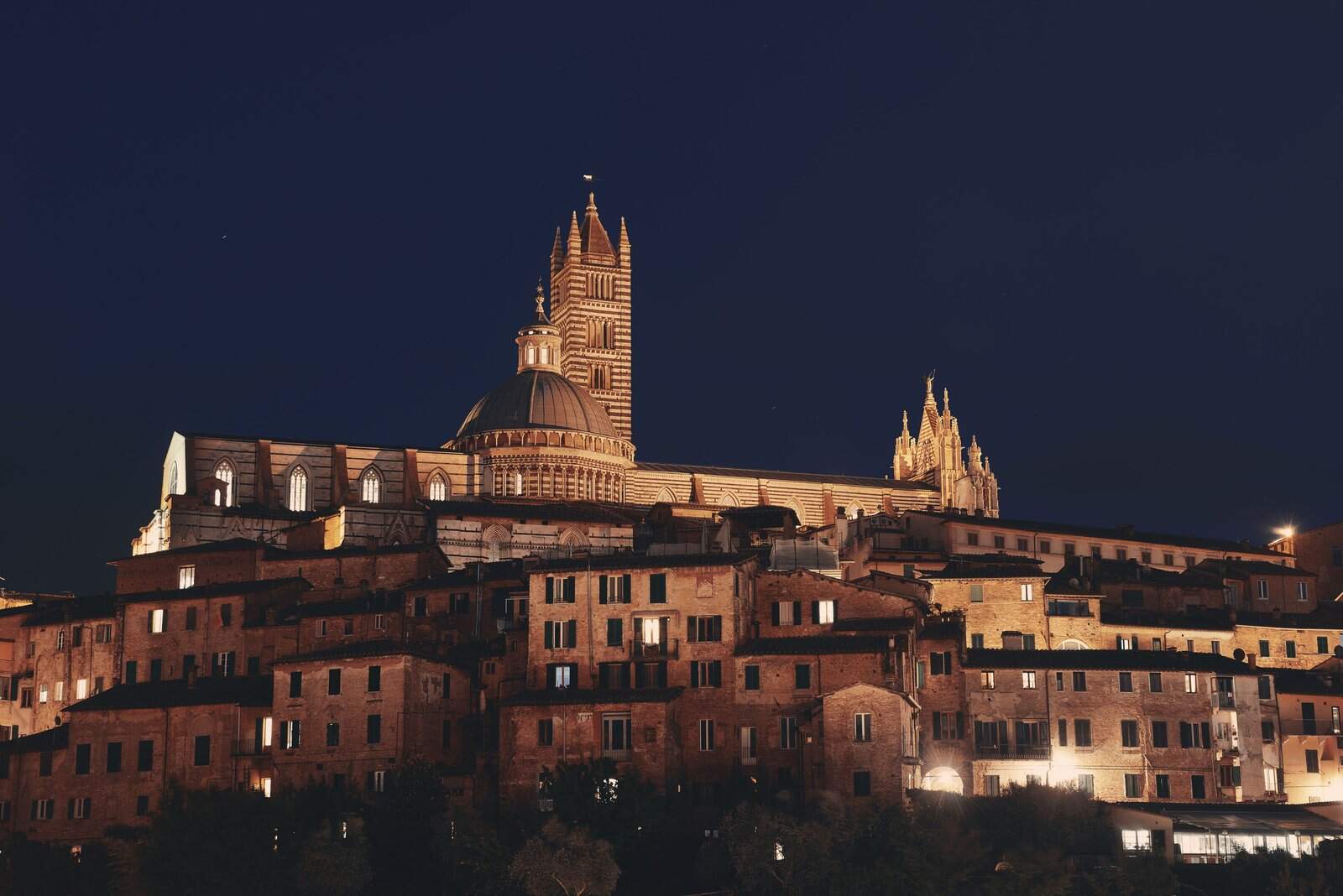
This Siena Travel Guide starts with a simple truth: Siena feels intact. Not rebuilt into something modern. Not polished into a museum city. Intact. Brick, stone, steep lanes, shadowy alleys that tighten without warning, and a main square that looks like it was designed to hold a whole city’s emotions.
Siena sits in the middle of Tuscany, south of Florence, surrounded by rolling hills that look staged but aren’t. Cypress trees, vineyards, wheat fields, olive groves, and those pale dirt roads that seem to glow in afternoon light. The historic center is enclosed by ancient walls. Inside them, the city compresses. Buildings lean inward. Streets bend and tangle. Cars are limited. You walk and you keep walking.
Siena’s roots go back to Etruscan times, but its identity was forged in the Middle Ages. In the 12th and 13th centuries it became a powerful republic, wealthy through banking and trade, proud enough to build huge civic and religious monuments. Siena competed with Florence for power, art, and influence. Then plague struck in 1348, cutting the population hard. Later, Siena lost to Florence in 1555. Growth slowed. Ambition shifted. In a strange way, losing helped preserve the city’s medieval core because it never got “remade” on the same scale as some neighbors.
Today Siena is still driven by neighborhood identity. The contrade (districts) aren’t just historical labels; they are living communities with symbols, flags, rivalries, and memory. That matters most during the Palio, but the spirit is present year-round. You’ll see contrada emblems on walls and fountains. It’s not decorative. It’s identity.
Siena is compact, yet it doesn’t feel small. The streets do that trick where every turn hides the next scene. A quiet staircase. A tiny church facade. A sudden view over the countryside. A sloping piazza opening like a stage. You don’t “do Siena” fast. You drift into it.
If you only visit for a few hours, Siena can feel like a gorgeous set piece. If you stay overnight, it turns into a real place. Day-trippers leave. The Campo empties. The light softens. It gets quieter, more local, more believable.
When to Visit Siena
Siena runs on classic central Italian seasons, but because the city is small and walk-heavy, weather and crowd levels hit harder than you might expect.
Spring (April to June) is one of the best windows. April can be fresh and a little rainy, but May and early June are balanced: warm days, cool evenings, green countryside, comfortable walking. Outdoor dining returns. Hills look alive. If you plan to mix Siena with the Chianti area or Val d’Orcia, spring is ideal because the landscape is at its most vivid before summer heat dulls it.
Summer (July and August) is hot and busy. Afternoon heat can sit above 30°C (86°F), sometimes higher. Siena’s brick and stone soak up warmth then throw it back at you, so midday wandering can feel exhausting. Still, summer has its own appeal: long evenings, outdoor dinners, lively streets, and the city’s most famous event.
That event is the Palio di Siena, held twice each year in Piazza del Campo, traditionally on July 2 and August 16. The Palio is a bareback horse race that lasts about a minute, yet it dominates the city’s emotional calendar. The buildup matters more than the race itself. Contrade decorate their streets. Drums echo through alleys. Neighborhood dinners stretch late into the night. If you want Siena at maximum intensity, visit during Palio season. If you want calm museums and quiet streets, avoid those specific dates and the days immediately before them.
Autumn (September to October) is the other prime season. The heat drops, light turns softer, and the countryside shifts into harvest mode. September can still feel like late summer. October is usually quieter and comfortable for long walks. If you like wine, this season pairs naturally with day trips to nearby regions.
Winter (November to March) is Siena’s calm period. Temperatures are cooler but not usually extreme. Rain appears occasionally. Tourist numbers drop. Restaurants feel more local. Museums have more space. Siena in winter can feel introspective, like the city is finally breathing after the rush.
One practical detail: Siena is steep. Rain and cold make stone streets slick. If you visit in late fall or winter, bring shoes with grip. You will notice the difference on staircases and sloped lanes.
Where to Stay in Siena
Where you stay in Siena changes the entire trip because the historic center is a pedestrian world with limited traffic. Staying inside the walls makes Siena feel immediate. Staying outside makes logistics easier, especially with a car.
Inside the Historic Center (within the walls) is the best choice for first-timers who want maximum atmosphere. You wake up and you’re already in the medieval city. Piazza del Campo, the Duomo, Torre del Mangia, major museums and churches are all walkable. Nights feel special because day visitors leave and Siena gets quieter.
Hotels and apartments inside the center are often in historic buildings. Expect charm and irregularity. Room shapes can be odd. Staircases can be narrow. Elevators may not exist. In return, you get old stone walls, quiet courtyards, and sometimes rooftop views over terracotta tiles.
Near Piazza del Campo is the most central option. It’s lively during the day, calmer at night. If you visit near Palio season, this area becomes the heart of the city’s energy and crowds.
Near the Duomo area can feel slightly calmer and more elevated. You’ll be close to cathedral access and museum spaces. Streets here can be steep, so it’s good if you like the “old city climb” vibe, less good if you have mobility issues.
Just outside the walls works well for travelers arriving by car. Parking is easier. Rooms may be larger. Check walking time to the city gates. Many outside-wall stays are still close enough that you can walk in daily without trouble, but the hill up to the center is real. If you’re pulling luggage, plan for that.
Countryside agriturismos are best for travelers who want Siena as a base but also want wide views, quiet nights, and a slow Tuscan rhythm. These are ideal if you are doing a Tuscany road trip. You’ll drive into Siena, park outside the walls, then walk in. That extra step is worth it if you’re also exploring wine towns and rural landscapes.
One key Siena rule: if you have a car, don’t assume you can drive to your hotel door. Siena’s center is a ZTL (limited traffic zone). Fines can happen if you enter restricted areas. Many hotels can help arrange permits for brief access in some cases, but you must coordinate ahead of time. Confirm parking instructions before you arrive. This saves stress.
How to Reach Siena
Siena does not have its own major airport. You reach it through nearby cities and connect by train, bus, or car. The most common entry points are Florence, Rome, and Pisa. Siena is very doable without a car, but a car becomes useful if Siena is part of a larger Tuscan countryside plan.
By Air
The closest major airport is Florence Airport (FLR). It is the most convenient for Siena when flights align with your schedule. From Florence Airport, you typically connect into the city center first, then continue to Siena by bus or train. Official site: https://www.aeroporto.firenze.it
Rome Fiumicino Airport (FCO) is another major option, often with more international flight choices. The onward trip to Siena is longer and usually requires a train connection or a rental car. Official site: https://www.adr.it/fiumicino
Pisa International Airport (PSA) can be a good option for some European routes. From Pisa you connect by train or car. It is not the closest, but it can be practical depending on flight prices and schedules.
By Train
Siena has a train station connected by regional rail lines. Trains in this part of Tuscany are not high-speed. They are functional, scenic, and slower. The key is to think “regional pace,” not “bullet train speed.”
From Florence Santa Maria Novella (Firenze SMN), regional trains commonly take around 1.5 hours to reach Siena. The route can include intermediate stops. It is reliable enough for normal travel planning. Official rail info: https://www.trenitalia.com
From Rome, trains to Siena generally require at least one transfer, sometimes more depending on timing. Total travel time often lands around 3 hours or longer. It is doable, but it’s not a quick hop.
Important detail: Siena’s train station is below the historic center. You arrive in the lower city. From there, you take escalators and/or buses up toward the old town. This is normal. Just plan an extra 15–25 minutes if you have luggage.
By Bus
For Florence to Siena, buses are often the simplest and most direct option. They can be faster than the train and they often arrive closer to the historic center than the train station does. This matters if you want to step into Siena and start walking immediately.
Bus services change by season and operator, but the main point stays the same: if you’re coming from Florence without a car, bus travel is usually the cleanest route.
By Car
Driving is the most flexible way to reach Siena if you are exploring Tuscany broadly. From Florence, the drive commonly takes around 1 to 1.5 hours depending on route and traffic. The countryside drive can be stunning, especially through Chianti-style landscapes.
From Rome, driving often takes around 2.5 to 3 hours depending on traffic and your chosen route. Rome traffic can add unpredictability, so build buffer time.
The main Siena car rule is ZTL awareness. You park outside the walls in designated lots and then walk in. Many travelers do this once and immediately understand why Siena feels so preserved. The center is not built for modern car flow. Keep it that way.
By Organized Tour
If you are based in Florence, Siena is a common day trip on organized tours, often paired with San Gimignano, Pisa, or wine tastings. This can be convenient, but it compresses Siena into a quick visit. If you care about Siena’s atmosphere, consider staying overnight instead of only touring it.
How to Get Around Siena
You walk. That’s the main answer. Siena is a pedestrian city at its core, and the best experiences happen at walking speed.
The historic center is compact, but it is steep. Streets slope sharply. Staircases appear without warning. Some alleys feel like they’re climbing straight into the sky. Shoes matter here more than in many Italian cities. A comfortable sole plus good traction will save you by day two.
Buses connect the train station and outer neighborhoods to the center. They are useful if you arrive with luggage, or if you are staying outside the walls and don’t want to climb every time.
Cars are restricted in much of the historic center. This is why Siena feels quiet compared to many tourist cities. Taxi services exist but are rarely needed once you are inside the walls.
Plan for slow movement. Siena rewards slow movement. It’s part of the deal.
Top Tips for Siena
Stay overnight if you can. This changes everything. Siena becomes calmer after late afternoon. The Campo opens up. Restaurant service feels less rushed. The city feels less like a set and more like a living place.
Start mornings early. Siena’s streets are at their best before tour groups fill the main routes. Early light on brick walls is also quietly beautiful.
Climb the Torre del Mangia early in the day. The stairs are narrow and the climb is real. Morning lines are usually better than midday lines.
Visit the Duomo complex early too, especially in peak season. Cathedral interiors can get crowded quickly.
During summer heat, shift your day. Do major walking in the morning. Use midday for museums, a long lunch, or a slow café stop. Then wander again in the evening.
Eat away from Piazza del Campo if you want better value and a more local feel. The Campo area is beautiful, but it is also the most tourist-priced zone. Walk ten minutes and prices often soften.
Learn the idea of the contrade. You don’t need a lecture. Just know the city is divided into districts with strong identity. If you visit during Palio season, it becomes essential context. Without it, the energy can feel confusing.
Look for small fountains and hidden squares. Siena is full of them. They’re often where you feel the city most clearly, away from the main tourist flow.
Plan your car arrival carefully. Siena ZTL zones are not forgiving. If your stay is inside the walls, coordinate parking and drop-off instructions in advance.
Don’t treat Siena as “a quick stop between Florence and Rome.” It can be that, sure. But it loses something. Siena deserves time.
Typical Costs in Siena
Siena is often slightly less expensive than Florence, yet it can still feel pricey in high season, especially for lodging inside the walls. Costs swing by season and by how close you stay to the center.
Lodging tends to be the biggest expense. Budget stays and basic B&Bs can sometimes start around €80–120 per night, with higher prices in late spring, summer, and festival periods. Mid-range hotels often land around €140–250 per night. Boutique historic properties and upscale stays can exceed €300, especially in peak season.
Food can be very manageable if you eat simply. A casual lunch of pasta or soup can be €12–18. A full dinner with wine often lands around €35–60 per person. A quick panino can be €6–10. Gelato is usually €3–5. Espresso at the bar is often around €1.20–2, depending on where you sit and how touristy the spot is.
Transportation costs are moderate. Regional trains from Florence to Siena are usually under €15 one way. Buses can be similar. If driving, parking outside the walls is a daily fee that varies by lot and duration.
Attractions are generally affordable compared to major blockbuster museums in larger cities. Siena’s cathedral complex and tower entry fees exist but they are not extreme. You can also spend very little by focusing on walking, churches, and viewpoints.
A moderate daily budget (excluding lodging) often lands around €40–70 per person if you keep it simple. Add wine tastings, long dinners, and paid attractions and that number rises fast. Siena is good at convincing you to stay longer at the table.
Must-Try Foods in Siena
Siena’s food is Tuscan at its core: rustic, direct, ingredient-led. It doesn’t rely on flashy presentation. It relies on flavor and tradition.
Pici is the signature pasta. Thick, hand-rolled strands, often served with cacio e pepe, garlic tomato sauce, or ragù. It has bite. It fills you up.
Pappardelle al cinghiale (wide pasta with wild boar sauce) is common in this part of Tuscany. Rich, earthy, and best after a day of walking hills.
Ribollita is the classic bread and vegetable soup. Simple on paper, comforting in practice. In cooler months it makes perfect sense.
Crostini or crostini neri often appear as starters. Tuscan pâté-style toppings, sometimes with chicken liver. It’s traditional. Not shy.
Bistecca is part of the wider Tuscan identity. If you order a large T-bone style steak, it is often meant to be shared. If you travel solo, consider other dishes unless you want a serious meat commitment.
Panforte is Siena’s famous sweet. Dense, spiced, packed with nuts and fruit. It’s medieval in spirit and still sold everywhere.
Ricciarelli are almond cookies dusted in powdered sugar. Softer than they look. Great with coffee.
Wine is part of the table culture here. Siena sits near major wine regions. You’ll see Chianti Classico easily, plus bottles from Montalcino and Montepulciano nearby. Even a “simple” meal can become a wine evening without trying.
Top Places to Visit in Siena
Siena’s best sights are concentrated inside the historic center, which makes planning easy. You can see a lot without commuting. Still, don’t turn it into a race. Siena is better when you leave space for wandering.
Piazza del Campo is the city’s heart. Shell-shaped, sloping inward. It feels like a natural amphitheater. This is where the Palio happens, but even on ordinary days it’s the center of Siena’s public life. Sit on the brick. Watch the rhythm. Morning feels different than dusk.
Palazzo Pubblico faces the Campo and represents Siena’s civic power. Inside, historic frescoes tell stories about governance, morality, and the city’s self-image. Even if you’re not an art expert, the atmosphere is strong.
Torre del Mangia rises beside the Palazzo Pubblico. Climbing it gives you the cleanest overview of Siena’s rooftops and the Tuscan landscape beyond. The stairs are narrow and the climb is steady. You earn the view.
Siena Cathedral (Duomo di Siena) is visually intense. Black-and-white marble stripes outside. A richly detailed interior. Complex floors, sculpture, and a feeling of overwhelming craftsmanship. It’s a major reason Siena competes with much larger cities in terms of artistic impact.
Duomo complex spaces often include museums and viewpoints depending on ticket options, and they expand what “the cathedral visit” means. If you like architecture and religious art, this is a deep rabbit hole.
Santa Maria della Scala sits across from the Duomo. It was once a major hospital complex and now contains museum spaces and layers of history. It’s often less crowded than the cathedral itself, which makes it a smart midday stop.
Basilica of San Domenico has a stark, powerful interior and is associated with Saint Catherine of Siena. The walk there takes you through quieter streets, which is part of the appeal.
Fortezza Medicea offers a more open walking area and a break from tight medieval lanes. It’s also a good place to stretch legs and look outward.
City walls and viewpoints matter in Siena. Even small overlooks can give you that “Tuscany spread out below” moment. Seek these on purpose. They’re part of the city’s reward system.
Contrada streets are a sight in themselves. Look for fountains, emblems, flags, and neighborhood churches tied to specific districts. This is Siena’s identity structure, not a tourist gimmick.
If you have extra time, Siena also works well as a base for quick nearby visits. Monteriggioni is close and atmospheric. San Gimignano is more touristy but iconic. Val d’Orcia landscapes are a short drive away. Siena sits in a strategic spot.
Top Restaurants to Try in Siena
Siena favors traditional Tuscan cooking. You can find refined dining, but the city’s best meals often feel grounded: pasta, meat, soup, good wine, and slow service that assumes you’re not in a rush.
Osteria Le Logge is a well-known option for refined Tuscan dishes in a historic setting. It’s the kind of place where classics get careful attention.
Taverna di San Giuseppe is popular for its cellar-like atmosphere and classic menu. It’s a solid pick when you want “traditional Siena dinner” in a memorable space.
Antica Osteria da Divo is known for dining rooms built into ancient stone spaces. The environment itself becomes part of the meal.
La Taverna di Cesare is a smaller, intimate style option that leans local and traditional.
La Prosciutteria style spots (cured meats, cheese boards, wine) can be perfect for a casual, fast meal when you don’t want a full sit-down dinner. Siena is good at simple, delicious “snack meals” that turn into a full meal anyway.
For the best experience, consider lunch as well as dinner. Lunch service can feel calmer. Dinner can feel busy, especially in high season. Reservations are a smart move in summer and around weekends.
Also, don’t ignore bakeries and pastry shops. Siena’s sweets matter. Panforte and ricciarelli are not optional if you like desserts.
Final Thoughts on This Siena Travel Guide
Siena holds its medieval identity tightly. It doesn’t chase modern trends aggressively. It stays contained within walls, hills, and brick, and that containment is exactly why it feels special.
Walk slowly. Stay overnight if you can. Let the light change across Piazza del Campo. Eat pici. Buy a small panforte to take with you, then end up eating it too early. That happens.
This is the quiet power of Siena: it doesn’t beg you to love it. It just stands there and waits.






 Rate it or leave a comment!
  Rate it or leave a comment!

 Own or work here?