




St. Peter’s Basilica: How to Visit the Most Important Church in the World
St. Peter’s Basilica is not just a church. It’s the symbolic center of Catholicism, one of the greatest architectural achievements in history, and one of the most powerful spaces you can walk into anywhere on Earth. Even if you are not religious, this place hits hard. The scale, the art, the silence, the weight of history — it all lands the moment you step inside.
This is not a “pop in for ten minutes” stop. It deserves real time, real attention, and a little preparation. This guide covers everything you need to know before you go: history, layout, major artworks, dress code, entry rules, dome climb details, opening hours, and how to visit without ruining the experience for yourself.
What St. Peter’s Basilica Is
St. Peter’s Basilica stands on what is believed to be the burial site of Saint Peter, one of Jesus’s apostles and the first Pope. Because of that, this church is the spiritual heart of the Vatican and one of the most sacred places in Christianity.
The current basilica was built between the early 1500s and the early 1600s, replacing an older church from the time of Emperor Constantine. Some of the most famous names in art and architecture worked on it, including Bramante, Raphael, Michelangelo, and Bernini.
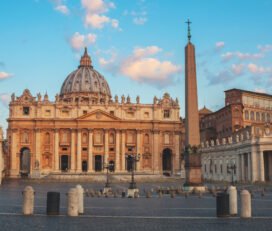
Michelangelo designed the massive dome, which dominates Rome’s skyline and became a model for churches all over the world. Bernini shaped the interior and the surrounding square, turning the basilica into a complete artistic and symbolic experience.
Where It Is Located
St. Peter’s Basilica is located inside Vatican City, the smallest country in the world. It sits at the western end of Rome, just across the Tiber River from the historic center.
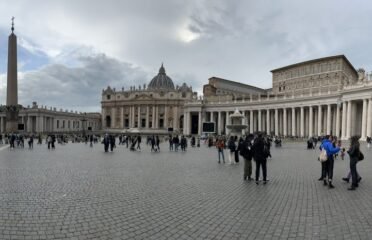
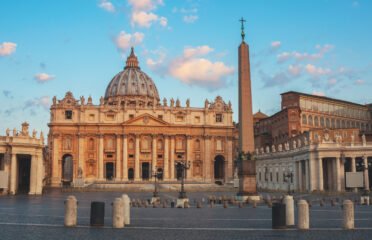
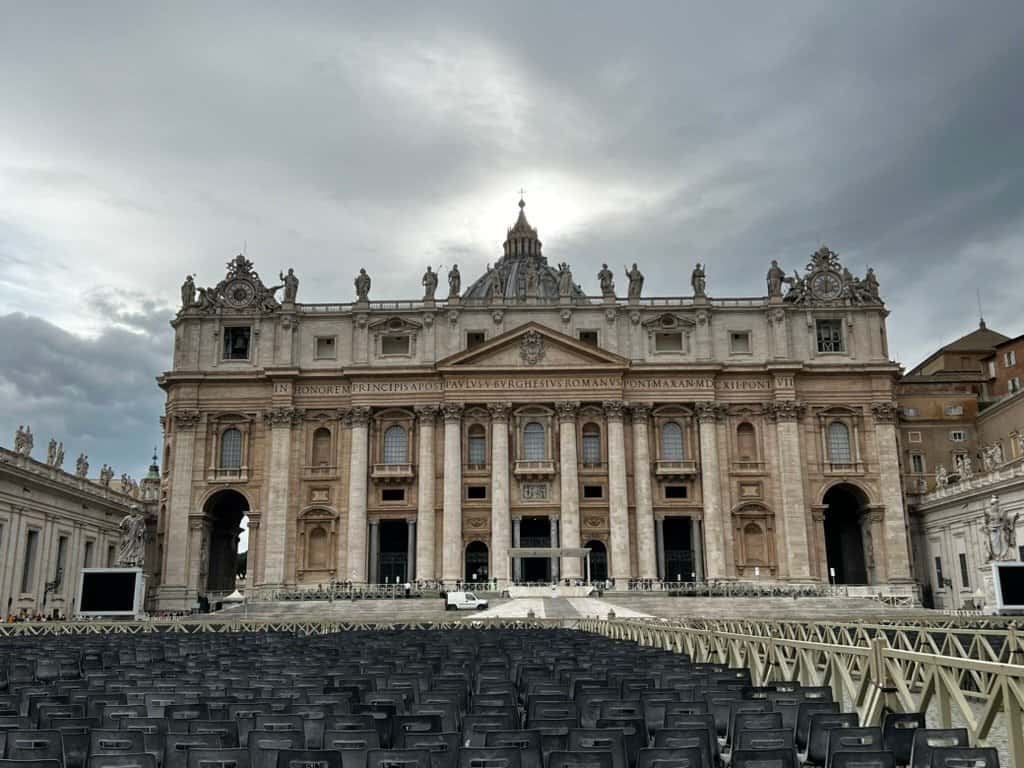
You enter the basilica through St. Peter’s Square, the massive open plaza framed by Bernini’s colonnades. The square itself is part of the experience and sets the tone before you ever walk inside.
Entry and Ticket Information
Here’s something important to know right away:
Entry to St. Peter’s Basilica is free.
You do not need a ticket to enter the main church. However, security screening is required, similar to an airport-style check, and lines can be long during busy hours. Around like 2 hours sometimes.
The only part that requires a paid ticket is the dome climb.
Dome (Cupola) Ticket Prices
- €10 — elevator partway up + stairs to the top
- €8 — stairs only (no elevator)
The dome ticket is purchased on-site, after you enter the basilica. I always pre-book and do skip the line options. So, I recommend doing that.
You can also purchase a skip the line audio guide ticket online for about 7 euros.
Opening Hours
St. Peter’s Basilica is generally open:
- Daily: 7:00 am to 7:00 pm (April to September)
- Daily: 7:00 am to 6:30 pm (October to March)
Last entry is usually about 30 minutes before closing.
On Wednesday mornings, access may be limited due to the Papal Audience in St. Peter’s Square. On major religious holidays, hours can change or access can be restricted.
Always check the schedule if you are visiting on a Wednesday or during Easter, Christmas, or other major Catholic celebrations.
Dress Code (This Is Non-Negotiable)
St. Peter’s Basilica enforces a strict dress code. If you don’t follow it, you will be denied entry, even if you waited in line.
To be safe:
- Shoulders must be covered
- Knees must be covered
- No tank tops, short shorts, or mini skirts
If you are visiting in summer, bring a light scarf or shirt to cover up. This one detail saves a lot of frustration.
Security and Lines
Everyone goes through security screening before entering. During peak season, lines can stretch across the square.
Best times to visit:
- Early morning, right when it opens
- Late afternoon, closer to closing
Midday is the busiest. If you show up late morning, expect to wait.
First Impressions: The Interior Scale
The moment you walk inside, the scale becomes hard to process. The basilica is enormous. Markers on the floor show the lengths of other famous churches, and they are tiny by comparison.
The ceilings soar. The marble floors stretch endlessly. Everything is oversized, yet perfectly balanced. This was intentional. The architecture is meant to humble you.
Major Sights Inside St. Peter’s Basilica
There is a lot to see. These are the highlights that help the space make sense.
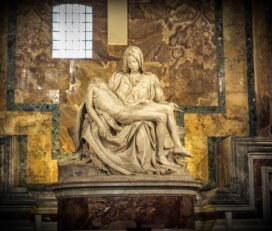
Michelangelo’s Pietà
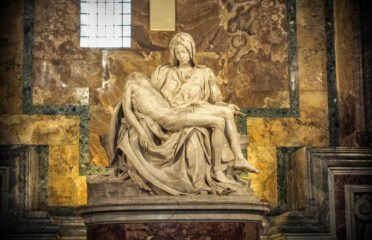
The Pietà is one of the most famous sculptures in the world. Michelangelo carved it when he was still in his twenties. It shows Mary holding the body of Jesus after the crucifixion.
The detail is unreal. The marble looks soft. The emotion is quiet but heavy. Today it sits behind protective glass, but it is still one of the most powerful works in the basilica.
The Central Nave
The long central aisle draws your eye straight toward the main altar and the dome above it. As you walk forward, notice the floor patterns, side chapels, and monumental statues lining the space.
This walk alone is an experience. Take it slow.
The Baldachin by Bernini
At the heart of the basilica stands the massive bronze Baldachin, designed by Gian Lorenzo Bernini. It sits directly over the high altar and the tomb of Saint Peter below.
The twisted columns rise dramatically toward the dome. This structure marks the spiritual center of the church.
The Dome Interior
Look up. The interior of the dome is covered in mosaics, inscriptions, and imagery. Latin text runs around the base, reminding visitors of Peter’s role as the foundation of the Church.
From below, it feels impossibly high. From the top, it feels even higher.
Papal Altars and Side Chapels
As you explore, you’ll find numerous chapels, tombs, and altars dedicated to saints and popes. Each one has artwork, sculpture, or architectural detail worth noticing.
This is not a one-highlight building. It’s layers on layers.
The Vatican Grottoes (Below the Basilica)
Below the main floor are the Vatican Grottoes, where many popes are buried. This area is quieter and more reflective.
Access is usually included with basilica entry and follows the same dress code. It’s worth visiting if you want a deeper sense of the site’s religious importance.
Climbing the Dome (Cupola)
If you are physically able, the dome climb is one of the best things you can do in Vatican City.
Here’s what to expect:
- Elevator option takes you partway
- Stairs get narrow and curved
- The final stretch is tight and steep
At the top, you get one of the best views in Rome. You can see St. Peter’s Square, Vatican Gardens, and much of the city beyond.
If you dislike tight spaces or heights, skip it. Otherwise, it’s worth every step.
Best Time to Visit
- Early morning: Calm, quiet, and spiritual
- Late afternoon: Warmer light, fewer tour groups
Wednesdays and major religious holidays require extra planning due to Papal events.
Guided Tour or Self-Guided?
You can absolutely explore on your own, but a guided tour adds context that helps everything click.
- Self-guided: Good for slow wandering and reflection
- Guided tour: Best for understanding symbolism, art, and history
Audio guides are also a solid middle option.
Common Mistakes to Avoid
- Wearing the wrong clothes
- Showing up at peak hours with no patience
- Rushing through without looking up
- Skipping the dome if you are able to climb
Pairing St. Peter’s Basilica With Other Sights
- St. Peter’s Square
- Vatican Museums and Sistine Chapel (on a separate ticket)
- Castel Sant’Angelo nearby
Do not try to cram everything into one rushed day. Space it out if you can.
Final Thoughts
St. Peter’s Basilica is one of those places that justifies its reputation. It is massive without being cold, ornate without being chaotic, and historic without feeling distant.
Go early, dress properly, take your time, and let the scale and silence work on you. Whether you visit for faith, art, history, or curiosity, this is a place you don’t forget.
 Rate it or leave a comment!
 Rate it or leave a comment!
 - Open Now07:00 AM - 07:10 PM

- Monday07:00 AM - 07:10 PM
- Tuesday07:00 AM - 07:10 PM
- Wednesday07:00 AM - 07:10 PM
- Thursday07:00 AM - 07:10 PM
- Friday07:00 AM - 07:10 PM
- Saturday07:00 AM - 07:10 PM
- Sunday07:00 AM - 07:10 PM


 Own or work here?
Nearby Places to Eat and Drink See All


Nearby Places to See and Do See All