
Best Ways to Explore the Taj Mahal Without Feeling Rushed
By


I will be honest with you: my first visit to the Taj Mahal was not what I expected. I arrived with a group of fifteen people, followed a tour guide holding a red umbrella, and spent forty-five minutes shuffling through crowds to reach the front of the main structure. We stayed for photos, then left. The whole experience lasted two hours.
Walking back to the car that day, I felt something was missing. Yes, I saw one of the world’s most beautiful buildings. But did I experience it? Not really.
That’s when I learned something crucial about visiting the Taj Mahal: how you plan your visit changes everything. Thousands of tourists arrive daily, but most follow the same rushed schedule. They cram the experience into a few hours, tick the box, and move on to the next destination.
But it does not have to be that way.
Why the Taj Mahal Feels Rushed (And How It Does not Have To)
The Taj Mahal receives around 7-8 million visitors annually. That’s roughly 20,000 people walking through the gates every single day. When you’re part of a massive crowd, the magic gets lost somewhere between the packed pathways and jostling for the perfect photo.
Most tour groups operate on tight schedules. They maximize visits to multiple monuments in a single day, which means the Taj Mahal gets squeezed into a two-to-three-hour window. Everyone moves together, everyone photographs the same angle, and everyone leaves feeling slightly disappointed that the reality did not match the romanticized version in their head.
The good news? You can ignore this formula entirely.
If you plan deliberately and arrive with realistic expectations, you will experience something completely different. The Taj Mahal reveals its true beauty when you slow down. It rewards curiosity, patient observation, and time spent simply sitting with it.
Start With the Right Timing
This is the single most important decision you will make. The time you visit determines whether you’re fighting crowds or soaking in peace.
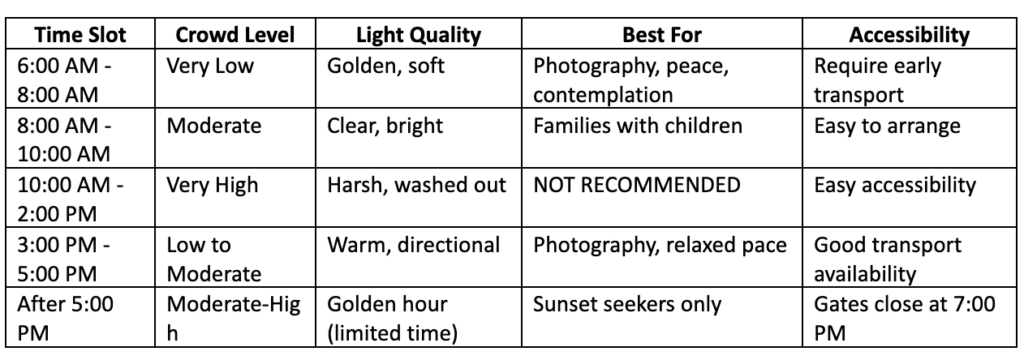
Early Morning Visit (6:00 AM – 8:00 AM)
The gates open at 6:00 AM, and this is genuinely the sweet spot. You will encounter maybe 500-1000 people instead of the typical 5000+. The light is softer, the air is cooler, and the marble glows with a gentle golden tone that’s impossible to photograph poorly.
I walked the gardens at 6:45 AM on a winter morning and had entire sections to myself. There’s something profoundly moving about experiencing such a significant monument when it feels almost private. You can linger at viewpoints without feeling pressured to move along.
The catch? You need to arrange early transport and be willing to wake up before sunrise. But this trade-off is absolutely worth it.
Late Afternoon Visit (3:00 PM – 5:00 PM)
The second-best window is late afternoon. Families and large tour groups typically wrap up their visits by 2:00 PM to catch their flights or drive to other cities. By 3:00 PM, the rush genuinely subsides.
The light at this time is warm and directional, creating dramatic shadows across the marble. Photography becomes genuinely interesting. You’ve got solid light for at least two hours before sunset.
Times to Avoid at All Costs
- 10:00 AM – 2:00 PM: Peak crowd hours. The entire monument feels congested.
- Sunset visits: Everyone tries to photograph the sunset, making it the busiest and most packed period of the day.
- Weekends and holidays: Double the usual crowds.
Plan for Actual Time, Not Just Visits
Here’s what many travelers miss: the Taj Mahal is not a checklist item. Plan to spend 2-3 hours minimum, preferably 4 hours. This allows you to actually see it rather than just look at it.
What you can do with proper time:
- Walk the entire perimeter of the gardens (20-30 minutes)
- Sit on different benches and observe how light changes the perception of marble color
- Enter the mausoleum and experience the interior acoustics and inlay work (20 minutes)
- Explore the side chambers and detail work most people rush past
- Simply sit and absorb the atmosphere without pressure
- Have chai or water at the garden café without feeling rushed
Time allows appreciation to build. The monument reveals layers. You notice the precise geometric patterns in the marble work. You see how the building seems to change color throughout your visit. You understand why architects and artists spent nearly 22 years constructing it.
Visiting Time Comparison Table
Practical Tips for a Better Experience
1. Skip the Standard Tour Group
Hiring a personal guide or visiting independently gives you complete control over pacing. You walk when you want, linger when something interests you, and ask detailed questions without feeling rushed. A private guide costs 500-800 Indian Rupees ($6-10 USD) and transforms the experience entirely.
2. Buy Your Ticket Online
The ticket line alone consumes 20-30 minutes during peak hours. Purchase your ticket online beforehand (available through the official ASI website or travel platforms). Walk straight to the security checkpoint instead.
3. Bring What Actually Makes You Comfortable
Forget the tourist checklist. Bring a reusable water bottle, sunscreen, and a light scarf. The sun is intense even in winter. Good walking shoes matter more than you’d think—the paths are long and marble gets hot. A lightweight folding umbrella works better than sunglasses for the glare off white marble.
4. Use the East and West Gates Strategically
Most tourists enter through the main south gate. The east and west gates receive far fewer visitors. If you’re visiting midday (which is not ideal, but sometimes you have no choice), enter through the east gate for a noticeably quieter experience.
5. Sit with It, Do not Just Photograph It
The impulse to photograph constantly can actually diminish your experience. Put your phone away for 20-30 minutes. Sit on a bench in the gardens. Watch how the light plays across the marble. This simple act—actually seeing something rather than capturing it—changes your entire perspective.
Explore Nearby Without the Tourist Trap
The Taj Mahal does not exist in isolation. Agra has other monuments and local experiences worth your time.
Agra Fort sits just 2 kilometers away and offers different architectural perspectives. Visit in the afternoon when Taj Mahal crowds peak. You will see the fort from angles that frame the distant Taj Mahal beautifully.
Mehtab Bagh (Garden of Moonlight) sits across the Yamuna River. The view of Taj Mahal from here feels completely different—more distant, more integrated into the landscape. Fewer tourists discover this spot.
Local markets in Old Agra give you authentic Agra beyond the monument. Walk through petha (sweet) shops, interact with merchants, and understand how locals actually live.
If you’re planning a comprehensive visit to the region, organized options like a Taj Mahal Tour through platforms like Pioneer Holidays can take the logistics off your plate, leaving you free to focus on actually experiencing the monument without worrying about transport or timing coordination.
The Photography Question
Everyone wants beautiful photos. Here’s what actually works:
- Early morning produces the best light and the clearest shots
- Do not fight crowds for the front view—everyone takes the same photo from the same spot. Move around. Photograph details, gardens, archways, the way light hits specific marble patterns
- Golden hour (late afternoon) creates genuinely interesting light for photography
- Hire a professional photographer locally if you want quality couple photos—they know the best times, angles, and locations
- Stop thinking about photos long enough to actually see the monument
FAQ: Your Burning Questions Answered
Q: Is it worth visiting the Taj Mahal? Sounds overhyped.
A: Yes, genuinely. But only if you visit properly. A rushed visit disappoints. A thoughtful visit changes perspective.
Q: Can I visit Taj Mahal twice in one day?
A: You can, but why would you? Once with proper time beats twice in a rush.
Q: Is it safe to visit alone or as a couple?
A: Absolutely. Agra is generally safe for tourists. Standard travel precautions apply.
Q: How much time do I actually need?
A: 3-4 hours minimum. Anything less feels cramped.
Q: Is early morning really worth waking up early for?
A: Without question. It’s the difference between a good experience and an exceptional one.
Q: Can I visit during monsoon season?
A: Yes. Fewer tourists, lush gardens, interesting clouds and light. Bring rain gear.
The Real Experience Awaits
The Taj Mahal deserves better than a quick visit. It’s one of humanity’s most remarkable achievements—a structure that took 22 years to build, employed thousands of craftspeople, and incorporates mathematics and artistry in ways that still astound historians.
When you give it the time and attention it deserves, something happens. You move past the monument-as-photo-op mentality. You start noticing the precision of inlay work, the geometry of gardens, the way afternoon light transforms white marble into something ethereal.
That’s when a visit becomes a memory. That’s when you understand why people call it a monument to love.
Plan properly. Arrive early. Slow down. Let it work on you.
Your Taj Mahal experience will be completely different than the crowds of people rushing through. And honestly, that’s the whole point.