
Albania as Your Base Camp: Five Easy Cross-Border Trips from Tirana
By
By the Bora Travel team · Tirana, Albania
Most people plan Albania as the destination. The travelers who get the most out of the Balkans plan it as the base.
Look at a map and the logic is hard to miss. From Tirana you can be standing above Lake Ohrid in North Macedonia in about three hours. You can cross a 16th-century stone bridge in Prizren, Kosovo, in less time than it takes to reach some Albanian beaches on an August Saturday, or walk the walls of Kotor in Montenegro by mid-afternoon. Down on the Riviera, Corfu sits so close to Saranda that it fills the horizon, and from the port of Durrës an overnight ferry puts you in southern Italy by breakfast.
As a travel agency based in Tirana, we see the same pattern every season: visitors fly in for a week, fall for Albania, and only later realize how much was a single bus ride away. This guide is the version we wish they had read before booking. It covers five cross-border trips that work from an Albanian base, with realistic travel times, the border details that actually matter, and the order we would do them in.

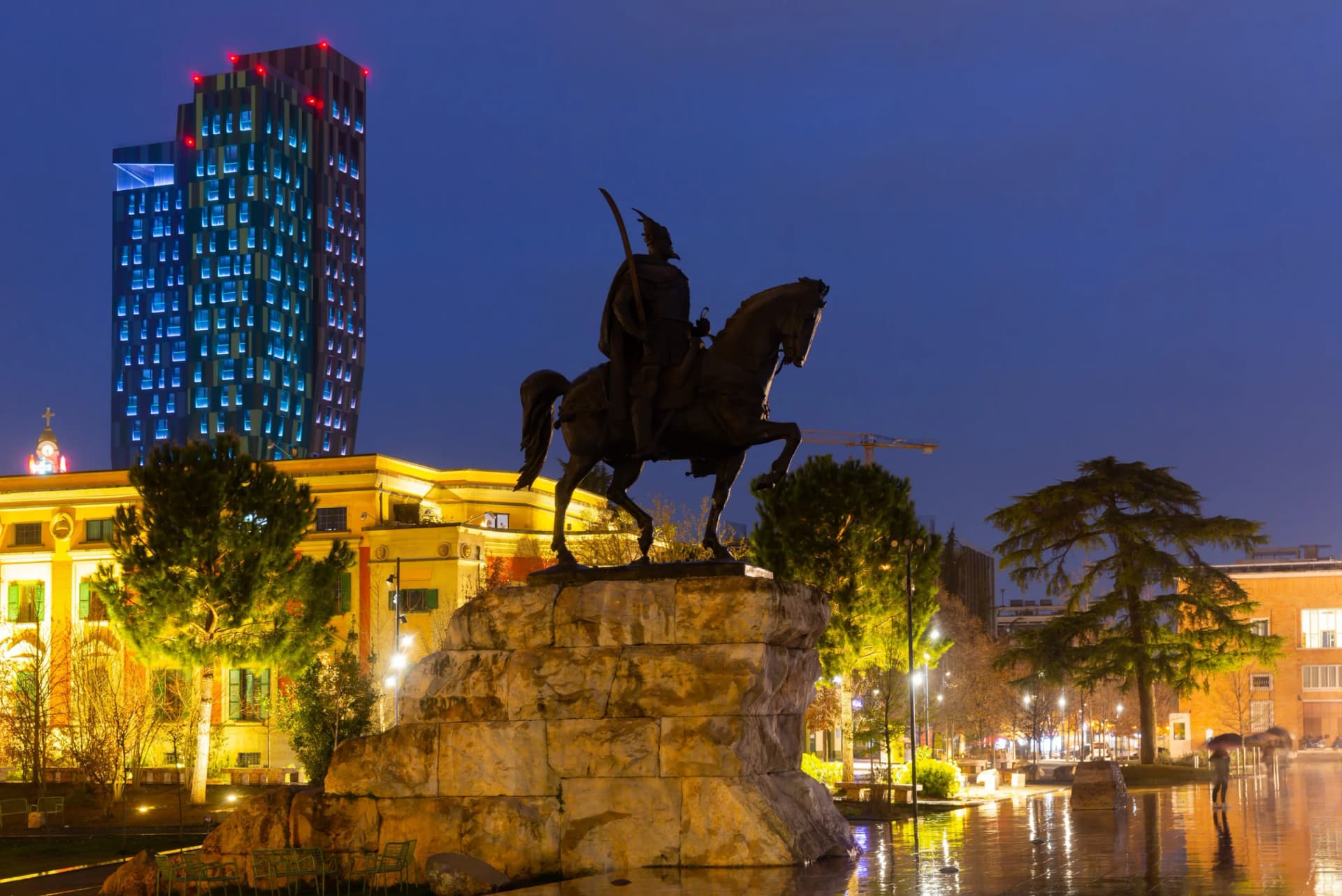
Photo: Albnext / Wikimedia Commons, CC BY-SA 4.0
Why Albania works so well as a base
Three things make Albania unusually good as a hub for a longer Balkan trip.
It's central and compact. Tirana sits roughly in the middle of a ring of borders. North Macedonia, Kosovo and Montenegro are all reachable by road in a few hours, Greece is a short sea crossing from the southern coast, and Italy is one night away by ferry.
It's still good value. Accommodation and meals in Albania generally cost less than on the Montenegrin coast, in Corfu or in Puglia in high season. Sleeping most nights in Albania and making shorter forays across the border keeps a two-week trip affordable without cutting anything out.
Your phone keeps working. Since 1 July 2021, Albania, Kosovo, Montenegro, North Macedonia, Serbia and Bosnia and Herzegovina have had no roaming charges between them. An Albanian SIM card bought on arrival works in Prizren, Kotor and Ohrid at home rates, within each operator's fair-use limit on data. Greece and Italy are the exception: an Albanian SIM still pays roaming there, so pick up an EU eSIM for those legs.
One money note before you go: Albania uses the lek, Kosovo and Montenegro use the euro, North Macedonia uses the denar, and Greece and Italy are on the euro. Carry some cash everywhere. Many intercity buses and small cafés still don't take cards.
The five trips at a glance
Trip | Country | Leave from | Travel time | Best for | Ideal stay |
|---|---|---|---|---|---|
Ohrid | North Macedonia | Tirana | 2.5–3.5 hours by bus or car | Byzantine churches, lake swimming | 1–2 nights |
Prizren | Kosovo | Tirana | About 2.5–3 hours by bus | Ottoman old town, food, history | Day trip or 1 night |
Kotor | Montenegro | Tirana | 4.5–7 hours by bus, depending on the service | Fjord-like bay, fortress walls | 2 nights |
Corfu | Greece | Saranda | 30–75 minutes by ferry | Venetian old town, beaches | Day trip or 1–2 nights |
Puglia | Italy | Durrës | 8–10 hours by overnight ferry | Trulli, white towns, food | 3–4 nights |
1. Ohrid, North Macedonia: the lake Albania shares
Lake Ohrid is one of the oldest lakes in Europe, and the whole lake is protected. The Macedonian shore has been a UNESCO World Heritage site since 1979, and in 2019 the listing was extended to the Albanian side. The town of Ohrid is the showpiece: a hillside of red roofs with Samuel's Fortress on top and, at the edge of the old town, the 13th-century Church of St. John at Kaneo perched on a cliff above the water. Go to Kaneo early in the morning, before the tour groups arrive, when the lake is often flat as glass.

The Church of St. John at Kaneo, above Lake Ohrid. Photo: kallerna / Wikimedia Commons, CC BY-SA 4.0
Getting there: buses leave Tirana daily and take roughly two and a half to three and a half hours via Elbasan and the Qafë Thanë border crossing. By car, it's about 130 km.
Our tip: make it a loop. Instead of returning the way you came, drive south along the Macedonian shore to the Monastery of St. Naum, cross back into Albania at the Tushemisht border right next to it, and return through Pogradec. On the way, stop at the village of Lin, on a small peninsula on the Albanian shore, where the ruins of an early Christian church still hold 6th-century floor mosaics. You see both sides of the lake for the price of about one extra hour.
2. Prizren, Kosovo: the easiest day trip from Tirana
Since the motorway from Albania into Kosovo opened (Albanians call it Rruga e Kombit, the "Road of the Nation"), Prizren has turned into an easy day trip. Buses take about two and a half to three hours each way.
Prizren is the best-preserved Ottoman-era town in Kosovo. The old Stone Bridge crosses the Bistrica River right below the Sinan Pasha Mosque, built in 1615, and the fortress above town is the place to be at sunset. For anyone interested in Albanian history, the complex of the League of Prizren, where Albanian leaders gathered in 1878, is a short walk from the bridge. Travelling in August? Check the dates of Dokufest, the international documentary and short film festival that takes over the old town every summer.

Prizren's Stone Bridge, the Sinan Pasha Mosque and the fortress on the hill. Photo: Aljabakphoto / Wikimedia Commons, CC BY-SA 4.0
A note for drivers: the international Green Card insurance is not accepted in Kosovo, so foreign-plated and rental cars need short-term border insurance, which you buy at the crossing. Ask your rental company for written cross-border permission before you leave Tirana. Not every company allows Kosovo, and those that do usually charge for it.
3. Kotor, Montenegro: a fjord in the Adriatic
The Bay of Kotor looks like a Norwegian fjord that has drifted into the Mediterranean: steep limestone walls drop into deep blue water, with the walled town of Kotor tucked into the innermost corner. The town and bay are a UNESCO World Heritage site, and Kotor is the busiest stop in this guide, so timing matters more here than anywhere else.

The view that pays for the climb: Kotor and its bay from the town walls. Photo: Pudelek (Marcin Szala) / Wikimedia Commons, CC BY-SA 3.0
Getting there: direct buses from Tirana run through Shkodër and the Hani i Hotit border crossing. The fastest services take about four and a half hours, the slowest closer to seven. Shkodër, with Rozafa Castle above the lake, is worth a night on the way up.
Our tip: climb the walls to the Fortress of St. John (roughly 1,350 steps) early in the morning, then explore the old town's lanes after lunch. Cruise passengers tend to arrive mid-morning, and in summer the path is hot and crowded by 11:00. Spend your second day in Perast, a small baroque town further along the bay, and take the short boat ride to Our Lady of the Rocks, the church on a man-made islet just offshore.
4. Corfu, Greece: the island you can see from Albania
From Saranda, on the Albanian Riviera, Corfu isn't a vague shape on the horizon. It fills it. Ferries cross in anything from about 30 minutes on the fast boats to 75 minutes on the slower car ferries. Sailings are frequent in summer, and the timetable thins out considerably in winter.

Corfu on the horizon, seen from Butrint Castle a short drive south of Saranda. Photo: Calistemon / Wikimedia Commons, CC BY-SA 4.0
Corfu's Old Town, with its two Venetian fortresses and the arcaded Liston promenade, makes an easy day trip. Two details catch people out. First, Greece is one hour ahead of Albania, so a return ferry listed for 18:00 Greek time is 17:00 in Saranda. That's easy to miss when you book from the Albanian side. Second, you're entering the Schengen area. The EU's Entry/Exit System (EES) now records non-EU visitors' fingerprints and photo at the border, and the port queue can be slow on summer mornings. Take an early boat and don't plan a tight connection.
If you have a spare morning in Saranda, visit the ancient city of Butrint first. The view from its castle across the Vivari Channel to Corfu is the one in the photo above.
5. Puglia, Italy: overnight by sea
The most underrated trip on this list starts at the port of Durrës, about 40 minutes from Tirana. Overnight ferries to Bari leave in the late evening and arrive the next morning, taking roughly eight to ten hours depending on the company. A cabin replaces one night's hotel. From Bari, the trulli of Alberobello are about an hour inland, along with Polignano a Mare and Monopoli on the coast. Lecce and Otranto are further south.

Painted trulli roofs in Alberobello's Rione Monti quarter. Photo: Benjamin Smith / Wikimedia Commons, CC BY-SA 4.0
There's a family connection here too. Southern Italy is home to the Arbëreshë, descendants of Albanians who crossed the Adriatic from the 15th century onwards. A few villages in Puglia, Chieuti and Casalvecchio di Puglia among them, still keep the language alive. Crossing from Durrës retraces that same journey. If you'd rather fly, Tirana has regular short flights to several Italian airports. The ferry wins when you want to bring a car or save a hotel night.
Two routes that tie it together
Ten days, south and east (Albania, North Macedonia and Greece):
Tirana: 2 nights
Ohrid: 2 nights, returning via St. Naum, Lin and Pogradec
Berat: 1 night
Gjirokastër: 1 night
Saranda: 2 nights, with a day trip to Corfu
Back to Tirana for your flight home
One week, north (Albania, Montenegro and Kosovo):
Tirana: 1 night
Shkodër: 1 night
Kotor: 2 nights
Back to Tirana: 1 night
Prizren: a day trip or 1 night, then fly home from Tirana
Both routes keep backtracking to a minimum and leave room for a lazy day, which you'll want after the border queues of a summer weekend.
Practical notes before you cross a border
Documents: carry your passport, even if your nationality allows ID-card entry in some of these countries. Entry rules differ by passport, so check each country before you travel.
Rental cars: you need written permission and Green Card insurance from the rental company for each border, plus the separate border insurance for Kosovo. Some companies charge per country or rule out certain crossings, so ask before you sign.
Buses: in July and August, buy international bus tickets at least a day ahead. Many operators still sell by phone or at the terminal rather than online.
Season: May–June and September–October are the sweet spot. Ferries and buses run often, borders are quieter and the light is kinder for photos. In winter, ferry timetables shrink and mountain roads are slower.
Booking it all: a trip with five moving parts (flights, ferries, cross-border buses and hotels in four currencies) is easier when one person holds it all. A Tirana-based agency such as Bora Travel can package the legs and keep them on a single booking, which makes changes far simpler when a ferry is cancelled because of wind.
The bottom line
Albania deserves more than a week of anyone's trip. But treating it as a base rather than a single stop changes the shape of the whole journey: three or four countries, very little backtracking, and plenty of evenings back in a country where dinner still costs less than you expect. If you only have one spare day, start with Prizren or Ohrid. Save Kotor and Puglia for when you have two or more.
About the author: Bora Travel is a travel agency in Tirana, Albania. Its team plans everything from European city breaks to multi-country Balkan routes, and has been helping Albanian and international travelers for over a decade.