
How to Catch the Green Flash in Aruba, and Why the Island Stacks the Odds
By
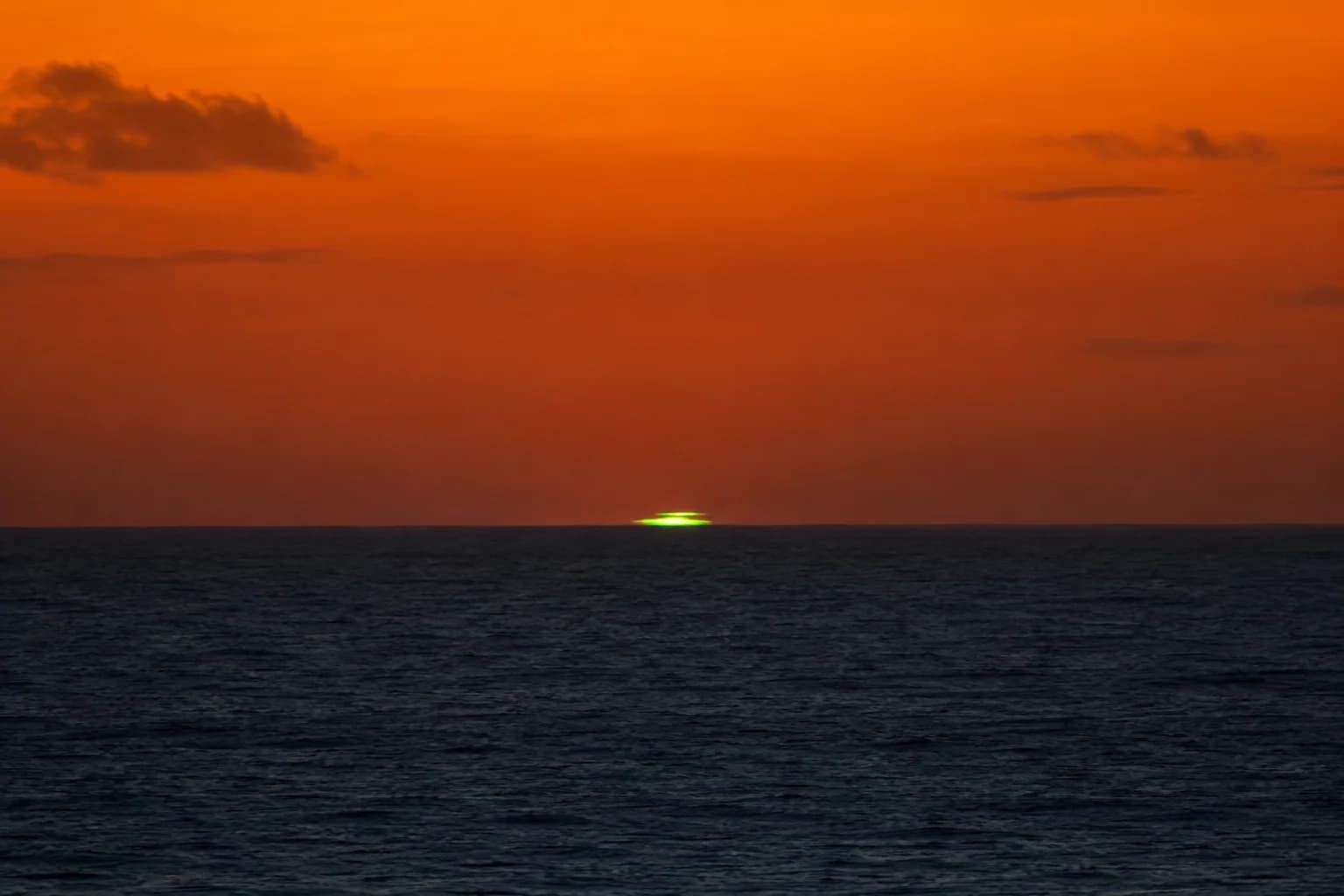
Ask around at any beach bar on Aruba's west coast, and someone will swear they've seen it: a flicker of emerald on the last sliver of the sun, gone before anyone else at the table looked up. Ask the next person, and they'll tell you it's a story sailors invented after one rum too many. Both of them are half right. The green flash is a real, well-documented optical effect, but it's also brief, fussy about conditions, and easy to miss if you don't know what you're looking for.
Aruba is one of the better places in the Caribbean to try. The reasons come down to weather and geography, and once you understand them, you can plan an evening around your odds instead of hoping for luck.
What The Green Flash Actually Is
Sunlight bends as it passes through the atmosphere, and it bends more when the sun is low because the light has to travel through more air to reach you. Shorter wavelengths bend a little more than longer ones, so the atmosphere behaves like a very weak prism. The setting sun you see is actually a stack of slightly offset colored images, with red at the bottom and green and blue a fraction higher up.
Most of the blue gets scattered out along the way, which is why the sky looks blue, and the low sun doesn't. That leaves green as the topmost color still reaching your eye. When the red and orange lower edge slips below the horizon, there's a moment when only the upper rim remains, and it's green. That moment is the flash.
On its own, the color separation is tiny, far too small to see with the naked eye. What makes it visible is a mirage. When the sea surface is warmer than the air just above it, the layered air acts like a lens, stretching the sun's upper edge and magnifying that green rim into something you can actually catch. Andrew T. Young, the San Diego State University astronomer who has spent decades cataloging green flashes, describes this common "inferior-mirage" flash as best seen from near sea level and lasting only a second or two.
Young's work also flags a catch. Many people who report a green flash are probably seeing a yellow stage that their eyes read as green, because staring at a bright red sun for several minutes bleaches the red-sensitive cells in the retina. That's worth knowing before you go, since it changes how you should watch.
Why Aruba's Conditions Help
A green flash needs three things: a sharp, distant horizon, clear air along your line of sight, and no cloud sitting on the horizon at the exact spot where the sun goes down. Aruba does unusually well on all three.
Start with the horizon. The island's west and northwest coasts face the open Caribbean Sea, and the sun sets over nothing but water in every month of the year. The Venezuelan coast lies to the south, well out of the sunset's path, and Curaçao sits off to the east. There's no neighboring island or headland to clip the view.
Then there's the sky. The island's national meteorological department places Aruba in the Southern Caribbean Dry Zone, classifies its climate as semiarid, and reports that average cloud cover through the day is highest in the morning and lowest in the late evening. That pattern matters more than any annual rainfall figure, because the only clouds that count for a green flash are the ones on the western horizon at sunset, and Aruba's evenings tend to be its clearest hours.
The island's shape helps too. Aruba is low and flat, and its highest point, Jamanota, stands under 200 meters. Mountainous islands like Dominica and St. Lucia force moist air upward throughout the afternoon, building clouds over their peaks. Aruba doesn't have the relief to do that, so the sky over it stays comparatively clean.
None of this guarantees anything. A thin band of cloud sitting right on the horizon is the most common spoiler, and it can show up on evenings that look perfectly clear overhead. Summer episodes of Saharan dust, which drift across the Atlantic most years, can also soften the horizon enough to wash the effect out.
When To Plan Your Attempt
The Met Office's data points to a clear seasonal pattern. The dry season runs roughly from February through June, and February has the lowest average cloud cover of the year. The rainy season runs from September into January, and during those months showers can fall in the early to late evening, right when you'd be watching. If you've got flexibility in your travel dates, late winter and spring give you the best run of clean sunsets.
Aruba sits at about 12.5 degrees north, close enough to the equator that sunset times barely move through the year. The sun goes down a little after 6 p.m. in late autumn and a little after 7 p.m. in early summer. Because it drops almost vertically at this latitude, the whole sunset goes quickly: roughly two minutes from the moment the lower edge touches the water to the moment the last point of light disappears. Check the exact time on the day and be in position 20 minutes early, so you're not walking down the beach when it happens.
Where To Watch From Land
You want the lowest, clearest view of the western horizon you can get, with nothing in the way.
On the island's northwest tip, the hilltop California Lighthouse at Hudishibana gives you a wide, elevated view of open sea to the west and north. The height won't give you the classic sea-level flash that Young describes, but it lets you see further along the horizon and spot any cloud bank before the sun reaches it. That makes it a good scouting spot for a first evening: if the horizon looks clean from up there, you know the next night's conditions are worth chasing from lower down.
For a sea-level view, Eagle Beach's wide, low-rise stretch of sand works well. The beach is deep, the hotels behind it are mostly low-rise, and the sand runs flat down to the water, so you can walk to the tide line and put nothing between yourself and the horizon. Arashi Beach, just below the lighthouse, is another good option, though it gets busy on weekend evenings.
Why The Water Is The Best Seat
Even a good beach can have obstructions, from palm trees and piers to swimmers and people holding up phones. Getting out on the water removes most of them while keeping you relatively close to sea level, which is useful for spotting the inferior-mirage flash Young describes.
That makes an evening sunset sail along Aruba's coast another option if watching for the green flash is already on your list. What matters most is having an unobstructed view toward the western horizon around sunset. Check the forecast before heading out, since a low bank of clouds can block the final sliver of sun even when the rest of the sky looks clear.
A boat does have one drawback. Its motion makes photography harder, so brace against a rail and shoot in bursts rather than trying to time a single frame.
How To Watch Without Fooling Yourself
Most failed attempts come down to technique rather than weather. Don't stare at the full sun as it sets. Beyond the obvious risk to your eyes, that's exactly what bleaches your red receptors and sets you up to mistake yellow for green. Watch the horizon beside the sun instead, and only look directly at the last sliver in the final few seconds, when it's dim enough to see comfortably.
Keep your attention on the precise point where the rim disappears, because that's where the flash appears, and it won't wait for you to refocus. If you've got a phone or camera with decent zoom, frame the setting sun and hold down the shutter for burst mode through the final seconds. Checking the frames afterward is the most reliable way to know whether you saw green or just yellow, since a camera sensor doesn't suffer from the same bleaching your eyes do.
Most evenings you'll get a fine sunset and no flash, and that's the honest reality of chasing one anywhere. Aruba gives you better odds than most: clear evening skies, open water to the west, and a sun that drops fast enough to keep you focused. Pick a dry-season evening with a clean horizon, get low and close to the water, and keep your eyes on the last point of light. If it turns green, you'll know exactly what you saw and why it happened there.