Archaeological Site of Nea Paphos
QC45+C99, Paphos 8040, CyprusArchaeological Site of Nea Paphos
The Archaeological Site of Nea Paphos sprawls across a coastal hillside in Paphos, Cyprus, offering one of the eastern Mediterranean's richest layers of ancient history. What began as a Hellenistic city founded in the 4th century BCE evolved through Roman, Byzantine, and Frankish rule, leaving behind mosaics, villas, fortifications, and temples that span nearly two millennia. Walking the site, you move between periods the way you might turn pages: Greek foundations give way to Roman floors inlaid with colored stone, then medieval walls rise above them. The result is less a single monument than an open-air archive of how one place adapted and reinvented itself across empires.
Why This Place Matters
Nea Paphos gained prominence after the old city of Paphos (Palaia Paphos) declined in the Hellenistic period. The new settlement quickly became the administrative and cultural center of the island, and its strategic harbor ensured it remained significant through Roman times. The mosaics discovered here rank among the finest Greco-Roman examples ever found, revealing the tastes and daily lives of wealthy residents. Byzantine churches added a later spiritual layer, and Frankish defenses tell of medieval struggles for control.
The site was partially destroyed by Arab raids in the 7th century CE and earthquakes, yet enough survives to give you a tangible sense of urban life across centuries. That continuity, and the quality of what remains, makes Nea Paphos essential for anyone interested in how Mediterranean civilizations persisted and transformed.
Quick Facts
- Founded around the 4th century BCE during the Hellenistic period
- Designated a UNESCO World Heritage Site in 1980
- Covers approximately 57 hectares across the Paphos waterfront
- Main structures span from the 4th century BCE to the medieval period
- Open year-round, though hours vary seasonally
- Located about 1.5 kilometers north of Paphos harbor
Getting There
The site sits on the northern edge of Paphos, reachable on foot from the old harbor in roughly 20 to 25 minutes if you follow the coastal path. If you're arriving by car, parking exists near the main entrance and scattered lots throughout the site. Taxis from the airport or town center are straightforward. During summer months, walking in direct sun can be punishing, so consider arriving early or planning to explore shaded sections during midday heat.
The main entrance is well signposted from the road running parallel to the coast. Once inside, the site is largely open-air and unfenced, meaning you can enter and exit at various points depending on which sections interest you most.
The Layout and Experience
Nea Paphos is not a compact site you'll exhaust in an hour. The terrain slopes gently downward toward the sea, and major structures are scattered across this hillside rather than clustered together. The layout reflects ancient city planning: residential villas in some zones, public buildings in others, fortifications on higher ground.
Your route will depend on which entrance you use and what you want to prioritize. Many visitors start at the main visitor facilities near the top, then work downward toward the coast. The walking is moderate, with paved paths between major zones, though some areas remain rougher underfoot. Bring water and sturdy shoes.
The experience is intimate in a way many archaeological sites aren't. You're often alone with the ruins, able to sit within a Roman room or trace the outline of a villa's walls without crowds. That quiet is part of the appeal, though it also means you'll need a guidebook or audio guide to make sense of what you're seeing. Without context, a pile of stones is just that.
Main Highlights
The House of Dionysus
This is the site's crown jewel, a Roman villa dating to the 2nd century CE. The house earned its name from one of its most celebrated mosaics: Dionysus riding a leopard. The mosaics throughout the house are exceptionally well preserved, depicting mythological scenes with remarkable detail. Dolphins, hunting scenes, and geometric patterns fill other rooms. The sheer quality of the work reveals the wealth and cosmopolitan taste of its owner. You can walk through the actual rooms where these floors remain in place, which is rarer than you might expect at archaeological sites.
The House of Aion
Another Roman villa, this one famous for a striking mosaic showing the triumph of Dionysus. The composition and the vibrancy of the stone colors are striking even by Roman standards. The house also offers a clear sense of residential layout: entry halls, courtyards, private quarters, and service areas.
The Odeon
This small Roman theater or concert hall dates to the 2nd century CE. It's less dramatic than a full amphitheater but reveals how cultural life was organized in the city. Enough tiers remain for you to imagine performances taking place here, with the sea visible beyond.
The Medieval Castle
Rising on a prominent headland, this Frankish fortification dates to the 13th century. It offers views across the site and the harbor, and its stone walls show the transition from ancient to medieval construction. The castle was built partly using stones from earlier structures, a common practice when new powers arrived.
Byzantine Churches
Several church foundations dot the site, including the Basilica of Chrysopolitissa, which dates to the 4th century CE. These structures remind you that Nea Paphos remained an important Christian center after the Roman period. Some retain decorative elements or mosaics, though many are fragmentary.
The Tombs of the Kings
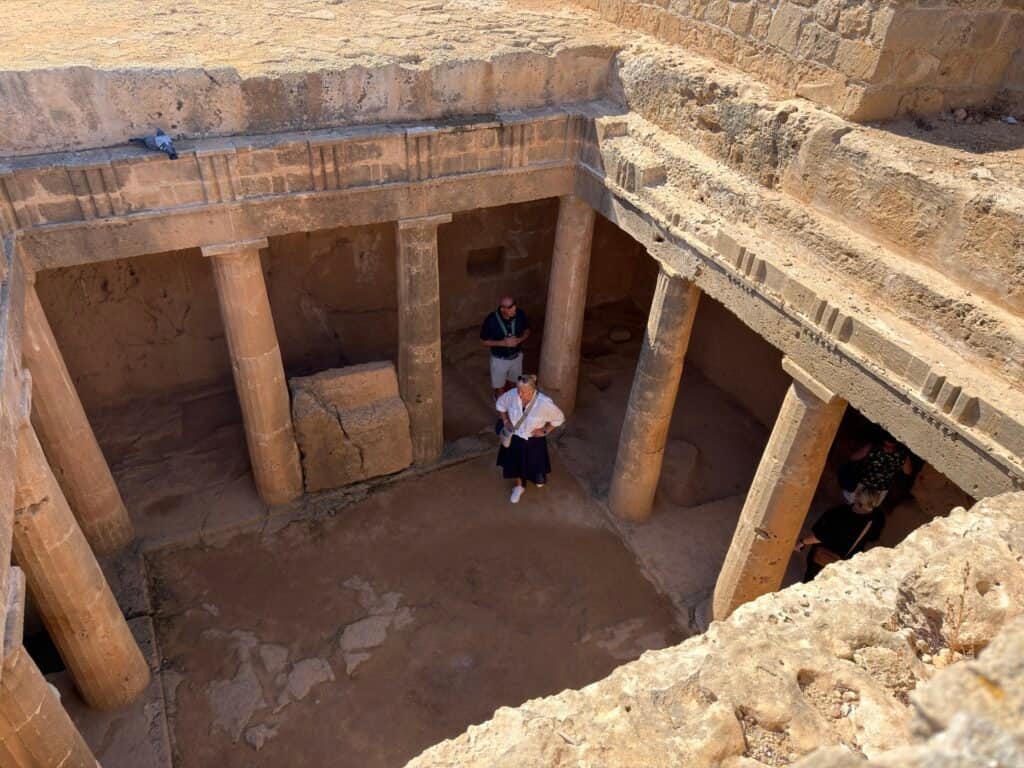
Just south of the main archaeological zone lies this separate monument, a series of rock-cut tombs from the Hellenistic and Roman periods. The name is somewhat misleading (they likely belonged to wealthy citizens rather than royalty), but the scale and craftsmanship of the underground chambers are impressive. You can descend into several, experiencing the coolness and darkness that has preserved them for over two thousand years.
History and Background
The original Paphos, located inland, was famous as a sanctuary of Aphrodite and served as a religious and cultural center. When Hellenistic kingdoms fractured the Mediterranean world after Alexander the Great's empire collapsed, the Ptolemaic ruler of Egypt decided to relocate the city's center to the coast. The new Paphos, founded around the 4th century BCE, offered better access to maritime trade and military defense.
Under the Ptolemies, Nea Paphos flourished. When Rome absorbed Egypt in 30 BCE, the city transitioned smoothly into the Roman system, becoming the capital of the Roman province of Cyprus. Wealthy merchants and administrators built grand villas adorned with mosaics that reflected Greco-Roman artistic traditions. The city's prosperity continued through the early Byzantine period.
Disaster struck in the 7th century when Arab raids devastated the coast. The city never fully recovered from this blow, though settlement continued. Medieval Frankish and Venetian rulers left their marks with fortifications. By the Ottoman period, the site had largely been abandoned, leaving it to be buried under soil and vegetation until systematic excavation began in the 1960s.
Tickets and Entry
General admission is required, and you can purchase tickets at the main entrance. The ticket grants access to most of the site, though the Tombs of the Kings may have a separate entrance and fee. Guided tours are available through tour operators in Paphos and offer valuable context if you prefer not to rely on a guidebook. Audio guides are sometimes available at the entrance or through your phone if you download the appropriate app in advance.
Photography is permitted throughout the site for personal use. If you're planning to use images commercially or publish them, check current regulations at the entrance.
Best Time to Visit
Late October through April offers comfortable temperatures and lower crowds. The site is pleasant to walk during these months without the exhausting heat of summer. December through February brings occasional rain, but the landscape is greener and the light softer for photography.
Summer (June to September) draws crowds and intense midday heat. If you must visit then, arrive before 9 AM or after 4 PM, and plan to spend the hottest hours in a museum or cafe in town.
Spring (March to May) and early autumn (September to early October) are ideal. The weather is warm but not oppressive, wildflowers bloom in spring, and the site remains relatively uncrowded.
Photography Tips
The mosaics in the House of Dionysus and House of Aion are visually stunning but present challenges. They're protected under shelters that diffuse light, which preserves them but creates flat, shadowy conditions for photos. Early morning or late afternoon light filtering through the shelter openings works better than midday. Bring a lens that handles lower light well.
The medieval castle and harbor views offer the best landscape shots, especially during golden hour. The contrast between the fortress walls and the sea beyond makes for compelling images. Walking the site at sunset gives you warm light across the ruins and fewer visitors in your frame.
Avoid shooting directly into the sun when photographing the Odeon or other structures where the sea forms the backdrop. Polarizing filters help reduce glare off pale stone.
Facilities and Preparation
The site has a visitor center near the main entrance with a small museum displaying artifacts and offering context through displays and maps. A cafe operates seasonally. Beyond that, facilities are limited. There are few shaded rest areas scattered throughout the site, so bring a hat, sunscreen, and at least one liter of water per person. Wear comfortable walking shoes with good grip, as some paths are uneven and can be slippery after rain.
A printed site map or guidebook is invaluable. Without one, you'll struggle to understand what you're looking at. The site is large enough that it's easy to miss major structures if you're just wandering. Download offline maps or take photos of signage at junctions so you don't lose your bearings.
Combining with Nearby Attractions
Paphos harbor is a 20-minute walk south and offers restaurants, the castle, and boat trips along the coast. The Paphos Archaeological Museum, about 1 kilometer away, houses smaller finds and offers deeper context for what you've seen at the site. The Ethnographic Museum of Paphos provides insight into local life and traditions from more recent centuries.
If you're interested in Byzantine history, the Church of Agia Kyriaki, located at the edge of the archaeological site, is worth a visit. The village of Geroskipou, a few kilometers inland, has traditional architecture and the Museum of Folk Art.
Sample Visit Plan
A thorough visit takes 3 to 4 hours. Start at the visitor center to orient yourself and pick up a map. Head first to the House of Dionysus to see the mosaics while you're fresh and the light is still good. Work your way through the adjacent structures, then move toward the Odeon and the coast. If you have energy, climb to the medieval castle for views. End at the Tombs of the Kings on your way out if you're leaving via the southern entrance. If time is tight, focus on the House of Dionysus, House of Aion, and the castle, which give you the best sense of the site's scope and significance.
Practical Tips
- Start early or late in the day to avoid heat and crowds, especially in summer
- Carry more water than you think you'll need; there are no fountains throughout the site
- Wear layers; mornings and evenings can be cool even in warm months
- A printed guidebook or downloadable map is essential; GPS can be unreliable among ruins
- The visitor center has restrooms; use them before starting your walk
- Consider hiring a guide if you want detailed historical context and interpretation
- Visit the Paphos Archaeological Museum before or after the site to see artifacts and gain broader context
- The site is largely unshadowed, so sunglasses and a hat are not luxuries
FAQ
How long should I spend at Nea Paphos? Most visitors spend 2 to 3 hours if they focus on the main highlights. A thorough exploration takes 4 to 5 hours. You can also break it into two visits if you're staying in Paphos for several days.
Is the site suitable for people with mobility issues? The main pathways between major structures are relatively flat and paved, but the terrain is uneven in places. The Tombs of the Kings require descending stairs. If you have limited mobility, focus on the House of Dionysus, House of Aion, and the Odeon, which are accessible via the main paths.
Are there guided tours available? Yes. Tour operators in Paphos offer guided walks of the site, and some hotels can arrange private guides. These typically last 2 to 3 hours and provide historical context that enhances the experience considerably.
Can I visit the site without a ticket? The site is partially fenced and monitored. You need a ticket for proper access to the main areas. Attempting to enter without paying is not recommended and deprives you of access to the visitor facilities and information.
What's the difference between Nea Paphos and Palaia Paphos? Palaia (Old) Paphos was the original religious and cultural center, famous for its Aphrodite sanctuary, located several kilometers inland. Nea (New) Paphos was founded later as a coastal city and became the administrative capital. Today, Palaia Paphos is a small archaeological zone; Nea Paphos is the major site you visit.
Opening hours
Reviews
Sign in and mark this place visited to leave a review.
No reviews yet.
Free Trip Planner
Plan your Paphos trip with our free planner
Build a day-by-day itinerary with AI suggestions, hand-picked places, and friends. Free forever — no credit card.