Arco de Cerro Brujo
Isla de San Cristóbal, Ecuador Posted by bazartravelsTraveler
Arco de Cerro Brujo
Arco de Cerro Brujo is a natural rock arch on the northern coast of San Cristóbal Island in the Galápagos. The formation rises dramatically from the ocean, carved by centuries of wave action into a distinctive stone gateway. It's one of the most photographed features in the archipelago, and for good reason: the arch frames turquoise water, black volcanic rock, and often a clear horizon all at once. Most visitors reach it by boat as part of a guided tour, though the arch itself sits on land accessible only with a guide.
Why this place matters
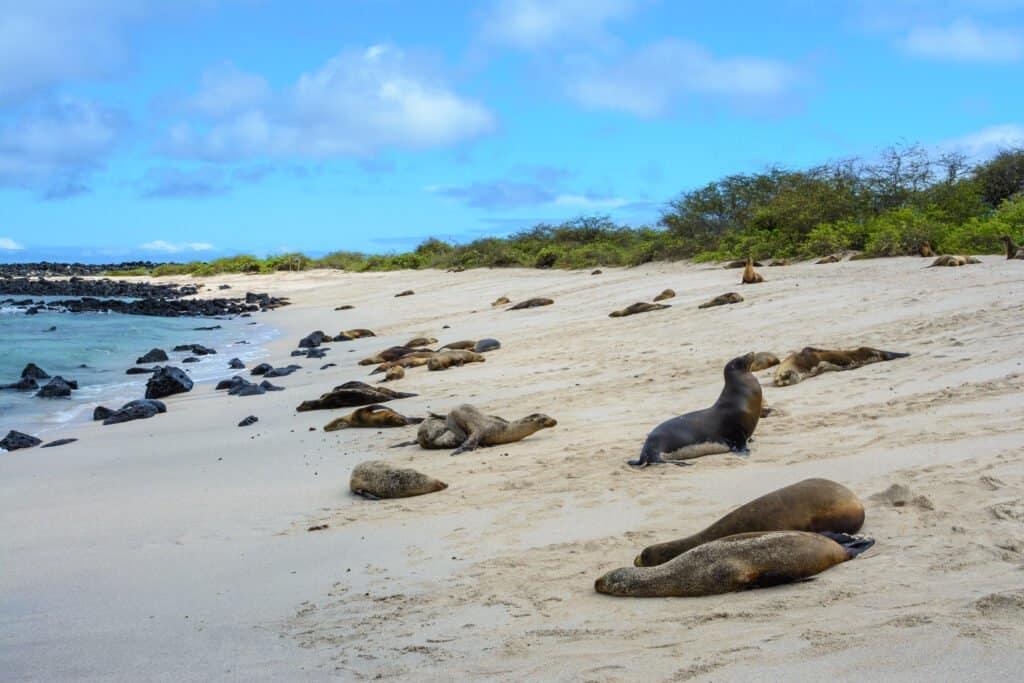
The arch represents the raw geology that defines the Galápagos. These islands are volcanic in origin, and Arco de Cerro Brujo shows what happens when lava meets the Pacific over millennia. The site is also a reliable place to see Galápagos wildlife in their natural habitat. Galapagos sea lions often haul out on the rocks nearby. Frigatebirds and boobies nest in the coastal vegetation. You might spot marine iguanas basking on the rocks below the arch, or occasionally a Galápagos penguin in the water.
The arch sits within protected waters, part of the Galápagos Marine Reserve. No private boats can operate here without a permit. This protection keeps the area relatively undisturbed and means the wildlife you see has had generations to adjust to human presence on guided tours.
Quick facts
- Location: Northern coast of San Cristóbal Island, Ecuador
- Type: Natural rock arch formed by wave erosion
- Best visited: Morning, when light is strongest and sea conditions tend to be calmer
- Access: By guided tour only, usually combined with a beach landing at Cerro Brujo
- Wildlife: Galápagos sea lions, frigatebirds, boobies, marine iguanas, occasionally penguins
- Distance from Puerto Baquerizo Moreno: Approximately 30 kilometers by boat
Getting there
You cannot visit Arco de Cerro Brujo independently. All visits must be arranged through a licensed tour operator based in Puerto Baquerizo Moreno, the main port on San Cristóbal. The arch is typically part of a half-day or full-day excursion that also includes a landing at the Cerro Brujo beach adjacent to the arch.
Boats depart from the waterfront in Puerto Baquerizo Moreno. The journey takes roughly 45 minutes to one hour depending on sea conditions. Morning departures are standard, and tours tend to return by early afternoon. You'll need to book a tour operator ahead of time, especially during peak seasons (December through January, and June through August).
The boat ride itself is part of the experience. The waters around San Cristóbal are home to dolphins, sea turtles, and various seabirds, so even the transit offers wildlife viewing opportunities.
The layout and experience
The arch itself is a towering natural gateway of dark volcanic rock. Its opening frames the ocean beyond, and the structure rises high enough to be visible from the boat approach. You don't climb or enter the arch. Instead, your guide will position the boat to give you the best angle for viewing and photography, usually stopping at a distance of 30 to 50 meters depending on sea conditions.
After viewing the arch from the water, most tours include a wet landing at Cerro Brujo beach, a black sand beach directly beside the arch formation. This is where the wildlife interaction intensifies. Sea lions rest on the rocks and sand nearby. You'll walk along a marked trail with your naturalist guide, who will point out nesting birds, explain the volcanic geology, and help you identify marine iguanas on the rocks.
The landing area is small and can feel crowded if multiple tour groups arrive simultaneously. The Park Service manages this by limiting the number of visitors per day and requiring guides. Expect to spend 30 to 45 minutes on the beach and at the arch itself, depending on your tour's length.
Main highlights
The arch is the primary draw, and seeing it in person is striking. Photographs don't fully capture the scale or the color of the water against the black rock. The texture of the volcanic stone is rough and ancient-looking, with visible weathering and erosion patterns.
Sea lion encounters are almost guaranteed. The animals here are accustomed to tour groups and remain calm, though your guide will maintain a respectful distance. Watching them interact with each other, haul out, or swim is one of the most intimate wildlife moments you'll have in the Galápagos. Pups are often present during certain months.
Frigatebirds and boobies nest in the scrubland above the beach. Depending on the season, you may see nesting behavior, chicks, or courting displays. The birds are more active in their breeding season, which varies by species.
Marine iguanas are visible on the rocks, especially in the cooler months when they come ashore to bask and warm themselves. They're unique to the Galápagos and seeing them in their natural setting is a highlight many visitors prioritize.
History and background
The arch was formed over thousands of years as waves eroded a natural weakness in the lava flow. San Cristóbal Island itself is the oldest in the Galápagos archipelago, with volcanic activity dating back several million years. The eastern side of the island, where the arch sits, has been shaped by persistent Pacific swells.
The Galápagos were designated a UNESCO World Heritage Site in 1978. Arco de Cerro Brujo falls under the protection of the Galápagos National Park, established in 1959. This protection framework means all visits are regulated: guides must be certified naturalists, visitor numbers are controlled, and no commercial activity beyond guided tourism is permitted.
The arch has no recorded name in local history prior to modern tourism. "Cerro Brujo" translates roughly to "Wizard's Hill," referring to the broader landform. The arch itself became iconic as tourism in the Galápagos grew in the late 20th century.
Best time to visit
The Galápagos has two main seasons: the warm season (December to May) and the cool season (June to November). Each has trade-offs for visiting Arco de Cerro Brujo.
The warm season brings calmer seas, warmer water, and more active sea lion pups. However, it also draws the most tourists. The cool season offers better visibility for some wildlife, fewer crowds, and lower tour prices, but the water is cooler and the seas can be rougher.
Morning visits are preferable to afternoon ones. Light is better, sea conditions tend to be calmer, and you're more likely to see wildlife active and alert. Most tour operators schedule morning departures for this reason.
If you're prone to seasickness, the cool season (June through August) tends to have choppier conditions. The warm season is generally smoother for boat travel.
Photography tips
The arch photographs best when the sun is at your back or to the side, illuminating the opening and the water inside it. Early morning light, when the sun is still low, creates strong shadows that emphasize the arch's three-dimensional form.
Bring a zoom lens or good telephoto capability. You won't be very close to the arch, and details like texture and erosion patterns are better captured from 30 to 50 meters away with magnification than from close range. Wide-angle shots of the arch with the open ocean work well too.
The black sand beach and dark rocks can fool exposure metering. If you're using auto exposure, your camera may overexpose the sky or underexpose the rocks. Shoot in manual mode or use exposure compensation to hold detail in both the sky and the arch.
Wildlife photography at the beach landing is easier. Sea lions move slowly and are relatively predictable. A camera with fast autofocus helps with birds in flight, but stationary animals like marine iguanas are straightforward to photograph.
Facilities and preparation
There are no facilities at Arco de Cerro Brujo itself. The beach landing is raw and exposed. Bring reef shoes or water shoes with good grip, as the black lava rock is sharp and can be slippery. Your tour operator will advise on footwear.
Sun protection is essential. The black volcanic rock reflects and amplifies UV radiation. Bring high-SPF sunscreen, reapply it often, and wear a hat and UV-blocking sunglasses. A rash guard or lightweight long-sleeve shirt is a good idea for extended time on the beach.
Bring a light jacket or windbreaker. Even on warm days, the ocean breeze can be strong and cooling, especially on the boat ride there and back.
Seasickness medication is worth considering if you're susceptible. The boat ride is usually moderate in roughness, but conditions vary. Talk to your tour operator about sea conditions before booking if this is a concern.
Bring minimal gear beyond camera and sun protection. Your tour guide will carry water and snacks. Bags are not recommended on the beach landing, as there's nowhere to safely store them and the terrain is uneven.
How it compares to similar places
San Cristóbal has other notable coastal sites. Punta Carola, near Puerto Baquerizo Moreno, is more accessible for independent exploration and offers sea lion and bird viewing from shore. Arco de Cerro Brujo requires a boat trip but offers a more remote, dramatic landscape and a higher concentration of wildlife in a smaller area.
Compared to other Galápagos islands, San Cristóbal is often overlooked in favor of Santa Cruz or Isabela. But for visitors based on San Cristóbal, Arco de Cerro Brujo is the signature experience. If you're island-hopping, it's worth the half-day commitment.
Combining with nearby attractions
Many tours combine Arco de Cerro Brujo with other San Cristóbal sites. Cerro Brujo beach itself is often part of the same tour. Punta Pitt, on the eastern tip of San Cristóbal, is another boat-based excursion that can be combined with Arco de Cerro Brujo on a full-day tour.
If you're staying in Puerto Baquerizo Moreno for multiple days, you can visit the town itself: the Charles Darwin Research Station, Punta Carola, and the waterfront. These are accessible on foot or by short taxi ride and don't require a boat.
Sample visit plan
A typical half-day tour departs Puerto Baquerizo Moreno at 7 or 8 in the morning. You'll spend 45 minutes to an hour on the boat reaching the arch and Cerro Brujo beach. Once there, expect 30 to 45 minutes for boat viewing of the arch and a beach landing with a naturalist guide. The return journey takes another 45 minutes to an hour, arriving back in port by early afternoon. Total time commitment is usually 4 to 5 hours.
If you book a full-day tour, Arco de Cerro Brujo is typically combined with Punta Pitt or another site, extending the experience to 7 to 8 hours with lunch included.
Practical tips
- Book your tour at least one day in advance through your hotel or a tour operator in Puerto Baquerizo Moreno
- Arrive at the boat dock 15 minutes before departure; some operators have strict boarding times
- Wear reef shoes or water shoes with good grip for the black lava rock
- Apply sunscreen before boarding and reapply after getting wet
- Bring a light windbreaker or rash guard; ocean breezes cool quickly
- If you're sensitive to motion, take seasickness medication before boarding, not after departure
- Morning tours have better light and calmer seas than afternoon tours
- Ask your guide about the specific wildlife present that day; seasons affect what you'll see
- Respect the distance guidelines your guide sets for wildlife; they're enforced by park rangers
- Bring a zoom lens if photographing; you won't be very close to the arch
FAQ
Can I visit Arco de Cerro Brujo without a guide? No. All visits to the arch and surrounding areas are controlled by the Galápagos National Park and require a licensed naturalist guide. Independent exploration is not permitted.
How close can I get to the arch? You'll view the arch from the boat at a distance of 30 to 50 meters, depending on sea conditions and Park Service regulations. The beach landing puts you on the shore nearby, but you don't walk directly under or into the arch.
What wildlife will I definitely see? Sea lions are almost always present. Frigatebirds and boobies are common. Marine iguanas are frequent but not guaranteed. Galápagos penguins are rare and seasonal. Your guide can advise on likelihood based on the current month.
Is the boat ride rough? It's usually moderate. The Galápagos can have choppy conditions, especially June through August. Talk to your tour operator about current sea conditions before booking if motion sickness is a concern.
How long is the visit? A half-day tour is typically 4 to 5 hours total, with 30 to 45 minutes spent at the arch and beach. Full-day tours combine Arco de Cerro Brujo with another site and run 7 to 8 hours.
Reviews
Sign in and mark this place visited to leave a review.
No reviews yet.
Free Trip Planner
Plan your San Cristobal trip with our free planner
Build a day-by-day itinerary with AI suggestions, hand-picked places, and friends. Free forever — no credit card.