
 Posted by Brandon B.Admin
Castello Pozzi: Milan's Quietly Compelling Courtyard Castle
Tucked along Viale Berengario in the Citylife district of western Milan, Castello Pozzi is one of those places that stops you mid-stride. The building's crenellated towers and medieval-style facade look genuinely out of place next to the modernist apartment blocks that surround it, and that contrast is more or less the whole point. Most visitors to Milan spend their days at the Duomo or the Castello Sforzesco, but if you find yourself wandering through the residential neighborhoods west of the city center, Castello Pozzi rewards a closer look.
It isn't a medieval fortress. The building dates to the early twentieth century and was built as a residential complex in a historicist style that borrowed heavily from Gothic and Romanesque castle architecture. The result is something that reads more like a stage set than a ruin, which makes it oddly charming rather than imposing.
Why Castello Pozzi Matters
Milan doesn't have a shortage of grand architecture, but most of it is concentrated along well-worn tourist corridors. Castello Pozzi sits firmly off those routes, in a neighborhood that mixes long-established Milanese families with the international crowd drawn to the nearby Citylife complex. That mix gives the street a lived-in quality you don't always get near the major sights.
The building also represents a particular moment in Italian urban design, when architects were reaching back toward historical forms to give new residential construction a sense of weight and permanence. You can find similar impulses in early twentieth century buildings across northern Italy, but few execute the castle conceit as literally as this one does, towers and all.
Quick Facts
- Address: Viale Berengario 8, 20149 Milan
- Neighborhood: Citylife / Sempione area, western Milan
- Building type: Early twentieth century residential complex in historicist style
- Access: Exterior and street-level courtyard visible from the public street
- Admission: Free to view from outside
- Nearest metro: Lotto (M5) or Amendola Fiera (M5), roughly 10 minutes on foot
- Best approach: On foot from Citylife shopping district or Parco Sempione
Getting There
The most straightforward route from central Milan is the M5 (lilac line) metro to either Lotto or Amendola Fiera. From Lotto, the walk along Viale Berengario takes about 10 minutes and passes through a stretch of residential streets that feel genuinely Milanese rather than tourist-facing. If you're already at the Citylife shopping complex, the walk is even shorter, maybe 5 minutes heading northwest.
Tram lines running along Corso Sempione also get you reasonably close. If you're coming from the Castello Sforzesco area, a 20-minute walk westward through Parco Sempione is a pleasant way to combine both in a single afternoon.
There's no dedicated parking structure for visitors since this is a residential address, so arriving by public transport or on foot is the practical choice.
The Layout and Experience
Castello Pozzi is, at its core, a private residential building. You aren't visiting a museum or a ticketed attraction. The experience is about the exterior: the towers, the rusticated stonework, the arched entryways, and the way the whole structure rises unexpectedly from a street lined with early twentieth century apartment buildings.
The facade facing Viale Berengario is the most dramatic angle. The crenellations along the roofline are genuine architectural features rather than applied decoration, and the main entrance arch has real presence. Depending on the time of day and the season, the light hits the stone facing in ways that shift the building's mood considerably. Morning light tends to pick out the texture of the facade more clearly, while late afternoon softens the whole thing into something almost warm.
The surrounding streets are quiet most days, which means you can stand and look without feeling rushed. This is a neighborhood of local bars, dry cleaners, and small alimentari, not souvenir shops.
History and Background
The building was constructed in the early 1900s during a period when Milan was expanding rapidly beyond its historic core. Developers and architects working on residential commissions in the city's newer districts often looked to historicist styles to distinguish their projects from plainer commercial construction. The castle form, with its towers and battlements, carried associations of solidity, tradition, and a certain aristocratic ambition that appealed to the aspirational middle and upper-middle class buyers of the era.
The Citylife district itself has a layered history. The area around the old Fiera di Milano fairgrounds has been reinvented several times over the past century, most recently with the high-profile Citylife development that brought Zaha Hadid's curved residential towers and Daniel Libeskind's angular skyscraper to the skyline. Castello Pozzi predates all of that by nearly a century, which gives it a particular kind of historical weight in a neighborhood that is otherwise defined by architectural ambition of a very different kind.
The name "Pozzi" likely refers to the original developer or landowner, a common naming convention for Milanese residential buildings of the period, though the exact origin is not widely documented in public sources.
Best Time to Visit
Since the experience is primarily about the exterior, the quality of the light matters more than the season. Clear mornings between roughly 9am and 11am tend to produce the most favorable conditions for seeing the facade clearly. The building faces east-southeast, so it catches direct morning light before falling into partial shadow as the day progresses.
Spring and autumn are generally the most pleasant times to be walking the residential streets of western Milan. Summer can be warm and humid in the city, and while that doesn't change the building itself, a long walk through Parco Sempione beforehand becomes noticeably less comfortable in July or August. Winter visits work well too, especially on clear days when the pale stone reads sharply against a blue sky.
Weekday mornings are quieter than weekend afternoons, when the nearby Citylife complex draws larger crowds that sometimes spill into the surrounding streets.
Photography Tips
The full facade is best captured from the opposite side of Viale Berengario, which gives you enough distance to include both towers in a single frame without distorting the proportions. A standard lens or a short telephoto works better here than a wide angle, which tends to exaggerate the perspective and make the building look shorter than it is.
The arched entrance is worth a close-up on its own. The stonework detail around the arch is finer than it appears from across the street. If you shoot from slightly below the arch line, you get a good sense of the scale without needing any special equipment.
Early morning is strongly preferable if you want the facade without parked cars in the foreground. By mid-morning, the street tends to fill up with resident vehicles.
Combining with Nearby Attractions
Castello Pozzi pairs naturally with a broader afternoon in western Milan. The Citylife complex is a 5-minute walk away and worth seeing purely for the architectural contrast: Hadid, Libeskind, and Arata Isozaki's towers are about as far from early twentieth century historicism as you can get, and seeing them in the same afternoon makes both more interesting.
Parco Sempione, one of Milan's largest green spaces, is about a 15-minute walk east. The Castello Sforzesco sits at the park's eastern edge and offers the genuine fifteenth century fortress experience for comparison. The walk between the two castles, one real and one theatrical, through the park is a good way to spend a morning.
The Triennale di Milano design museum is also close, on the northern edge of Parco Sempione, if you want to add a ticketed cultural stop to the day.
Practical Tips
- This is a private residential building. Respect the privacy of residents and don't attempt to enter beyond what is publicly accessible from the street.
- There are no facilities on site. The nearest cafes and bars are on Corso Sempione, about a 10-minute walk east.
- Combine the visit with Citylife or Parco Sempione to make the trip worthwhile, since the building itself takes only 15 to 20 minutes to see properly.
- Viale Berengario is a relatively quiet street but does have moving traffic. Take care when crossing to photograph from the opposite pavement.
- Google Maps locates the building accurately. Search for the full address to avoid confusion with the more famous Castello Sforzesco.
- No guided tours are offered. This is purely a self-guided, exterior visit.
FAQ
Can you go inside Castello Pozzi?
The building is a private residence. The exterior and any publicly accessible street-level views are what visitors can see. There is no public interior access, no museum, and no ticketed entry.
Is it worth a special trip from central Milan?
On its own, probably not. But if you're already planning a visit to Citylife, the Triennale, or Parco Sempione, adding Castello Pozzi to the route takes minimal extra time and the visual payoff is genuine. It's the kind of place that makes your afternoon feel more interesting, not the centerpiece of a day.
Is the building actually medieval?
No. Despite the castle aesthetic, Castello Pozzi dates to the early twentieth century and was built as residential housing. The medieval appearance is entirely intentional and stylistic rather than historical.
Is there an entrance fee?
Viewing the exterior from the public street is free. There is no admission charge of any kind.
Reviews
Sign in and mark this place visited to leave a review.
No reviews yet.
Free Trip Planner
Plan your Milan trip with our free planner
Build a day-by-day itinerary with AI suggestions, hand-picked places, and friends. Free forever — no credit card.
Related reading

Things to see near Castello Pozzi
San Michele Maggiore Church
Cathedral of Pavia
Towers of Pavia (Torri di Pavia)
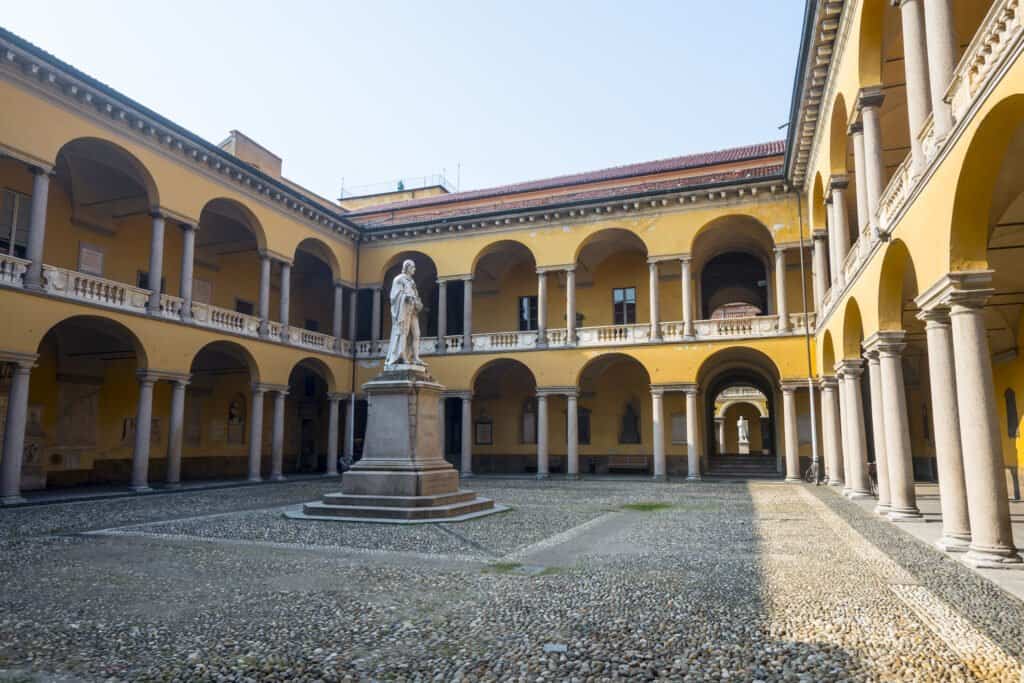
The University of Pavia
Places to eat or drink near Castello Pozzi

Pasticceria Vigoni

Pizza e Mozzarella
![[LA] Gelateria della Musica](https://lh3.googleusercontent.com/grass-cs/AABkmLezQ1aahZ3Sj4IKvguuB34dH27jVTId85hNXzYEv9WG7GfBYHmI1cwHUPQVisLeNLAKCNmd1glh0QlkPrqj2oRaVJ7D4jkdmWOq7BbYLzAtEceYr8t1MxXkfmk96U5ezHE2vYUBkvyeVynx=w576-h576)
[LA] Gelateria della Musica

Officina Milano
More places in Milan

Villa Necchi Campiglio

miscusi Milano Centrale
Reminisce The Good Ol’ Days At La Scala
