Overview
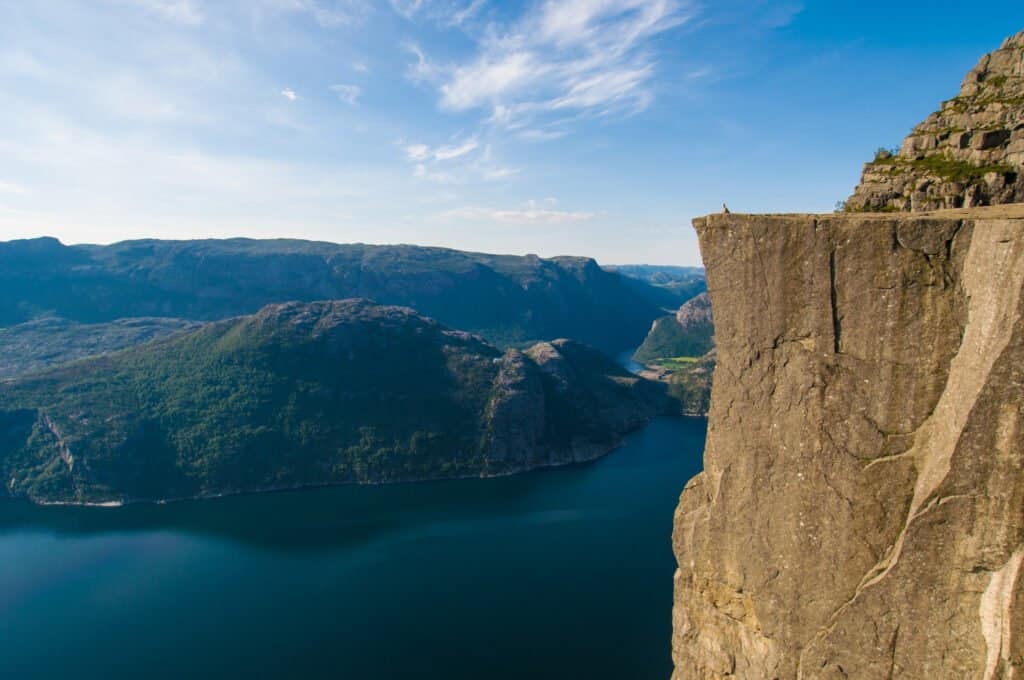
Kjerag is a mountain peak in Sandnes Municipality, Rogaland, rising 984 meters above sea level in southwestern Norway. The mountain draws thousands of visitors each year, most heading for a single destination: the Kjeragbolten, a massive boulder wedged between two cliff faces near the summit. Hikers come from across Europe to stand on this famous stone, suspended 984 meters above the Lysefjord below, for what has become one of Norway's most photographed moments.
The hike to Kjerag is not a casual walk. It takes between four and six hours round trip, involves steep terrain, chains bolted into rock faces, and a final approach across loose scree and boulders. On peak season days, hundreds of people queue for their turn on the Kjeragbolten. The mountain rewards those who make the effort with unobstructed views across the fjord and surrounding peaks, and on clear days, visibility extends for dozens of kilometers.
Why this place matters
Kjerag has become a symbol of Norway's outdoor adventure culture. The Kjeragbolten itself transformed from a local curiosity into an international landmark after BASE jumpers began leaping from it in the 1990s. That extreme association faded, but the boulder's iconic status only grew. It now ranks among the most visited natural landmarks in Norway, drawing climbers, hikers, and photographers who range from serious mountaineers to people with minimal hiking experience.
The mountain sits within the Lysefjord area, a region of dramatic geology and scenery. Kjerag's prominence comes partly from its location at the fjord's edge, creating a sense of exposure and height that feels more extreme than the actual elevation. The boulder itself is a geological accident, a chunk of stone trapped during the ice age that somehow remains balanced on this cliff face. That precarious positioning is part of what makes it so compelling to visitors.
Quick facts
- Elevation: 984 meters above sea level
- Round-trip hiking time: 4 to 6 hours depending on fitness and crowds
- Trailhead location: Øygardsvein road, approximately 30 kilometers south of Stavanger
- No entrance fee or permits required
- Best months for hiking: May through September
- Kjeragbolten width: approximately 5 meters
Getting there
The trailhead sits off Øygardsvein, a winding mountain road that climbs inland from the fjord. If you're driving from Stavanger, head south toward Sandnes, then follow signs for Lysebotn and Øygarden. The drive takes roughly 45 minutes to an hour depending on traffic and which starting point you choose. Parking is available at the main trailhead, though on weekends and during peak season, the lot fills early. If the official lot is full, overflow parking exists nearby, but expect to walk an additional 10 to 15 minutes.
Public transport to Kjerag is limited. Buses from Stavanger reach some nearby towns, but the final stretch to the trailhead typically requires a car or taxi. If you don't have your own vehicle, hiring a local guide or joining a group tour often solves the transportation puzzle.
The layout and experience
The hike begins at a marked trailhead with information boards and facilities. The first section climbs steeply through terrain that starts forested, then opens to exposed rock and alpine vegetation. Within the first hour, you gain significant elevation and the views begin to open up.
The middle section of the hike follows a ridge line with chains installed at the steepest points. These chains are not safety equipment in the traditional sense. They're anchors that help you maintain grip on near-vertical sections of rock. Using them correctly matters. On busy days, people queue at these chain sections, waiting their turn to climb. The experience can feel more like a crowded staircase than a wilderness adventure, especially on weekends.
The final approach to Kjeragbolten involves scrambling across loose scree and boulders. The boulder itself sits in a gap between two cliff faces, with the Lysefjord visible through the gap below. Standing on the Kjeragbolten means standing on a stone balanced over a vertical drop. The psychological effect is stronger than the actual danger, but it's real enough that many people feel genuine vertigo.
The experience changes dramatically depending on when you arrive. On a clear weekday morning in June, you might have the boulder to yourself for minutes at a time, with only wind and bird calls for company. On a Saturday in July, you'll wait in line, take your photo in 20 seconds, and move on. Both experiences have merit, but they're entirely different.
Main highlights
The Kjeragbolten is the obvious centerpiece, but the hike itself offers several distinct moments. The first chain section appears suddenly, and the realization that you're about to climb a near-vertical rock face tends to focus attention. The ridge walk that follows offers 360-degree views of the surrounding mountains and the fjord. On clear days, you can see across to Preikestolen, another famous Norwegian mountain peak, roughly 20 kilometers away.
The boulder itself is smaller than most people expect. It's roughly the size of a large van, wedged into a gap that narrows as you descend. The stone is relatively smooth on the top, but the edges are uneven. The most photographed angle places someone standing on the boulder with the fjord visible in the background, creating an illusion of standing on a floating stone.
The view from the summit area extends across the Lysefjord to the surrounding mountains. Depending on visibility, you can see dozens of peaks, forests, and water. The sense of scale is genuine. You're standing on a narrow ridge with vertical drops on both sides, looking out across a landscape that feels both intimate and vast.
History and background
Kjerag has been known to locals for centuries, but it remained a regional destination until the 1990s, when BASE jumpers discovered it. The cliff face and the Kjeragbolten's position made it an ideal launch point. The sport's publicity brought international attention to the mountain. That extreme association has largely faded, but Kjerag's reputation as an adventurous destination persists.
The boulder itself formed during the last ice age, when glaciers covered the region. As ice retreated, it left behind this chunk of stone, somehow wedged into the cliff face. Geologically, it's a stable formation, though it has shifted slightly over the decades. Locals have stories of the boulder moving, though verification is difficult.
The hiking infrastructure on Kjerag developed gradually. The chains were installed incrementally over time as more people attempted the climb. The marked trail and facilities at the trailhead are relatively recent additions, reflecting the mountain's transformation from a local curiosity into a major tourist attraction.
Best time to visit
The hiking season on Kjerag runs from late May through September, depending on snow conditions. Earlier in the season, snow can linger on upper sections, making the climb more technical. By June, most snow has melted and the trail is clear, though weather remains unpredictable.
July and August bring the warmest weather and the most visitors. The parking lot fills by 8 a.m. on weekends, and the trail becomes crowded. If you prefer solitude, aim for a weekday in June or September. Weather is cooler and less stable, but you'll likely have long stretches of the trail to yourself.
Avoid visiting during poor weather. The exposed sections become dangerous in high wind, and visibility drops dramatically in clouds. Even a brief rainstorm can make the rock slippery and the descent slower. Check the forecast before you go, and be prepared to turn back if conditions deteriorate.
Photography tips
The Kjeragbolten photographs best from directly in front of the gap, with the fjord visible in the background. This is the angle you see in most published images. Getting that shot requires being on the boulder itself, which means waiting your turn on busy days. Bring a tripod or phone mount if you want hands-free images, since you'll need both hands to stay balanced on the stone.
The light changes dramatically throughout the day. Early morning light from the east illuminates the boulder and the fjord behind it. Afternoon light tends to flatten the scene. If photography is a priority, plan to reach the boulder by mid-morning.
Wider landscape shots from the ridge offer different appeal. The surrounding peaks and the fjord create compelling compositions without requiring you to stand on the boulder. These shots are easier to capture and often communicate the scale and drama of the location better than close-ups.
Facilities and preparation
The trailhead has a parking area and basic facilities including a toilet. There are no shops or cafes at the mountain itself, so bring water and food. The hike is strenuous enough that you'll need energy, and dehydration at altitude feels worse than it does at sea level.
Proper footwear is essential. The rock is slippery when wet and sharp when dry. Hiking boots with good ankle support and sticky rubber soles are strongly recommended. Casual sneakers or sandals are a poor choice, despite what you might see other people wearing.
Bring layers. The weather changes rapidly, and the wind at elevation can be cold even on warm days. A waterproof jacket and an extra fleece take up minimal space and can prevent hypothermia if conditions turn bad. The sun exposure is intense, so sunscreen and a hat matter.
A headlamp or flashlight is useful if you're hiking early or late in the day. The descent is slower than the ascent, and you don't want to be navigating the steep sections in dim light.
Combining with nearby attractions
Kjerag sits within the broader Lysefjord region, which offers several other attractions worth combining into a multi-day trip. Preikestolen, the famous cliff with the flat top, lies roughly 20 kilometers away and requires a similar level of hiking effort. Some visitors combine both peaks into a two-day trip, though that requires careful planning and logistics.
The Lysefjord itself is accessible by boat from Stavanger. Cruises through the fjord offer views of the cliffs and surrounding peaks from water level, providing context for the mountains you see from above. Some boat tours include views of Kjerag and Preikestolen from the fjord.
Stavanger, the region's main city, sits about an hour's drive away and offers museums, restaurants, and accommodations. The city serves as a logical base for exploring multiple attractions in the area.
Practical tips
- Start your hike early, especially on weekends. The lot fills and the trail becomes crowded by mid-morning during peak season.
- Check weather forecasts before you go. Turn back if visibility drops or wind intensifies, even if you're close to the summit.
- Bring more water than you think you'll need. The exposed terrain offers no shade and the altitude accelerates dehydration.
- Wear hiking boots with good grip. The rock is steeper and more technical than most people expect.
- The descent is harder on your knees than the ascent. Go slowly on the way down and consider trekking poles.
- On the Kjeragbolten itself, keep your center of gravity low and move deliberately. The stone is stable, but the exposure is real.
- If you're uncomfortable with heights, the boulder's psychological challenge may exceed its physical difficulty. The ridge walk offers excellent views without requiring you to stand on the stone.
FAQ
How difficult is the hike to Kjerag? The hike is strenuous and involves scrambling over loose rock and climbing steep sections with chains. It's not a technical climb, but it requires good fitness, sure footing, and comfort with exposure. Most people in reasonable shape can complete it, but some sections demand focus and careful footwork.
Is the Kjeragbolten safe to stand on? The boulder is geologically stable and thousands of people stand on it each year without incident. That said, it's a real stone suspended over a vertical drop. Falling would be catastrophic. Use common sense, move deliberately, and don't take unnecessary risks for photos.
Can you hike to Kjerag in winter? Winter climbing is possible but significantly more technical. Snow and ice cover the terrain, the chains become slippery, and daylight hours are short. Winter ascents require mountaineering experience and proper equipment. Most casual visitors should stick to the May through September window.
How crowded is Kjerag? Peak season weekends in July and August can see hundreds of people on the mountain simultaneously. Weekdays and shoulder season months (June, September) are considerably quieter. If crowds are a concern, plan your visit accordingly.
Do I need a guide to climb Kjerag? No guide is required, but one can enhance the experience, especially if you're uncomfortable with heights or unfamiliar with mountain terrain. Guides also handle logistics like transportation from larger towns and can provide context about the geology and history of the region.
Reviews
Sign in and mark this place visited to leave a review.
No reviews yet.
Free Trip Planner
Plan your Sandnes Municipality trip with our free planner
Build a day-by-day itinerary with AI suggestions, hand-picked places, and friends. Free forever — no credit card.