
Plaza Independencia
Pl. Independencia, Montevideo, Departamento de Montevideo, UruguayPlaza Independencia: Montevideo's Civic Heart
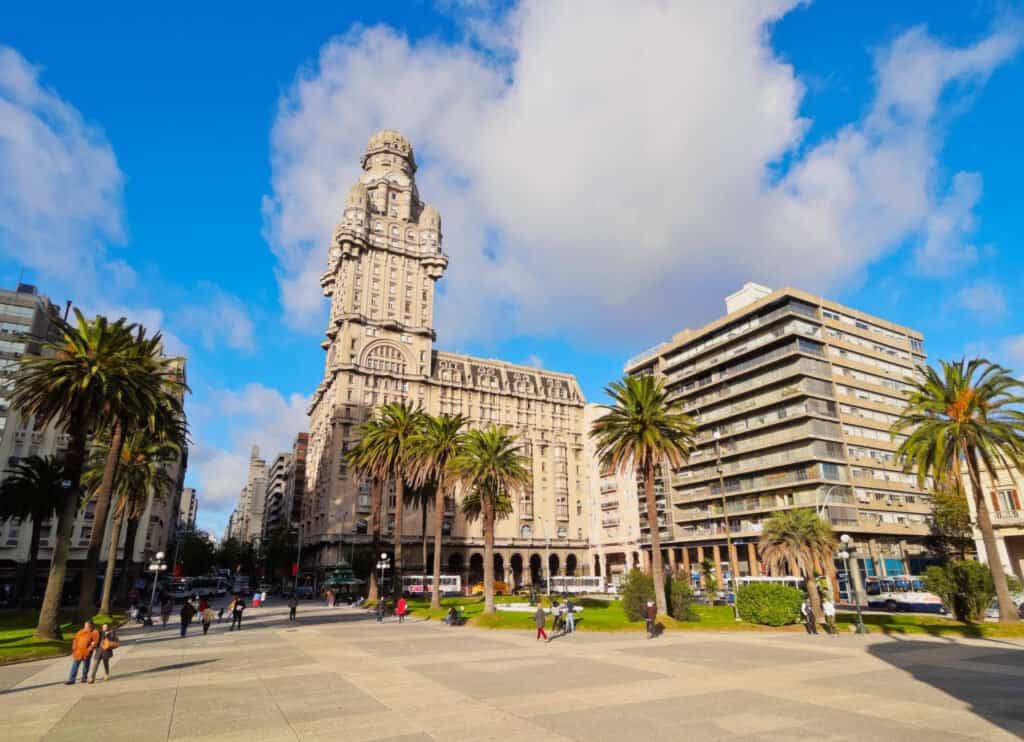
Plaza Independencia sits at the threshold between Montevideo's historic Old City and its modern downtown. This sprawling public square anchors the capital's identity, drawing locals and visitors alike to its shade, monuments, and the energy of the surrounding streets. The plaza's most recognizable feature is the Palacio Salvo, the art deco tower that rises from its eastern edge and has defined Montevideo's skyline since 1928. If you're spending time in the city center, you'll almost certainly pass through here.
Why this place matters
Plaza Independencia marks the spot where Uruguay declared independence from Brazil in 1828. The square functions as a gathering point for the city's public life, hosting celebrations, protests, and everyday foot traffic. The plaza's scale and position make it a natural orientation point. Stand in the center and you're positioned between the colonial charm of Ciudad Vieja to the west and the commercial corridors of downtown to the east.
The plaza also serves as a cultural anchor. The Teatro Solís, one of South America's most important theaters, sits just beyond the plaza's northwestern boundary. The Palacio Salvo dominates from the east. Museums and galleries cluster nearby. This convergence of civic and cultural institutions gives the plaza weight beyond its physical dimensions.
Quick facts
- Located at the intersection of Avenida 18 de Julio and Calle Sarandi in central Montevideo
- Palacio Salvo completed in 1928, standing 105 meters tall
- The equestrian statue of José Gervasio Artigas, Uruguay's national hero, anchors the plaza's center
- Free to visit and accessible year-round
- Walking distance to Ciudad Vieja, Teatro Solís, and downtown shopping
Getting there
Most visitors reach Plaza Independencia on foot. If you're staying in Ciudad Vieja, it's a 10 to 15 minute walk south and east through the old quarter's narrow streets. From downtown hotels or the shopping district, the walk is even shorter, often under 10 minutes depending on where you start.
Public buses serve the surrounding streets. Avenida 18 de Julio, which runs along the plaza's southern edge, is one of the city's main transit corridors. If you're using ride-sharing apps, you can arrive directly at the plaza or at any of the nearby streets. Parking on the plaza itself is limited, but paid lots operate in the surrounding blocks.
The layout and experience
Plaza Independencia is an open, uncluttered space. The Artigas monument occupies the center, a bronze equestrian statue beneath a portico. This is the focal point, and most visitors naturally gravitate toward it. The plaza's main seating clusters near the monument and along the western side, where shade from mature trees provides relief from the sun.
The Palacio Salvo dominates the eastern edge. Its distinctive stepped crown and art deco facade make it unmistakable. You don't enter the palace from the plaza itself, though the building's presence shapes how you experience the square. The northwestern corner opens toward Teatro Solís and Calle Sarandi, which leads into Ciudad Vieja.
The plaza's character shifts depending on time of day. Mornings tend to be quieter, with local workers cutting across and a handful of people sitting on benches. Afternoons bring more foot traffic and energy, especially near the Artigas monument. Evenings warm up further as the sun drops and the surrounding streets come alive with restaurant activity.
Main highlights
The Artigas monument is the plaza's symbolic center. José Gervasio Artigas led the independence movement and remains a towering figure in Uruguayan national identity. The statue itself is worth studying for its composition and the inscriptions on the base. Locals often use the monument as a meeting point, so you'll frequently see groups gathering here.
Palacio Salvo commands attention from almost every angle in the plaza. The building's art deco styling, completed during a boom period in Montevideo's development, represents a moment when the city saw itself as modern and forward-thinking. The stepped, pyramidal crown is visible across much of downtown. While the palace is primarily office space, its exterior is the main draw for visitors. The ground floor includes shops and cafes where you can linger while studying the building's detailing.
The plaza's position as a visual and spatial connector is itself a highlight. Standing here, you're at the boundary between two distinct Montevideo experiences. To the west lies the colonial grid and intimate scale of Ciudad Vieja. To the east sprawls modern downtown with its taller buildings and commercial density. This contrast is difficult to appreciate from any single street.
History and background
The plaza was formally established in its current form during the late 19th century, though the site held significance earlier. The focus shifted decisively after Artigas became a national symbol and a monument was planned. The current equestrian statue was completed in 1923, sculpted by José Luis Zorrilla de San Martín, a Uruguayan artist. This gave the plaza its defining centerpiece and established it as a place of civic importance.
The 1920s brought rapid development. Palacio Salvo rose between 1925 and 1928, designed by architect Mario Palanti. The building reflected Montevideo's confidence and growth during that period. It was, for a time, the tallest building in South America. This era of construction and modernization positioned Plaza Independencia as the symbolic heart of a capital city asserting its identity.
The plaza has hosted major civic gatherings throughout Uruguay's modern history. It remains a gathering point for celebrations, marches, and public announcements. This role as a stage for collective civic life continues today, giving the plaza relevance beyond its historical monuments.
Best time to visit
Plaza Independencia is open and accessible at all hours. If you prefer fewer crowds and a quieter atmosphere, early mornings from roughly 7 to 9 am tend to be peaceful. You'll see local workers and residents moving through, but the plaza doesn't feel crowded. Late afternoons, starting around 4 or 5 pm, bring more people but also better light for photography, especially as the sun angles lower toward the buildings to the west.
Weekends draw more leisure visitors, families with children, and street performers. The atmosphere is livelier but still manageable. Avoid midday in summer if you're sensitive to heat, as the plaza offers limited shade in open areas, though trees provide coverage in certain sections.
Weather matters less here than at outdoor attractions requiring extended time. Since most visitors spend 20 to 45 minutes at the plaza, a brief rain shower is unlikely to derail your visit. That said, Montevideo's summers tend to be warm and clear, while winters are mild but can be windy.
Photography tips
The Artigas monument is the most photogenic element. Shoot from the plaza's perimeter to capture the statue with trees or buildings as backdrop. Early morning light from the east casts the monument in clear relief. Late afternoon light from the west can create dramatic shadows beneath the portico.
Palacio Salvo photographs best from the plaza's center or slightly to the south. Shooting from street level emphasizes the building's height and stepped crown. The art deco detailing becomes more visible if you move closer or use a telephoto lens to isolate sections of the facade. The building's cream and terracotta colors photograph well in soft, overcast light.
Wide shots capturing both the monument and the Palacio Salvo in a single frame convey the plaza's spatial relationship to the city. The surrounding streets and buildings help establish context. If you shoot from Calle Sarandi looking east, you can frame the Artigas monument with the Palacio Salvo rising behind it.
Facilities and preparation
The plaza itself has limited facilities. There are benches throughout, and water fountains are available but not abundant. Restrooms are not directly on the plaza, though cafes and shops in the surrounding buildings offer facilities for customers. The nearby Teatro Solís and Palacio Salvo both have public restrooms accessible from their lobbies.
Shade is available but unevenly distributed. The western and northern portions of the plaza have more mature trees. The central area around the Artigas monument is more exposed. If you're visiting on a hot day, plan to spend time in the shaded areas or nearby cafes.
The plaza is fully pedestrian and flat, making it accessible for people with mobility challenges. Nearby streets have sidewalks and curb cuts, though some older sections of Ciudad Vieja have uneven pavement.
Combining with nearby attractions
Teatro Solís is directly adjacent to the plaza's northwestern corner. This grand theater hosts opera, ballet, theater, and concerts. Guided tours of the interior are available, or you can attend a performance if your timing allows. The walk from the plaza to the theater entrance takes under five minutes.
Ciudad Vieja, Montevideo's historic quarter, begins where the plaza's western side ends. The grid of colonial-era streets contains galleries, cafes, antique shops, and the Museo del Carnaval. Most visitors combine a plaza visit with a walk through the old city, which adds 60 to 90 minutes to the itinerary depending on how deeply you explore.
Avenida 18 de Julio stretches east and south from the plaza, lined with shops, restaurants, and smaller museums. The Museo de Arte Precolombino e Indígena and other galleries cluster within a 10 to 15 minute walk. The shopping district, dense with stores and cafes, extends several blocks in both directions.
The Palacio Legislativo, seat of Uruguay's parliament, is roughly 20 minutes northeast on foot through downtown. Guided tours are available by advance request. If you're interested in Uruguayan governance and architecture, this pairs logically with a plaza visit.
Sample visit plan
Allocate 30 to 45 minutes for the plaza itself if you want to study the monuments and absorb the atmosphere without rushing. Arrive early, spend 15 minutes observing and photographing the Artigas monument and Palacio Salvo. Sit on a bench for 10 minutes to watch the plaza's rhythm. Walk around the perimeter to examine the building facades and the plaza's spatial transitions. If you're interested in architecture, spend additional time examining the art deco detailing on the Palacio Salvo's ground floor.
If you're combining the plaza with other attractions, build a 2 to 3 hour loop: start at the plaza, explore Ciudad Vieja to the west for 90 minutes, then return to the plaza before heading east toward Avenida 18 de Julio for cafes or shopping. Alternatively, visit the plaza in the morning, walk to Teatro Solís for a tour if available, then continue exploring downtown.
Practical tips
- The plaza is safe and well-traveled during daylight hours. Standard urban awareness applies, as with any city center
- Cafes and small shops surround the plaza on all sides. You can buy drinks, snacks, or coffee without leaving the immediate area
- Street performers and vendors occasionally work the plaza. Approach interactions with the same caution you would in any city center
- If you need to use a restroom, the Teatro Solís building has public facilities, or duck into a nearby cafe
- The plaza can be windy, especially in winter. Bring a light layer if you plan to sit for extended time
- Mobile phone service is reliable throughout the area. Google Maps works well for navigation to and from the plaza
FAQ
Is Plaza Independencia free to visit? Yes. The plaza is open public space with no entry fee. You can visit at any time of day or night.
How long does a typical visit take? Most people spend 20 to 45 minutes. If you linger on a bench or take time to photograph, you might spend an hour. Combining it with nearby attractions extends the time considerably.
Can I enter Palacio Salvo? The building is primarily office and retail space. You can walk through the ground floor arcade and shop, but the upper floors are not open to general public visits. The building's exterior is the main draw.
Is the plaza crowded? It depends on the time of day and day of the week. Early mornings are quieter. Afternoons and weekends see more foot traffic. It's rarely so crowded that you can't move around comfortably.
What's the best direction to approach the plaza from? From Ciudad Vieja, approach from the west via Calle Sarandi or Calle Rincón. This gives you a frontal view of the Artigas monument as you enter the open space. From downtown, approach from the east along Avenida 18 de Julio for a view of Palacio Salvo as you walk toward the plaza.
Reviews
Sign in and mark this place visited to leave a review.
No reviews yet.
Free Trip Planner
Plan your Montevideo trip with our free planner
Build a day-by-day itinerary with AI suggestions, hand-picked places, and friends. Free forever — no credit card.
Things to see near Plaza Independencia

Punta Carretas Lighthouse

Parque Rodó

De los Pocitos Beach

Escollera Sarandí
More places in Montevideo
Ciudad Vieja Montevideo

Museo de la Memoria

Museo Histórico Cabildo de Montevideo
