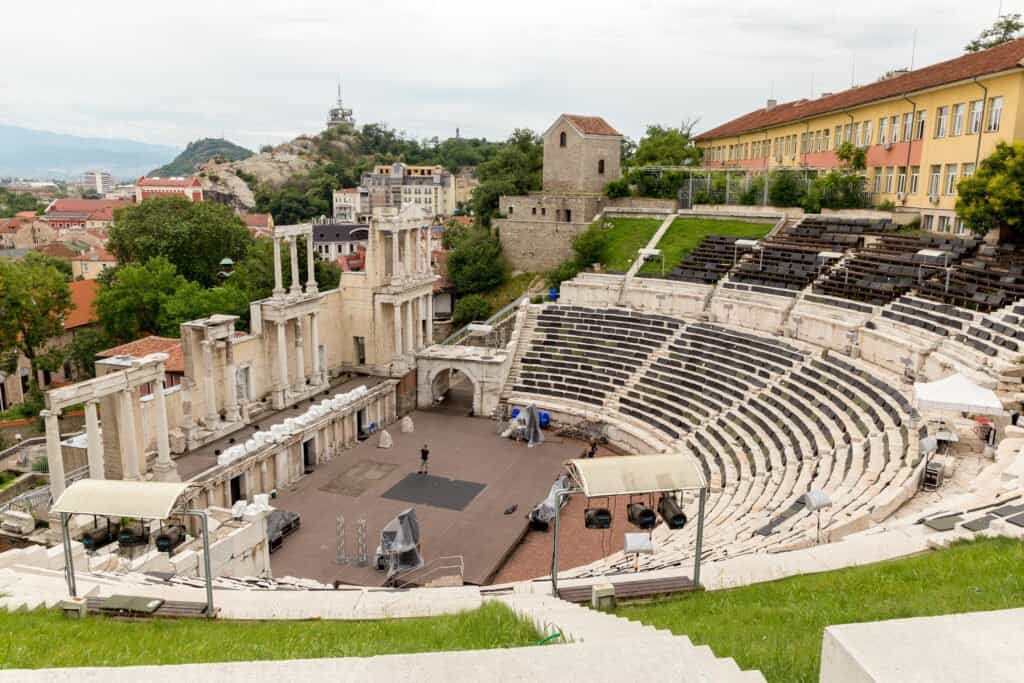
Plovdiv Old Town
Plovdiv 4000 Bulgaria Posted by Brandon B.Admin
Overview
Plovdiv Old Town sits on three hills in the heart of Bulgaria's second-largest city, a neighborhood where Roman ruins, Ottoman architecture, and Bulgarian Renaissance mansions coexist within a few hundred meters of each other. The oldest continuously inhabited European city, Plovdiv has been fought over and rebuilt by Greeks, Romans, Ottomans, and Bulgarians, and that layered history is most visible here. Walking through the narrow cobbled streets of the Old Town, you'll pass frescoed 19th-century townhouses, archaeological sites, and small museums tucked into former homes, all within what feels like a single, coherent neighborhood despite spanning nearly 5,000 years of occupation.
Why this place matters
Plovdiv Old Town is one of the few places in Europe where you can see a living settlement that has been continuously inhabited since ancient times. The city was founded around 1200 BCE and later became a major Roman provincial capital called Philippopolis. This unbroken continuity means the layers aren't hidden in a single excavation site but spread across the neighborhood where people still live and work.
The neighborhood also represents a specific moment in Bulgarian history. Many of the grand houses were built during the Bulgarian National Revival of the 1800s, a period when the region was still under Ottoman rule but Bulgarian merchants and craftspeople began reasserting cultural identity through architecture and decoration. Those houses, with their distinctive style and painted interiors, are the visual heart of what tourists come to see today.
Quick facts
- Located in central Plovdiv, Bulgaria's second-largest city
- Sits on three hills in the Old Town neighborhood
- Continuously inhabited for approximately 5,000 years
- Most famous buildings date from the 1800s Bulgarian National Revival period
- Several house museums and archaeological sites are open to visitors
- Walking the main streets takes 45 minutes to an hour
- Free to wander the neighborhood; individual museums charge separate entry
Getting there
The Old Town is best reached on foot from central Plovdiv. If you're arriving by bus or train, the city center is about 15 to 20 minutes' walk. Most visitors come up from the lower town near the main square, climbing toward the highest point where the Nebet Tepe fortress ruins stand. The streets are steep and uneven, so wear comfortable walking shoes with good grip.
There are multiple entry points depending where you start. The easiest approach for most visitors is to begin from the main pedestrian area near Dzhumaya Mosque and walk uphill into the neighborhood. You can also enter from the eastern side near the Roman Stadium if you're coming from that direction.
The layout and experience
The Old Town spreads across the three hills, but it's small enough that you won't get seriously lost. The main streets are well-trodden and lead naturally upward. Most of the significant buildings cluster on the middle hill, where you'll find the densest concentration of National Revival houses and the biggest museums.
Walking here feels different from other European old towns. It's not a museum piece frozen in time. People live in these houses. Laundry hangs between windows. Cats nap on doorsteps. Cafes occupy ground floors. This living quality means the neighborhood has an everyday rhythm rather than a tourist-trap feeling, though you'll definitely see other visitors, especially in summer afternoons.
The streets themselves are narrow, often just wide enough for two people to pass. Paving is uneven in places, with some sections of original stone and others patched with modern asphalt. In summer, the shade from overhanging buildings keeps things relatively cool. There are few benches and little signage, so it pays to move slowly and look up at the buildings themselves.
Main highlights
The Hindlian House is one of the most impressive buildings, a three-story mansion with ornate painted ceilings and detailed woodwork. It's now a museum, and the interior decoration gives a vivid sense of how wealthy merchants lived during the National Revival period. The craftsmanship is extraordinary, from the inlaid wooden ceilings to the painted walls.
Nebet Tepe fortress sits at the highest point and offers views across the city and toward the surrounding plains. The ruins themselves are modest, but the vantage point is excellent, and on clear days you can see far beyond the immediate neighborhood. This was the original fortified settlement, occupied since around 1200 BCE.
The Roman Stadium, partially built into the hillside, emerges from the lower part of the Old Town. Much of it remains buried or built over, but you can see the exposed sections and get a sense of the structure's scale. It dates from the 2nd century CE, when Philippopolis was a significant Roman city.
Several smaller house museums operate in former family homes, each focusing on a particular aspect of life during the National Revival or Ottoman period. These tend to be intimate spaces with 4 to 6 rooms rather than large institutional museums. The Lamartine House, where the French poet stayed briefly in the 1830s, is one such example.
The Dzhumaya Mosque sits just outside the Old Town proper but marks a clear boundary and is architecturally significant. Its minaret is visible from many points within the neighborhood and serves as a useful landmark for orientation.
History and background
Plovdiv's history stretches back to the Bronze Age. The three hills were originally separate settlements, later unified under the Romans, who called the city Philippopolis and made it a major provincial hub. You can still see Roman architectural fragments and inscriptions scattered through the neighborhood, though the most substantial remains are the Stadium and some wall sections.
After the Roman period came Byzantine rule, then Ottoman occupation for nearly 500 years. During the Ottoman era, the city remained prosperous as a trade center, but the Bulgarian population lost political power. The late 1700s and 1800s saw a cultural and economic revival among the Bulgarian merchant class. These wealthy traders built the grand houses that define the Old Town visually today, using Ottoman architectural forms but increasingly incorporating European styles and decoration.
Bulgaria gained independence from Ottoman rule in 1878. The National Revival houses built in the decades before and after this date reflect a moment when Bulgarian identity was reasserting itself architecturally and culturally. The ornate painted interiors, the use of local materials and craftspeople, and the deliberate choice of certain decorative styles all expressed this cultural reclamation.
In the 20th century, much of the Old Town deteriorated as wealthier residents moved to newer neighborhoods. From the 1980s onward, restoration projects began, funded partly by the Bulgarian government and partly by UNESCO recognition of the site. Today, restoration remains ongoing, with some buildings beautifully maintained and others still showing their age.
Tickets and entry
Wandering the streets of the Old Town itself is completely free. There's no gate, no entrance fee, no restriction on movement. However, individual museums and house museums charge separate admission. Most are in the budget to mid-range category. A few museums offer combined tickets if you plan to visit multiple sites.
Hours vary by museum, but most open around 9 or 10 in the morning and close by 5 or 6 in the afternoon. Some close on Mondays or Tuesdays. If you're interested in seeing the interior of specific houses, check opening hours in advance, as staffing can be inconsistent, particularly outside summer months.
The Nebet Tepe fortress ruins are also free to access, though there's no formal entrance or visitor facilities.
Best time to visit
Spring and early fall offer the most comfortable conditions for walking these steep streets. Temperatures are moderate, and the neighborhood isn't overwhelmed with tour groups. May through early June and September through October tend to be ideal.
Summer, particularly July and August, brings heat and crowds. The narrow streets can feel congested in midday, and the uphill walks are more strenuous in high temperatures. Morning visits in summer work better than afternoon ones.
Winter is quieter, with fewer tourists, but some museum hours reduce and occasional rain makes the cobbled streets slippery. The light at this time of year is beautiful for photography, though it gets dark early.
Avoid weekends if you prefer a quieter experience, as local families often visit the Old Town for weekend outings. Weekday mornings tend to be the most peaceful.
Photography tips
The narrow streets and overhanging buildings create dramatic shadows and interesting compositional challenges. Early morning light from the east or late afternoon light from the west tends to be most flattering for the building facades. Midday sun creates harsh shadows that flatten the details.
Details matter here. Close-ups of painted window frames, carved wooden doors, and decorative plasterwork often make more compelling images than wide shots of whole buildings. The texture of the stonework and the weathering on painted walls tell stories.
From the top of Nebet Tepe, you can shoot back down into the neighborhood with the city beyond, giving context to where you've been walking. This vantage point works well in late afternoon when the sun is lower.
Street-level shots of people sitting in doorways or cafes, laundry hanging between buildings, cats on steps—these documentary details capture the lived-in quality of the neighborhood more effectively than postcard views.
Facilities and preparation
The Old Town has limited formal facilities. There are a few cafes and small restaurants, but they're scattered rather than concentrated. You won't find a visitor center with bathrooms and information desks. If you need a restroom, a cafe is your best option, and you're expected to buy something. Bring water, particularly in warmer months.
The streets are steep and uneven. If you have mobility issues or difficulty with stairs, you'll find parts of the neighborhood challenging. The best sections for accessible walking are the lower streets near the Dzhumaya Mosque and the Roman Stadium. The upper parts require more climbing.
There's very little shade while walking, so sunscreen and a hat are advisable. The cobbled streets can be slippery when wet, so appropriate footwear is important year-round.
Most museums don't have gift shops or coat check services. Bags should be small enough to carry easily as you walk.
How it compares to similar places
Old towns are common across Europe, but most are either preserved as museums or heavily commercialized. Plovdiv Old Town occupies an unusual middle ground. It's not a theme park version of history, but it's not entirely a working neighborhood either. It's somewhere between, which is part of its appeal and also its challenge. You're navigating real streets with real residents while also encountering tourist infrastructure.
Compared to the old towns of Safranbolu in Turkey or Hallstatt in Austria, Plovdiv Old Town feels less polished and less crowded. Compared to residential historic neighborhoods in other Bulgarian cities like Koprivshtitsa, it's more substantial in size and more architecturally diverse because of the Roman and Ottoman layers.
Combining with nearby attractions
The Roman Stadium merges into the lower edge of the Old Town, so you can see it while exploring. The Dzhumaya Mosque is an easy walk. The Ancient Theatre, a restored Roman amphitheater, is about 10 minutes' walk away and hosts performances in summer. The Ethnographic Museum is also nearby in the lower town.
If you have a full day, you could combine the Old Town with the Bachkovo Monastery, which is about 25 kilometers away and is one of Bulgaria's most important Orthodox religious sites. This makes sense as a morning or afternoon excursion from Plovdiv.
The modern city center, with shops and restaurants, is directly below the Old Town, so you can easily transition between historic exploration and contemporary amenities.
Sample visit plan
A focused visit to the Old Town takes 2 to 3 hours if you're just walking and observing buildings. Add another 1 to 2 hours if you want to enter one or two house museums. A full day would allow you to explore thoroughly, visit multiple museums, sit in cafes, and experience the neighborhood without rushing.
Start in the morning from the lower town, walking up toward Nebet Tepe. Visit any museums you've chosen along the way, taking time to look at building details. Reach the top by midday for the view and a rest. Descend via a different route to see different streets. End with a late lunch or early dinner in one of the cafes.
If you're short on time, prioritize the walk itself and one major museum like the Hindlian House. The experience of moving through the neighborhood is more valuable than checking boxes.
Practical tips
- Bring a printed map or screenshot of the area since phone reception can be spotty in narrow streets
- Wear shoes with good grip, as cobbles are uneven and can be slippery
- Visit museums in the morning when staff is most likely to be present
- Bring water and snacks since food options are limited
- Ask residents for directions if you're unsure, most are friendly and speak some English
- Respect that people live here; don't photograph people or into private windows without permission
- Budget for museum entry fees separately from your meal costs
- If you're sensitive to uneven surfaces or steep hills, take the visit slowly and rest frequently
FAQ
How long should I spend in Plovdiv Old Town? Two to three hours is enough to walk the main streets and absorb the atmosphere. Add time if you want to visit house museums or eat. A full day allows for a more leisurely experience without feeling rushed.
Is it safe to walk around at night? Yes, the neighborhood is generally safe, and locals do walk here in the evenings. However, it's quite dark once the sun sets, and the uneven streets are harder to navigate. An evening visit works better if you go early in the evening rather than late.
Do I need a guide? Not essential. The neighborhood is small enough to explore independently, and a self-guided walk allows you to move at your own pace. Guided tours are available if you prefer context and historical details provided by someone knowledgeable.
Can I eat in the Old Town? Yes, there are cafes and a few restaurants, but options are limited compared to the lower town. Expect simple Bulgarian food at mid-range prices. Many visitors eat elsewhere and use Old Town cafes mainly for coffee or drinks.
Which museum should I prioritize if I only have time for one? The Hindlian House gives the best sense of how wealthy families lived during the National Revival period. The painted ceilings and interior decoration are impressive and memorable.
Reviews
Sign in and mark this place visited to leave a review.
No reviews yet.
Free Trip Planner
Plan your Bulgaria trip with our free planner
Build a day-by-day itinerary with AI suggestions, hand-picked places, and friends. Free forever — no credit card.
Related reading
Things to see near Plovdiv Old Town

Museum of the Rhodope Karst

The Bachkovo Monastery, Asenova krepost fortress, Museum of History

Peristera Fortress