Stand On The Prime Meridian
Open now
Stand On The Prime Meridian
Royal Observatory, Blackheath Ave, London, England SE10 8XJ, United Kingdom Posted by Brandon B.Admin
Stand On The Prime Meridian At The Royal Observatory
Standing with one foot in the Eastern Hemisphere and one in the Western is a surreal moment. The Royal Observatory in Greenwich, London sits on the Prime Meridian, the imaginary line that divides the world into east and west. This is where you can straddle that invisible boundary and understand how humans decided to measure the globe. The experience is free if you're content to simply stand on the line outside the building, or you can pay for general admission to explore the full observatory grounds and museums.
Why This Place Matters
The Prime Meridian was established at the Royal Observatory during the International Meridian Conference of 1884. Before that, every country used its own meridian for navigation and timekeeping. Ships relied on complex calculations and guesswork. Establishing a single global standard at 0 degrees longitude made it possible to create accurate maps and coordinate trade across oceans. Today, the meridian remains the international reference point for measuring time zones and geographic coordinates. Every GPS coordinate on Earth is calculated relative to this spot.
The observatory itself has stood on Blackheath since 1675, when King Charles II founded it. That's nearly 350 years of continuous operation as one of the world's oldest scientific institutions.
Quick Facts
- Location: Royal Observatory, Greenwich, London SE10 8XJ
- Founded: 1675
- Prime Meridian established: 1884
- Free to stand on the meridian line outside; museum entry requires a ticket
- Open most days from 10 am to 5 pm (hours may vary seasonally)
- Greenwich is about 8 miles southeast of central London
Getting There
The easiest approach is the Docklands Light Railway. Take the DLR to Cutty Sark station. It's a 5-minute walk uphill from there to the observatory entrance. The DLR is fast and frequent from Bank or Tower Gateway stations in central London.
If you prefer the Underground, the Jubilee Line stops at North Greenwich, but it's a longer walk across the Millennium Dome area. Most visitors find the DLR faster.
Buses also serve the area. Routes 129, 177, and 188 stop near the observatory gates on Blackheath Avenue. Walking up Blackheath Avenue from the DLR or bus stop is straightforward and takes about 5 to 10 minutes depending on fitness and traffic.
Parking is available but limited. If you drive, the Royal Observatory car park fills quickly on weekends and school holidays. Parking in nearby Blackheath village costs money and often requires walking further than public transport would.
The Layout And Experience
The Prime Meridian line runs north to south through the grounds. The famous brass line inlaid into the courtyard is the most photographed spot. You'll find it immediately as you enter the main courtyard area. The line is a recent addition, installed in 1884 after the meridian was officially adopted. Before that, the meridian was marked by a telescope, not a physical line.
To the west of the meridian line stands the main observatory building, a red-brick structure with a distinctive copper dome. To the east lies the newer Meridian Building, which houses most of the museum exhibits. Both are accessible with museum admission.
The grounds also include Flamsteed House, the original residence of the Astronomer Royal, and a planetarium in the basement. A narrow garden descends toward the Thames on the southern edge of the site. The entire complex occupies about 184 acres on Blackheath, though the main visitor area is much more compact.
Main Highlights
The brass meridian line itself is the primary draw for most visitors. Straddling it and taking a photo is quick and free. The line is about 3 meters long and crosses through the main courtyard near the information center.
Inside the Meridian Building, the Time Galleries explore how humans have measured and kept time since ancient civilizations. The chronometer collection is particularly strong. You'll see the marine chronometers that solved the longitude problem at sea, allowing ships to calculate their position accurately for the first time. These instruments are extraordinary examples of precision engineering from the 17th and 18th centuries.
The Astronomy Galleries cover the history of the observatory's research and its role in mapping the stars. Historic telescopes are on display. On clear nights, the observatory hosts evening telescope viewing sessions if you book in advance, though these require a separate ticket and are weather dependent.
Flamsteed House offers a glimpse into how the Astronomer Royal actually lived. The rooms are arranged to show daily life in the 17th century, with original furnishings and artifacts. The Great Room, where observations were recorded, is the highlight.
The Peter Harrison Planetarium beneath the main building runs shows throughout the day. These are immersive and popular with children, though they fill up on rainy days and school holidays.
History And Background
King Charles II commissioned the observatory in 1675 to solve a pressing problem: British ships were losing money and lives because navigators couldn't determine their longitude accurately. The king appointed John Flamsteed as the first Astronomer Royal and tasked him with creating an accurate star catalog that would serve as a reference for navigation.
For over 200 years, the observatory remained the world's premier center for astronomical observation and timekeeping. As telescopes improved and the building's location on Blackheath grew less ideal due to London's expansion and light pollution, the observatory's focus shifted more toward maintaining the Prime Meridian and Greenwich Mean Time.
In 1948, the operational work moved to Herstmonceux in Sussex. The Greenwich site became a museum, preserving the instruments and records of centuries of observation. The Prime Meridian itself remained the international standard and remains so today, even though the International Date Line runs through the Pacific Ocean on the opposite side of the globe.
Tickets And Entry
Standing on the Prime Meridian line in the courtyard is completely free. You can do this without buying a ticket. The brass line is visible from the street entrance, and you can access it during normal opening hours without paying anything.
Museum admission includes access to Flamsteed House, the Meridian Building galleries, and the Peter Harrison Planetarium. Tickets are sold as general admission passes. Children under 16 usually receive discounted rates. Annual memberships are available if you plan multiple visits.
Timed entry may be enforced during peak times like summer holidays and weekends. Booking online in advance is advisable, especially if you want to guarantee planetarium show times.
Evening telescope viewing sessions (weather permitting) require a separate booking and ticket. These are offered on select evenings and tend to book up quickly.
Best Time To Visit
The prime meridian line is accessible year-round during opening hours. The grounds are pleasant in spring when the gardens are in bloom, though the courtyard itself is fairly barren.
Summer brings school holidays and peak tourist season. The site gets crowded, especially between 11 am and 3 pm. If you want a less chaotic experience, arrive early in the morning or visit on a weekday outside of school holidays.
Autumn and winter are quieter. The weather is colder and grayer, which doesn't enhance the experience outdoors, but crowds are manageable. Winter evenings are sometimes clear enough for telescope viewing sessions if you're interested in that.
Rain doesn't affect standing on the meridian line itself, but it will deter you from lingering in the courtyard for photos. The museum galleries inside remain pleasant regardless of weather.
Photography Tips
The brass meridian line photographs best in overcast daylight. Direct sunlight creates harsh shadows and glare off the metal. Shoot from above for the clearest view of the line itself, or from ground level to capture someone straddling it.
The red-brick observatory building with its copper dome makes a good backdrop if you step back from the immediate meridian area. The Thames and North London skyline are visible from the southern edge of the grounds on clear days.
The courtyard can be crowded. If you want an unobstructed shot of the meridian line, arrive right at opening time or visit on a rainy weekday morning. Weekend afternoons in summer are nearly impossible for an empty shot.
Inside Flamsteed House, the Great Room has dramatic north-facing windows that create interesting light. Photography policies may restrict tripods or professional equipment, so check with staff before setting up.
Facilities And Preparation
The visitor center near the main entrance has a cafe with light refreshments, a gift shop, and clean restrooms. The cafe is small and tends to get crowded during peak hours. Bringing your own water and snacks is practical if you plan to spend more than an hour on site.
The grounds involve walking uphill from the entrance. The path to the meridian line itself is flat and paved, but reaching the southern edge of the grounds requires climbing. Wear comfortable walking shoes. The site is largely wheelchair accessible on paved paths, though some areas of the gardens are uneven.
The observation decks and some interior rooms have stairs with no elevator access. If you have limited mobility, mention this when buying tickets so staff can direct you to the most accessible route through the galleries.
The site is exposed to wind coming across Blackheath. Bring a windproof jacket even if the forecast looks mild. Summer sun exposure is significant in the courtyard, so sunscreen and a hat are sensible.
Combining With Nearby Attractions
The Cutty Sark, a 19th-century tea clipper ship, is a 5-minute walk downhill from the observatory. It's a quick addition if you have time. The ship's interior is preserved as a museum, and the exterior alone is striking if you're short on time.
Greenwich Market is also a short walk away. It's a covered market with independent stalls selling antiques, crafts, and food. It's busy on weekends and quieter on weekday mornings. The market gives you a sense of Greenwich as a living neighborhood, not just a tourist destination.
The Thames Path runs along the riverfront nearby. A walk along the path toward Deptford or toward the Millennium Dome offers views of the river and the city beyond. The walk is flat and straightforward.
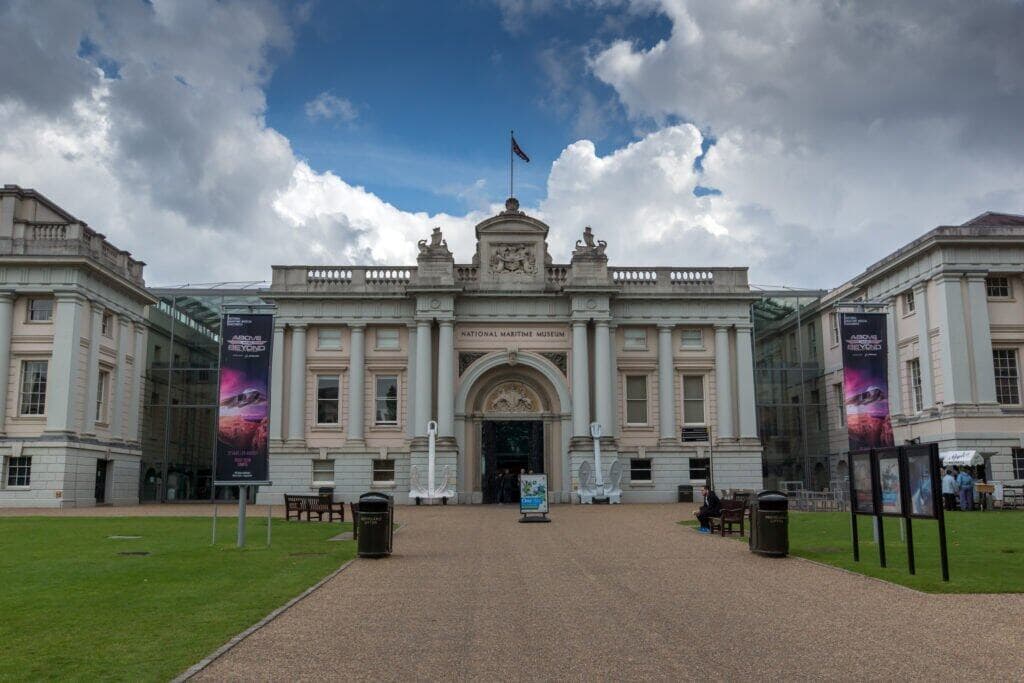
The National Maritime Museum is adjacent to the observatory grounds and shares some of the same ticket infrastructure. You can visit both in a single day if you start early.
Sample Visit Plan
If you have 1 to 2 hours and just want the Prime Meridian experience, arrive at opening time, walk straight to the meridian line, take your photos, and leave. No ticket required. The whole thing takes 20 to 30 minutes if you're efficient.
For a half-day visit with museum entry, arrive mid-morning. Stand on the meridian line first. Then buy a ticket and spend 1 to 2 hours in Flamsteed House and the Time Galleries. Skip the planetarium unless you're traveling with children. Grab lunch at the cafe or in Greenwich Market on your way out.
A full-day visit includes all museum galleries, a planetarium show, lunch, and a walk through Greenwich village or along the Thames Path. The Cutty Sark can be added if you're interested in maritime history. Start early to maximize daylight and avoid afternoon crowds.
Practical Tips
- Arrive right at opening time if you want an unobstructed photo of the meridian line
- Book museum tickets online in advance, especially on weekends and during school holidays
- The DLR from Bank or Tower Gateway is faster than the Underground or bus for most central London locations
- Wear layers and bring a windproof jacket even in mild weather
- The cafe is small; bring snacks if you plan a long visit
- Evening telescope viewing sessions are weather dependent and book up weeks in advance
- The grounds are steep in places; wear comfortable shoes with good grip
- Most of the prime meridian line experience is outdoors, so check the weather forecast
FAQ
Can I stand on the Prime Meridian for free? Yes. The brass meridian line runs through the public courtyard, and you can access it during opening hours without paying for museum admission. Standing on the line and taking a photo costs nothing.
How long does it take to stand on the meridian line? The actual experience of standing on it and taking a photo takes 10 to 20 minutes. Most visitors spend longer exploring the grounds or museum, but the meridian line itself is quick.
Is the Royal Observatory open every day? The site is usually open daily, though hours vary seasonally. Check the official website for current opening times before visiting, as hours can change for special events or maintenance.
What's the difference between the Prime Meridian and the International Date Line? The Prime Meridian (0 degrees longitude) runs through Greenwich and divides east from west. The International Date Line is roughly 180 degrees opposite and runs through the Pacific Ocean, marking where the date changes as you travel around the world.
Can I see the original meridian marker? The brass line you see today was installed in 1884. Before that, the meridian was marked by a telescope inside the building. The historic instruments are displayed in the museum galleries, so you can see what the old markers looked like.
Opening hours
Reviews
Sign in and mark this place visited to leave a review.
No reviews yet.
Free Trip Planner
Plan your England trip with our free planner
Build a day-by-day itinerary with AI suggestions, hand-picked places, and friends. Free forever — no credit card.