
Settling Into Bellevue and Kirkland: What Corporate Relocations Teach About Furniture Care
By

There's a category of traveler that Bellevue, Washington knows well: the corporate relocatee. Tech industry moves from the Bay Area, international assignments to Microsoft's campus in Redmond, Amazon teams shifting between coastal offices — the greater Eastside has been absorbing these arrivals for years, and they bring a particular relationship with temporary and transitional living spaces. Furnished apartments in Bellevue's downtown corridor, extended-stay suites near the tech campuses, corporate housing in the Spring District near the new light rail — these spaces turn over constantly, and the people passing through them become accidental experts in something most permanent residents never think about: the actual condition of the furniture they're living with.
What the relocating class figures out quickly, and what longer-term residents tend not to notice precisely because familiarity filters perception, is that upholstered furniture in the Pacific Northwest accumulates differently than furniture in drier climates. The Eastside's ambient humidity — milder than Seattle proper but still meaningfully wet from October through April — keeps fabric fibers in a sustained moisture state that makes them effective collectors of whatever the surrounding environment produces. Dust, dander, particulates from the rain-washed exterior air, the biological residue of daily domestic use. Furniture that looks clean almost always holds more than it appears to, and the person settling into a space after a long flight from Chicago or Singapore notices this in a way the person who's been living with it for two years doesn't.

What Bellevue's Rental Market Has Created
The demand for professionally managed temporary housing on the Eastside has produced a tier of furnished rental properties — particularly in downtown Bellevue, the Spring District, and the Bel-Red corridor — that compete directly on the quality of their interiors. Property managers who supply these units to corporate clients have learned, through enough negative feedback from tenants, that the furniture condition is one of the primary variables determining whether a placement extends or whether the tenant moves to a hotel instead. The sofa isn't decoration in this context — it's infrastructure, and it gets evaluated accordingly by people who arrive with fresh eyes and no loyalty to the space.
Professional furniture cleaning Bellevue WA services have built a specific workflow around this market segment: rapid-turnaround cleaning between tenant transitions, fabric protection treatments that extend the window between cleanings, and documentation of furniture condition for property managers who track depreciation across their portfolios. It's a different relationship with upholstery care than the residential homeowner model — more systematic, more frequent, and more technically informed. The practical effect is that the quality of furniture cleaning services on the Eastside is noticeably higher than in markets where demand is purely residential, because the clients who drive the standard are corporate accounts that know exactly what they need and hold providers to it.
What a Professional Inspection Actually Finds
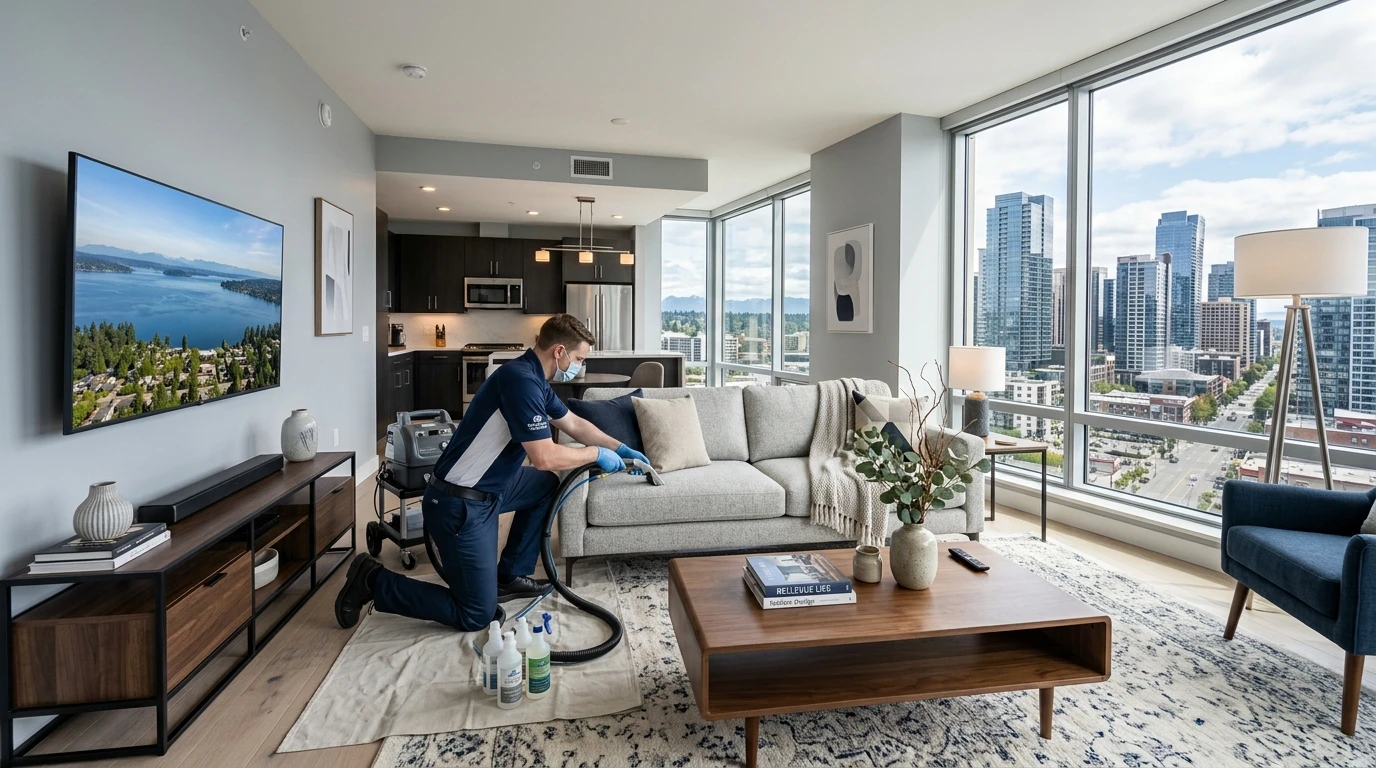
One of the things that surprises corporate tenants who watch a professional cleaning happen in their temporary Bellevue apartment is the pre-cleaning assessment. Before any solution is applied, a trained technician examines every piece of furniture: identifies the fabric type, locates the care code tag, checks for pre-existing damage, and documents stains for targeted treatment. For tenants who've only ever seen consumer cleaning products applied without any of this preparation, the precision is unexpected.
The assessment reveals things that aren't visible to the occupant. Fabric that looks uniform often has areas of concentrated soil — armrests and seat cushions where body oils have penetrated the fiber over multiple occupancies, creating a baseline that regular vacuuming doesn't address. The foam substrate beneath the upholstery fabric absorbs moisture over time, from spills that were wiped but not extracted, from humidity, from the cleaning sprays used between tenants. When this layer isn't periodically flushed through hot water extraction, the furniture begins to hold odors that new occupants notice immediately — the faint ambient staleness that no surface treatment resolves because the source is inside the cushion, not on the fabric surface.
The Maintenance Cycle Property Managers Use — and Why It Works
Bellevue property managers who've managed furnished corporate housing for more than a few years converge on roughly the same maintenance schedule for upholstered furniture: professional cleaning after every two to three tenant transitions, or every three to four months for high-turnover units. This is more frequent than the standard residential recommendation of once per year, but it reflects the actual accumulation rate of furniture used by different people in rapid succession rather than the same household over a slower period.
The economic logic is straightforward. A quality fabric sectional in a Bellevue corporate unit costs $1,800 to $3,500 to replace. Professional cleaning costs $200 to $300 per visit. Furniture maintained on a three-month cycle and treated with fabric protector after each cleaning typically lasts twice as long as furniture cleaned reactively — meaning the maintenance cost pays for itself in replacement deferral before any tenant retention benefit is counted. Property managers who've run this calculation don't think of furniture cleaning as a cleaning expense. They classify it as an asset management expense, which is a different budget conversation entirely.
What Long-Term Bellevue Residents Learn from This
The practical insight from the corporate housing world has a direct application for people who've owned or rented Bellevue homes for years. The accumulated condition of upholstered furniture is genuinely invisible to the people who live with it every day. The adjustment period when you move into a space and notice everything eventually gives way to the normalized baseline where you stop noticing. The furniture that a property manager would flag for cleaning before a new tenant arrival, the long-term resident perceives as normal — until a guest sits down and mentions it, or until the household moves out and sees what the furniture actually looks like in the inspection photos.
The response isn't complicated. Scheduling professional cleaning on a calendar basis — rather than waiting for a visible trigger — is what produces furniture that stays in genuinely good condition rather than furniture that cycles between neglected and cleaned. In Bellevue's climate, once per year is the floor for households without pets. Twice per year for households with pets or young children. The first appointment after a long reactive-only period will produce the most dramatic result; each subsequent visit is maintaining a better baseline rather than recovering from a worse one. Finding a reliable couch cleaning service and putting it on a recurring schedule is the change — everything else follows from that.