
Spain Yacht Charter, Hidden Coves, and 4 More Ways to Sail the Med
By
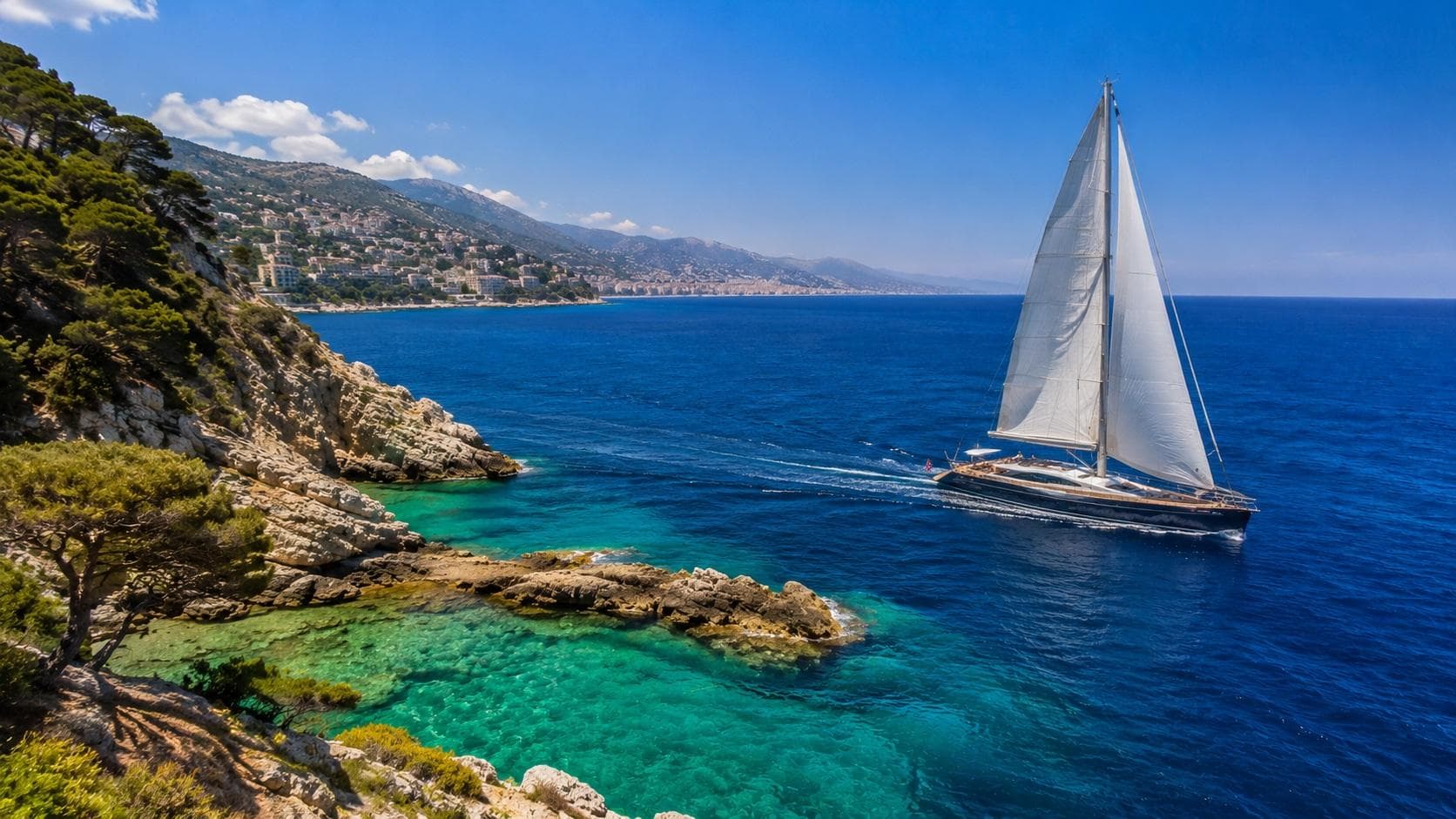
Spain sits at the crossroads of two sea personalities. To the east and south, the Mediterranean offers calm water, consistent summer thermals, and a coastline that alternates between limestone cliffs and protected calas barely visible from the road. To the west, past the Strait of Gibraltar, the Atlantic pushes back with cooler water, stronger swells, and beaches wide enough to absorb August without feeling crowded. Between these two coasts, and across the Balearic archipelago a hundred kilometres offshore, Spain assembles one of the most varied sailing environments in southern Europe. What follows is a breakdown of how to use it.
Spain Yacht Charter: Bases, Routes, and Wind Windows
The charter infrastructure in Spain concentrates in three distinct zones, each suited to a different sailing style and itinerary length.
The Balearic Islands form the most developed charter market in the country. Palma de Mallorca is the central hub: marinas at Club de Mar and Real Club Náutico de Palma handle significant bareboat traffic throughout the summer. Standard week-long circuits from Palma run north along the dramatic cliffs of the northwest coast — the Serra de Tramuntana descends almost vertically to the water here and loop back through the sheltered anchorages on the island's east and south sides: Cala Figuera, Cala Santanyí, and the broad bay at Portocolom. Menorca is a viable two-week extension; its southern coast, sheltered from the dominant northerlies, holds some of the clearest anchoring water in the western Mediterranean.
The mainland coast offers a different character. Barcelona and Empuriabrava on the Costa Brava are natural starting points for sailing north into the Gulf of Roses or south toward the Delta de l'Ebre estuary. The prevailing summer wind here is the tramontana — a sharp northerly that builds quickly in the morning and can hold boats in harbour for a day. The afternoon garbí, a south-westerly sea breeze, fills the gap when the tramontana is absent. Further south, Dénia and Alicante on the Costa Blanca offer gentler conditions in midsummer: lighter winds, day-sail distances between town harbours, and a long string of protected bays below the Serra Gelada headland.
In Andalusia, Marbella and Málaga serve as bases for coastal passages toward the Strait. Westward routing from here brings tidal considerations into play and rewards careful planning; the Levante — an easterly that funnels through the Strait — can develop fast and run against the current, producing short uncomfortable seas in the narrows.
For current fleet availability across these regions, yacht charter in Spain gives a working overview of models, bases, and pricing by week.
The French Riviera: Sailing from Nice to the Îles d'Hyères
Across the border and an easy delivery passage away, the French Riviera offers a sailing ground that pairs recognisable glamour with genuinely good anchoring. The stretch from Nice west to Toulon is dense with marinas — Antibes, Cannes, Saint-Raphaël, Saint-Tropez — and each has a charter infrastructure built around the summer influx.
The best sailing on this coast is not always the most obvious. The Îles d'Hyères — Porquerolles, Port-Cros, and Île du Levant — lie 15 kilometres off Hyères and are accessible by day passage from most western Riviera bases. Port-Cros is a national park; anchoring is restricted in the core marine reserve, but the designated areas around the island hold clean water and the kind of silence that is increasingly rare this close to the Côte d'Azur. Porquerolles allows more anchoring flexibility and has a village with restaurants operating on ferry arrivals — arrive by boat and the pace drops.
The dominant summer wind is the mistral, a northwesterly that accelerates down the Rhône valley and can reach 40 knots in the channel between the mainland and the islands. It arrives with clear skies and a rapid drop in humidity — generally predictable a day ahead. Well-protected anchorages on the south side of the Hyères islands or in the calanques east of Marseille offer shelter while it runs.
Italian Liguria: Hidden Coves Above the Cinque Terre

The Ligurian coast between Genova and La Spezia is one of the most recognisable stretches of Mediterranean coastline and also one of the less obvious choices for a charter base. The villages of the Cinque Terre — Riomaggiore, Manarola, Corniglia, Vernazza, Monterosso — are well documented; what is less discussed is that arriving by boat, and anchoring off the villages in the early morning before the day-trip ferries dock, produces an experience that is qualitatively different from any land-based visit.
La Spezia and the nearby Marina del Fezzano are the practical bases for this coast. The Gulf of La Spezia — also called the Gulf of Poets, after the Romantic-era writers who lived here — is a protected bay with easy day-sailing access to both the Cinque Terre to the west and the Ligurian Apennines coast to the east. Portovenere anchors the southern headland; the striped church of San Pietro on the rock above the harbour is one of the more photogenic approaches in Italian sailing. Hire a boat in Barcelona here
The wind pattern in summer is dominated by afternoon thermal breezes building from the south — manageable for most experience levels. The main constraint on this coast is depth: the approach to some village anchorages is shallow, and swinging room is limited. A small, easily manoeuvrable hull in the 35-38 foot range is more practical here than a large performance boat.
Sardinian West Coast: Wild Anchorages and Nuragic Culture
Sardinia sits far enough into the western Mediterranean that it rewards the passage required to reach it. The west coast in particular — from Alghero in the north down to Cagliari and the Sulcis Archipelago in the south — offers a combination of wild coastline and historical depth that is difficult to replicate on busier charter grounds.
Alghero itself is a Catalan-speaking city on the northwest tip of the island, with a medieval old town and a sailing base well-positioned for the dramatic limestone coastline to the south. The Capo Caccia headland — accessible only by sea or a long set of cliff stairs — houses the Grotta di Nettuno, a cave system opening directly onto the water. The passage south from Alghero to the Sinis Peninsula takes in the Oristano Gulf, where the Stagno di Mistras lagoon complex and the Phoenician ruins at Tharros sit within easy dinghy distance of an anchorage.
The Sulcis Archipelago — the islands of Sant'Antioco, San Pietro, and the smaller rocks offshore — is the most undercharted part of this coast. San Pietro's main town, Carloforte, was settled by Genoese colonists from Tunisia in 1738 and has maintained a distinct dialect and food culture since. The carlofortino tuna preparation — raw, cooked over wood, or cured — is specific to this town and worth arranging an itinerary around.
Prevailing summer winds on the west coast are the maestrale — a northwestern flow that can run hard in the Strait of Bonifacio at the island's north tip. Most summer itineraries use the west coast as a downwind run from north to south, then transfer back by ferry or air.
Croatian Dalmatia: The Benchmark for Island Sailing
Croatia's Dalmatian coast is the most developed charter destination in the Mediterranean by volume, and the density of the island chain explains why. From Split — the dominant charter hub, with multiple marina complexes at ACI Marina Split and Marina Kastela — the options spread in three directions: northwest toward the Šibenik Archipelago and the river town of Šibenik itself, southeast down the outer islands toward Hvar, Korčula, and Lastovo, or offshore to the Adriatic's most remote corners around the Kornati National Park.
The Kornati labyrinth — 89 islands and reefs covering 300 square kilometres — is the most striking sailing environment in this part of the Adriatic. The islands are almost entirely uninhabited; summer water is clear to 15 metres in the right conditions; the anchoring areas between islands have enough shelter from the bura (the cold northeastern wind) to make overnighting comfortable in most of the summer months. The jugo — a warm southerly — is the other dominant wind, arriving before frontal systems and giving a day's notice on most forecasting tools.
The island town of Hvar is the most photogenic stop on the southern route: the waterfront loggia, the 16th-century fortress above the old town, and the lavender fields on the Stari Grad plain all sit within a short walk of the main harbour. The town gets crowded in peak season — arriving early in the morning and leaving before the afternoon ferries dock makes the experience considerably more manageable.
Spain's sailing ground rewards those who look past the familiar resort coastline. The Balearics deliver the most polished charter experience; the Costa Brava and Costa Blanca offer mainland variety; Andalusia opens toward a different sea entirely. Add the neighbouring waters of southern France, Liguria, Sardinia, and Dalmatia, and the case for the western Mediterranean as a multi-season sailing project becomes straightforward.