
Amalfi on the map
8 places from this guide. Tap a pin to open the listing.
Amalfi gives its name to the whole stretch of coastline south of Naples, but the town itself is small enough to cross on foot in fifteen minutes, provided you don't mind stairs. This Amalfi travel guide covers the practical side of a visit here: when the light and the crowds work in your favor, how to get down from Naples or Rome without wasting a day, where to eat the lemon desserts the region is known for, and which sights earn the climb. Amalfi was a maritime republic a thousand years before it was a postcard, and that history still shapes the town's shape, its narrow lanes, and its obsession with paper and citrus.
Overview
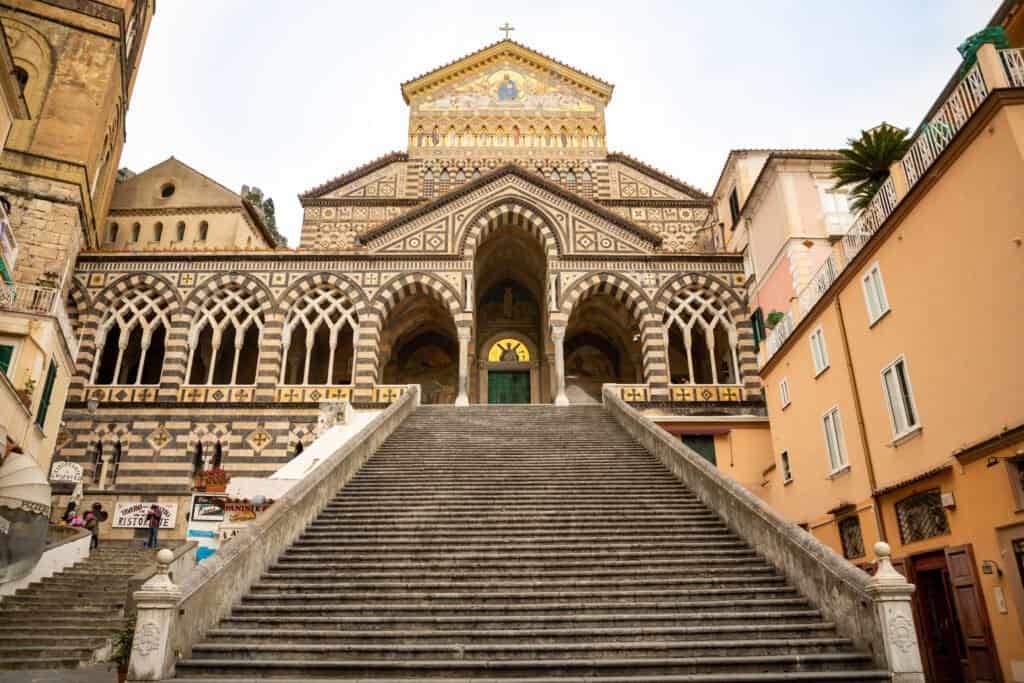
The center of gravity in Amalfi is Piazza Duomo, the square you land in after walking a few steps up from the seafront, and the place where every visit to town eventually loops back to. From the square, a wide staircase of 62 steps climbs to the Duomo di Amalfi, formally the Cathedral of Sant'Andrea, its bronze doors cast in Constantinople in the 11th century and its striped Arab-Norman facade redone in the 1800s after the original partially collapsed. The bell tower dates to the 1200s. Inside, through the cathedral complex, the Paradise Cloister (Chiostro del Paradiso) is worth the separate ticket: built in the 1260s as a burial ground for Amalfi's noble families, its interlaced Moorish arches and palm trees feel more like Andalusia than southern Italy.
Amalfi was one of the four maritime republics, alongside Venice, Genoa, and Pisa, and traded with North Africa and the Byzantine world centuries before Venice became the name people associate with Italian sea power. Little physical evidence of that wealth survives above ground, since a series of landslides and a devastating storm in 1343 took much of the medieval port with it. What's left is a town that reads more intimate than monumental, built into a cleft in the cliffs where the Valle dei Mulini comes down to the sea.
When to Visit
Spring, from April to June, and early fall, September into October, give you the best version of Amalfi. The sea is warm enough to swim in by late May, the hydrangeas and bougainvillea are at their peak, and the SITA buses along the coast road run without the summer gridlock. Daytime temperatures in these months tend to sit in the high teens to mid-20s Celsius, pleasant for walking the Path of the Gods or climbing to Ravello.
July and August are peak season, and the town fills up fast. Ferries and buses run most frequently in these months, which helps, but the coast road backs up and beach space at Marina Grande gets tight by mid-morning. If you're set on a summer visit, book accommodation well ahead and plan boat trips for early morning before the day-trippers from Naples and Sorrento arrive.
Winter, November through March, is genuinely quiet. Some restaurants and hotels close for the season, and ferry service thins out or stops entirely on some routes, but the town itself feels more like a working fishing port than a resort. If you want to see the Duomo steps without a crowd on them, this is when to come.
Where to stay
Amalfi itself is compact enough that almost anywhere in town puts you within walking distance of the Duomo. The real choice is less about neighborhood and more about how close to sea level and how close to the noise of Piazza Duomo you want to be.
- Around Piazza Duomo and the old town: the most central option, with narrow pedestrian lanes, easy access to the cathedral and the Paper Museum, and the shortest walk to restaurants. Expect some evening noise from the square.
- Near Marina Grande: the main beach and harbor, good for travelers who want easy ferry access and a sea view without climbing far. This is also where most boat excursions to Capri, Positano, and the grottoes depart.
- Up the Valle dei Mulini: quieter, a short walk inland and uphill, closer to the old paper mills, good if you want some distance from the crowds while staying walkable to the center.
- Atrani, Amalfi's tiny neighbor just a 10 to 15 minute walk east along the coast road, offers a cheaper, more residential alternative with its own small beach and easy access back into Amalfi.
How to reach the destination
Naples International Airport (NAP) is the closest major airport, roughly 75 kilometers from Amalfi, followed by Rome's Fiumicino (FCO) and Ciampino (CIA), both of which require a longer onward journey. Major carriers including Alitalia's successor ITA Airways, easyJet, Ryanair, and Lufthansa serve these airports from across Europe.
By train, Trenitalia connects Rome and Naples to Salerno, and Naples also connects to Sorrento via the separate Circumvesuviana line. Neither Salerno nor Sorrento has a train station in Amalfi itself, since the coast road and terrain never allowed a rail line to be built along it, so you'll finish the trip by bus, ferry, or car.
From Salerno or Sorrento, SITA Sud buses run along the coast road to Amalfi, and this remains the standard route for travelers without a car. Driving gives you flexibility to stop at viewpoints along the way, but the coast road is narrow, heavily trafficked in summer, and short on parking once you arrive, so many visitors rent a car only for exploring inland and rely on buses or boats for the coast itself. From April through October, Travelmar and Alilauro ferries run from Naples and Salerno directly into Marina Grande, often the most pleasant way to arrive, since you see the cliffs the way sailors have for a thousand years before you ever reach Piazza Duomo.
Getting around the destination
Within Amalfi itself, you walk. Nearly every address in town is reached by a stair rather than a road, and a car is close to useless once you're inside the center.
For trips along the coast to Positano, Ravello, or Praiano, SITA buses are the backbone of the local transport network, running frequently and cheaply, with fares typically in the range of 1.50 to 5.50 euros one way depending on distance. Sit on the right-hand side heading toward Positano for the best views. Buses get crowded in summer and have no night service, so plan your return before evening or budget for a taxi.
Ferries from Marina Grande connect Amalfi to Positano, Capri, and Salerno in about the time it takes to drink a coffee at the dock, usually under an hour to Positano and around 1.5 hours to Naples, though this service is seasonal and schedules shrink outside summer. Taxis and hotel-arranged private drivers fill the gaps, particularly at night or for groups with luggage, at a real premium over the bus. If you're staying more than a night or two, a Costiera Amalfitana day pass for the SITA bus network can save money over single tickets.
Top destination travel tips
- Wear shoes you can climb stairs in. Flip-flops and the Amalfi staircase system do not get along.
- Visit the Paper Museum (Museo della Carta) in the Valle dei Mulini to understand why Amalfi's coat of arms features a compass rose and why the local stationery shops still sell handmade "bambagina" paper. Amalfi supplied paper to much of southern Italy for centuries, using the water-powered mills still visible up the valley.
- Book a table rather than walk in, especially at smaller restaurants during summer dinner hours.
- Tipping isn't obligatory in Italy. Rounding up or leaving small change is appreciated but a service charge is often already included.
- Carry cash in small denominations for gelato stands, bus tickets bought on board, and smaller shops that prefer not to run a card machine for low amounts.
- The coast road gets genuinely congested in July and August. If you're driving, avoid midday transit through Positano and Amalfi and travel early morning or after dinner instead.
- Public beaches at Marina Grande are free but crowded by late morning in summer. Renting a sunbed from one of the lidos gets you more space at a cost.
Typical costs in the destination
Italy uses the euro. Amalfi runs mid-range to upscale by Italian standards, driven by its reputation and the summer crush of visitors, though it's possible to eat and sleep more cheaply if you avoid peak season and the streets directly off Piazza Duomo.
- Coffee at the bar: budget, typically a euro or two standing at the counter.
- A casual sit-down meal of pasta and a main: mid-range, expect prices to climb near the waterfront and drop a little up in the Valle dei Mulini.
- A tasting menu at a destination restaurant: upscale to fine dining.
- SITA bus tickets: budget, a few euros per ride depending on distance.
- Hotel rooms: mid-range in the shoulder season, rising to upscale and fully booked out in July and August, so reserve early.
- Ferry tickets along the coast: mid-range, more than the bus but faster and more scenic.
Must try food and drinks
- Scialatielli ai frutti di mare: a thick, hand-cut pasta local to the coast, usually tossed with mixed seafood and a light tomato base.
- Delizia al limone: a dome-shaped sponge cake soaked in lemon cream, invented along this coast and built entirely around the local Sfusato Amalfitano lemons.
- Limoncello: the lemon liqueur made across the region, often served chilled as a digestivo after dinner.
- Sfogliatella and other lemon-scented pastries at Pasticceria Pansa Amalfi, a bakery in Piazza Duomo that's been operating since the early 1800s and remains the spot locals point to first.
- A seafood dinner at Da Gemma, a long-running family restaurant just off the Duomo steps known for its anchovies and simple, well-sourced fish dishes.
- A more formal meal at Ristorante La Caravella dal 1959, one of the coast's longest-established fine dining rooms, built around regional ingredients and a serious wine list.
- Taralli, small savory ring-shaped snacks flavored with fennel seed, sold in paper bags from bakeries around town.
- Totano e patate, a simple squid and potato stew found on menus up and down the coast, usually a safe, unfussy order.
FAQ
How many days do you need in Amalfi?
Two full days covers the town itself, including the Duomo, the Paradise Cloister, and the Paper Museum, with time for a boat trip or a hike. Most visitors base here for three to five nights and use Amalfi as a hub for day trips to Ravello, Positano, and Capri.
Is Amalfi expensive?
It runs mid-range to upscale by Italian standards, particularly in July and August when hotel rates peak. You can manage costs by visiting in shoulder season, eating away from the main square, and relying on buses and ferries rather than private drivers.
Is Amalfi walkable?
Yes, and it has to be, since cars can't access most of the town's lanes and stairs. Expect a lot of steps regardless of where you're headed, and pack accordingly if you have mobility concerns.
Do you need a car in Amalfi?
No, and in town a car is more burden than benefit given the parking shortage and narrow streets. A car is only useful for exploring inland towns at your own pace; for the coast itself, buses and ferries work better.
Is English widely spoken in Amalfi?
In hotels, restaurants, and shops geared toward tourism, yes, fairly widely. Learning a few basic Italian phrases still goes a long way, especially outside the main square and in the off-season.
What is the best month to visit Amalfi?
May and September tend to offer the best balance of warm weather, swimmable sea, and manageable crowds. Confirm specific opening hours and ferry schedules before you travel, since both shift somewhat by season and year.
Is Amalfi worth visiting as a day trip from Naples or Sorrento?
It's possible but tight, since travel time by bus or ferry eats into the day. Staying at least one night lets you see the Duomo lit up in the evening and the town after the day-trip crowds have left, which is when it feels most like itself.
Top Places to Visit in Amalfi
View all See & Do
 See & Do
 See & Do
 See & Do
Paradise Cloister
Top Places to Eat in Amalfi
View all Eat & Drink
 Eat & DrinkLuxury · $$$$
 Eat & DrinkExpensive · $$$
 Eat & DrinkLuxury · $$$$