
CroatiaBosnia and HerzegovinaDestinations
Can You Visit Mostar From Dubrovnik in a Day? A Practical Guide
By
Yes, you can. The drive is roughly 2.5 hours each way in light traffic, which means a day trip to Mostar from Dubrovnik is entirely doable with a few hours in the city in the middle. Whether it is worth doing depends on how you handle the logistics, and the logistics are where most people run into trouble.
This guide covers what to expect from the journey, what to prioritise once you are there, and how to make the most of the hours you have.
The Drive: What You Are Actually Dealing With
Dubrovnik to Mostar is approximately 150 kilometres. On a map it looks straightforward. On the road it is more interesting than that.
The route passes through the Neum corridor, a short strip of Bosnia and Herzegovina that splits the Croatian coastline in two. This means two border crossings on the way there and two on the way back, regardless of whether Mostar is your final destination or not. In peak summer, those crossings can add anywhere from twenty minutes to over an hour each way.
Beyond Neum, the road climbs into the Herzegovina highlands. The landscape shifts from coastal Dalmatia to something more austere and dramatic: limestone karst, dry valleys, villages clinging to rocky hillsides, and eventually the descent into the Neretva River valley where Mostar sits. It is genuinely beautiful driving if someone else is doing the driving.
What to See in Mostar
Mostar is a compact city, which works in your favour when you have limited time. Most of what matters is within walking distance of the Old Bridge.
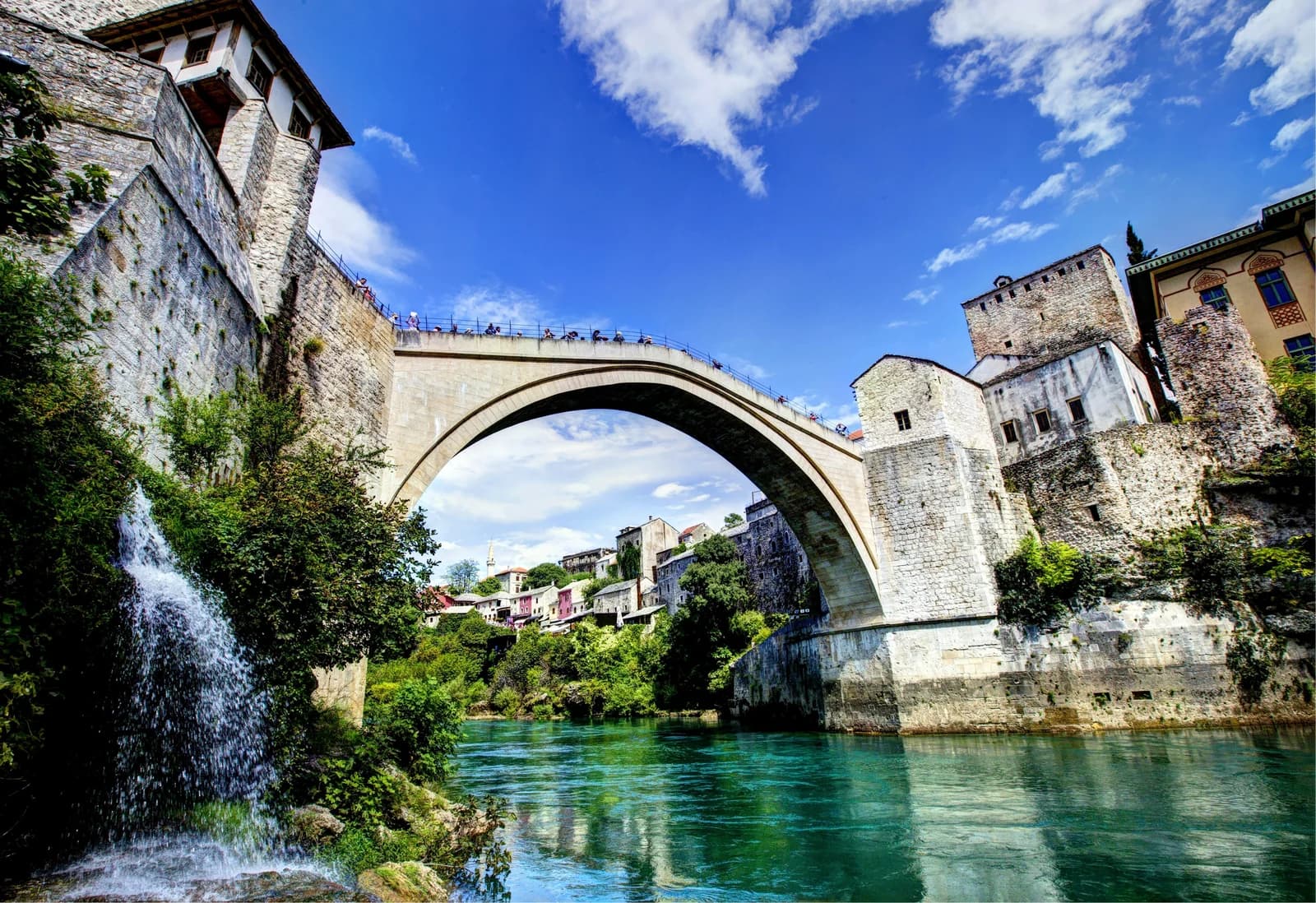
Stari Most: The Old Bridge is the reason most visitors come, and it delivers. The UNESCO World Heritage site was originally built in 1566 by the Ottoman architect Mimar Hayruddin and stood for over four centuries before being deliberately destroyed during the Bosnian War in 1993. It was rebuilt using the original limestone and the same medieval techniques, reopening in 2004. The reconstruction was overseen by UNESCO and funded by an international coalition. In 2005, the Old Bridge and surrounding historic district were inscribed on the World Heritage List.
What makes the bridge arresting in person is less its size, it is 29 metres long and 4 metres wide, than its height above the Neretva and the way it frames the city on both banks. Standing on it mid-morning before the crowds peak gives you one of the better views in the entire Balkans.
Kujundžiluk: The old bazaar street running north from the bridge is a narrow lane of craft workshops, copper merchants, textile sellers, and coffee houses that has operated continuously since the Ottoman period. The goods aimed at tourists are obvious enough, but the bazaar also has a genuine working quality to it that distinguishes it from purpose-built souvenir markets.
The left bank mosques and hammam: The Koski Mehmed Pasha Mosque, a short walk from the bridge, can be climbed for rooftop views across the city. The 17th-century hammam nearby is one of the better-preserved Ottoman bathhouses in the Balkans, now partially restored and open to visitors.
Blagaj: If your day has any flexibility at all, the village of Blagaj sits 12 kilometres from Mostar town centre and is worth the detour. A 16th-century Dervish tekke built directly over the source of the Buna River, where the river emerges from a cliff face at enormous volume, is one of those places that photographs significantly undersell. Early morning or late afternoon light does something extraordinary to the cliff and the water.
The Timing Problem
Here is where day trips from Dubrovnik most commonly go wrong. The journey is long enough that errors compound.
A late start means arriving in Mostar after the morning light has gone and the crowds have arrived. A slow border crossing on the return means arriving back in Dubrovnik after dinner. And if you are using the public bus, the timetable adds its own constraints: there is generally one morning departure from Dubrovnik and a limited set of return options from Mostar, with connections that do not account for delays.
The practical window for genuinely comfortable sightseeing in Mostar on a day trip from Dubrovnik is roughly four to five hours. Arriving by 10 or 10:30, leaving by 15:00 at the latest, gives you time to see the main sights without feeling rushed, and enough buffer for a relaxed border crossing return.
Getting There: Your Options
Public bus: Services run from Dubrovnik bus station and require at least one change. The journey including the wait is typically three hours or more in each direction, and summer crowds at the border make the timetable somewhat theoretical. This is the cheapest option and the least predictable.
Rental car: Gives you full flexibility on timing and the option to stop at Blagaj without negotiating the detour with anyone else. Requires comfort with international driving, Bosnian road signage, and the knowledge that parking near the Old Bridge in high season requires either luck or a very early arrival.
Mostar is the day trip almost everyone on the Dalmatian coast ends up considering, and for good reason — it is close enough to leave after breakfast and be back by dinner. The catch is the border. The Croatia–Bosnia crossing can crawl in July and August, and a missed bus connection can cost you the whole afternoon at the Old Bridge. That timing pressure is why a lot of visitors book a direct ride from Dubrovnik to Mostar rather than stitch together two bus legs each way. Balkan Chauffeur handles this trip for travelers pairing southern Croatia with a taste of Bosnia & Herzegovina.
What to Eat and Drink in Mostar
Bosnian food is one of the better arguments for crossing the border. Cevapi, small grilled minced meat sausages served in a flatbread with raw onion and kajmak cream, are the dish Mostar does consistently well and the thing most visitors eat once and immediately want again.
The old city has dozens of places to eat within a few minutes of the bridge. Quality varies, but portions are generous and prices are significantly lower than Dubrovnik. A proper sit-down lunch for two including drinks rarely exceeds fifteen euros.
Turkish coffee, served in a džezva with a sugar cube and a piece of lokum on the side, is the appropriate finish. Sit somewhere with a view of the river and take your time with it. The coffee experience in Mostar is one of the small genuine pleasures of the trip.
Final Thoughts
For most visitors to Dubrovnik, yes. Mostar offers something the Croatian coast does not: a layered, genuinely complex place where Ottoman, Austro-Hungarian, Yugoslav, and contemporary Bosnian culture exist simultaneously in the same street. It is not a pretty backdrop. It is a city with a difficult recent history that it carries openly, and that gives it a texture and seriousness that many day-trip destinations lack.
If you have a day free in Dubrovnik and the logistics are handled, Mostar is one of the best ways to spend it.