
Northern IrelandUnited KingdomDestinationsTravel Videos
Game of Thrones Filming Locations in Northern Ireland: Winterfell, the Dark Hedges and the Iron Islands
By
Explore on the map
12 places from the destinations in this story. Tap a pin to open the listing.
Northern Ireland was Game of Thrones' home for a decade. The Paint Hall in Belfast held the interiors, and almost everything outdoors was shot within ninety minutes of it — Winterfell, the Iron Islands, the Haunted Forest, Dragonstone's beach and the Dothraki Sea, all in a country about the size of Connecticut.
That is what makes it the best filming-location trip in the world for the show: you can see most of Westeros in three days without ever driving more than an hour and a half. Here is every major location, mapped, with the route that actually works.
Game of Thrones Filming Locations Tour
The video runs the coast route, from Belfast up to the Causeway Coast and back down through County Down. The written guide below adds the locations it passes, plus the ones further west that need a separate day.
The Dark Hedges — the Kingsroad

The Dark Hedges is the image everyone arrives for: two rows of beech trees planted in the eighteenth century along the approach to a Georgian mansion, grown together overhead into something that looks engineered rather than grown. It appeared as the Kingsroad at the start of season two, with Arya in boy's clothes on a cart heading north.
Be realistic about two things. Storms have taken several trees over the last decade, so the avenue is thinner than it looks in the show. And Bregagh Road is now closed to traffic — park at the Hedges Hotel or the designated car park and walk in.
Dawn is the only reliable time to photograph it without people in the frame. By ten in the morning in summer there are coaches.
Castle Ward — Winterfell

Castle Ward on Strangford Lough is the most complete location in Northern Ireland and the only one that leans into it properly. The eighteenth-century walled farmyard became Winterfell's courtyard, and the clock tower is the one Bran climbs.
You can hire costumes, shoot on the archery range where Jon and Robb shot theirs, and cycle the Winterfell Trail around the estate. The house is architecturally odd in its own right — one half classical, the other Gothic, because the couple who built it could not agree on a style and simply did both.
Ballintoy Harbour — the Iron Islands

Ballintoy is Lordsport on Pyke, where Theon lands and is met by Yara. It is a tiny working harbour at the bottom of a steep switchback road, and the black basalt, sea stacks and reliably foul weather did most of the production's work for it.
The road down is narrow and the car park small. Early, or not at all in August.
Cushendun Caves — the shadow baby

Cushendun Caves were cut into red conglomerate over roughly 400 million years, at the edge of a village that looks like it belongs in Cornwall — because it was designed by the architect who built Portmeirion. This is where Davos rows Melisandre ashore and she gives birth to the shadow.
Two minutes from the car park, free, usually quiet. Check the tide, and go when the sun is low enough to reach inside.
Murlough Bay and Larrybane — the Stormlands
Murlough Bay is a steep, remote bay on the north-east corner, reached by a single-track road that drops hard to the shore. It served as Slaver's Bay, where Tyrion and Jorah are taken captive, with the slopes above standing in for the Stormlands. Rathlin Island and the Scottish coast are visible on a clear day.
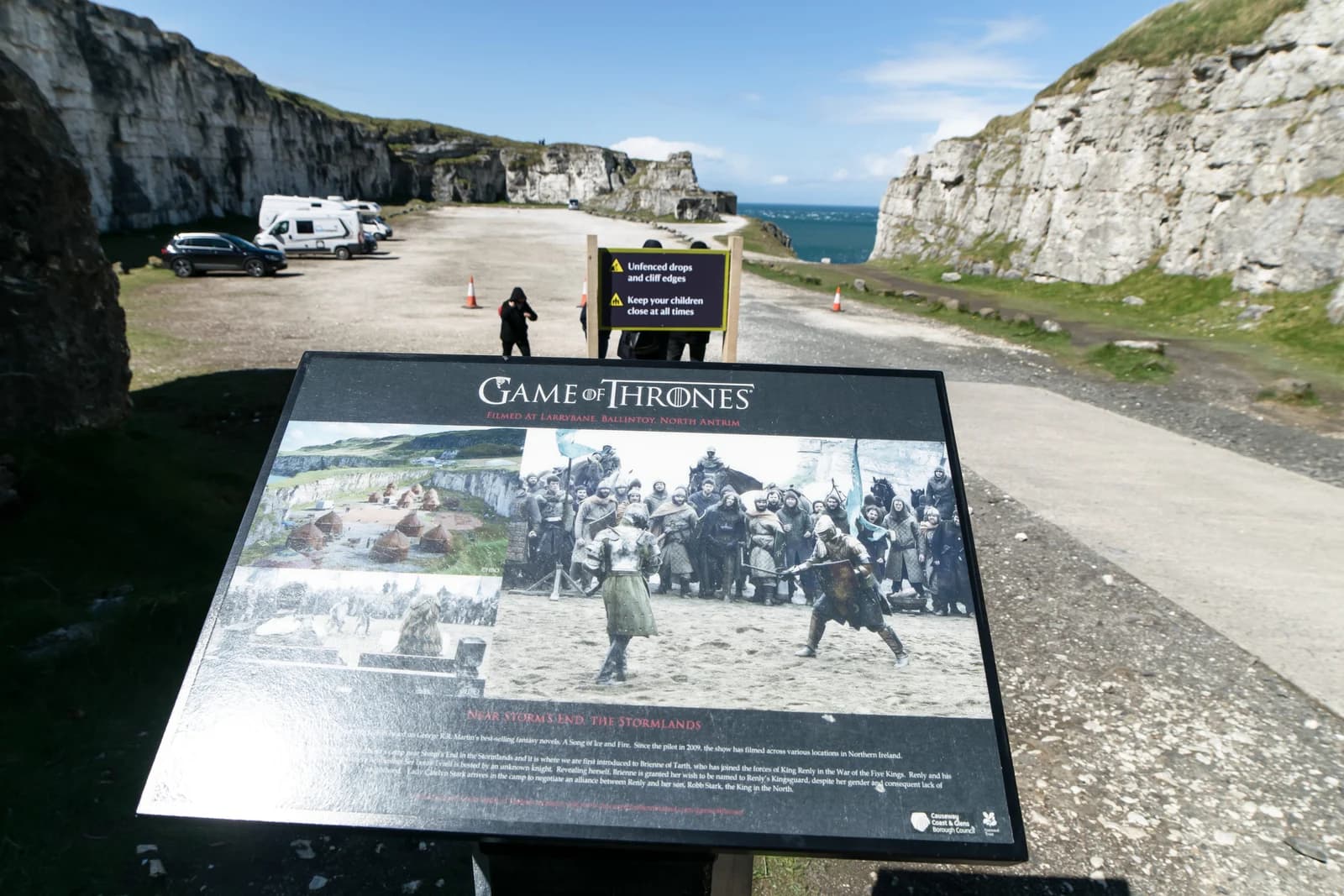
Larrybane Quarry, a disused chalk quarry, was Renly Baratheon's camp — the setting for Brienne's duel with Ser Loras. It sits directly beside the Carrick-a-Rede car park, and because everyone there is queuing for the rope bridge, the location itself is usually ignored.
Downhill Strand — Dragonstone
Seven miles of open sand below the cliffs at Downhill, with Mussenden Temple perched on the edge above. This beach is Dragonstone, where Melisandre burns the effigies of the Seven and Stannis pulls the flaming sword from the fire.
You can drive onto the sand at Benone. Walk up to the temple afterwards — built as a library in 1785 by an eccentric bishop, with the cliff eroding toward it ever since.
Tollymore Forest — beyond the Wall

Tollymore opens the entire series: the White Walker scene in the Haunted Forest was shot here, as was the Starks finding the direwolf pups. Forest, river and stone bridges in the foothills of the Mourne Mountains.
It is a proper forest park with trails, parking and a cafe, which makes it the easiest location here to spend half a day in rather than photograph and leave. The Mournes behind it are the best hill walking in the country.
Inch Abbey — King in the North
The ruins of a twelfth-century Cistercian abbey across the river from Downpatrick, where the northern lords proclaim Robb King in the North and Catelyn learns her husband is dead. Inch Abbey is free, open and almost always empty — a sharp contrast with the Dark Hedges twenty-five miles north.
Fifteen minutes from Castle Ward, so the two make an obvious Winterfell half-day.
Portstewart Strand and Binevenagh — Dorne and the Dothraki Sea
Portstewart Strand is two miles of dune-backed beach standing in for the coast of Dorne, where Jaime and Bronn come ashore and are ambushed by the Sand Snakes. You can drive onto the sand; there is a National Trust cafe.
Inland, Binevenagh is a basalt escarpment with a long flat plateau on top, used for the Dothraki grasslands where Daenerys lands on Drogon. You can drive nearly to the summit, and the view reaches Donegal, the Atlantic and sometimes Scotland. It is exposed, and the weather turns fast.
Pollnagollum — the Hollow Hill
Pollnagollum, in Belmore Forest in County Fermanagh, is a waterfall falling over a cave mouth, used as the Hollow Hill where the Brotherhood Without Banners hold Arya and the Hound.
It is far west of everything else here, near the border, and reaching it means a forest walk on ground that is usually wet. Boots, not trainers. Fermanagh's lakes justify the trip beyond the one scene.
A three-day route
Day one — County Down. Castle Ward and Inch Abbey in the morning, Tollymore Forest in the afternoon. Base yourself in Downpatrick or Newcastle.
Day two — the Causeway Coast. Dark Hedges at dawn, then Ballintoy, Larrybane and Carrick-a-Rede, the Giant's Causeway, and Cushendun or Murlough Bay to finish.
Day three — the north coast. Downhill Strand and Mussenden Temple, Portstewart Strand, Binevenagh. Fermanagh and Pollnagollum need a fourth day or a long detour.
Belfast itself is worth a day: the Titanic Belfast museum sits beside the Paint Hall where the interiors were shot.
Practical notes
Getting around. Hire a car. Several of these are down single-track roads with no bus service, and the distances are short enough that driving is genuinely easy.
Weather. It will rain. The locations look better for it — this is a show shot in Northern Ireland precisely because the skies are the way they are.
Access. Castle Ward, Carrick-a-Rede, Portstewart and Downhill are National Trust; a membership or a Touring Pass pays for itself across three days. Dark Hedges, Cushendun, Murlough, Inch Abbey and Binevenagh are free.
Tours. Day tours from Belfast cover the Causeway Coast cluster if you are not driving. They do not reach Fermanagh.
Going further? King's Landing was filmed in Croatia — see our guide to the Game of Thrones filming locations in Dubrovnik.