
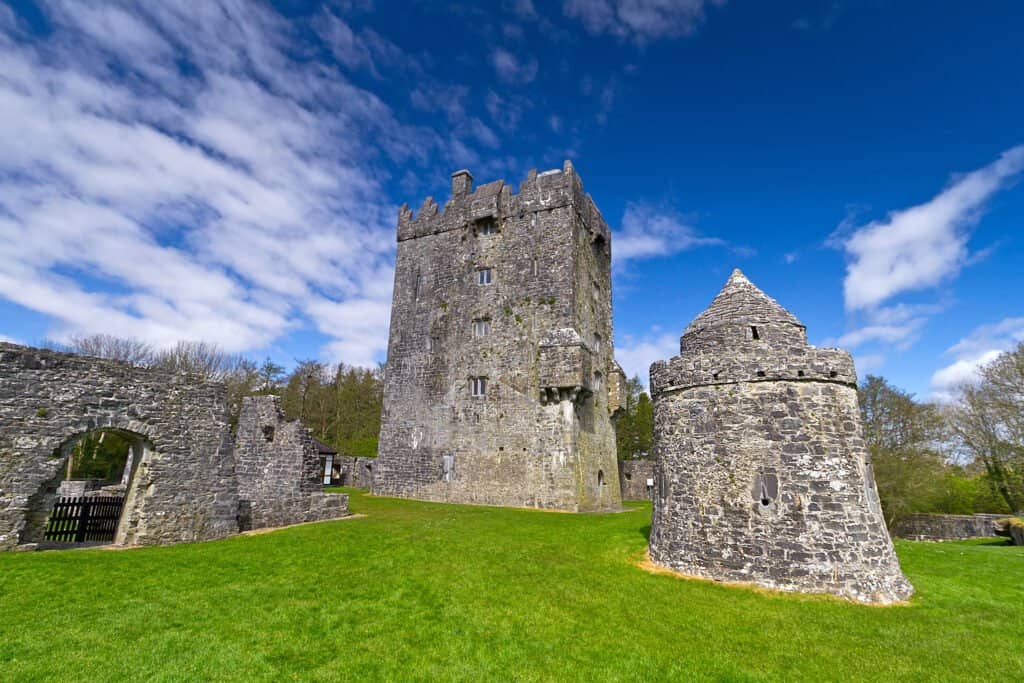
Ballintubber Abbey sits on a quiet stretch of road outside the village of Ballintober in County Mayo, about 20 minutes from Westport and 15 from Castlebar. It is not a ruin you look at from behind a rope. Mass has been said here, by most accounts, continuously since 1216, which makes it one of the very few churches in Ireland where that claim holds up to scrutiny. The abbey survived fire, suppression, and roofless decades, and it is still a working parish church today. That combination of depth of history and ordinary present-day use is what sets Ballintubber Abbey apart from most medieval sites you'll visit in Ireland.
Why Ballintubber Abbey matters
Plenty of Irish abbeys are more photogenic ruins. Ballintubber's significance is less about scale and more about continuity. Through the suppression of Catholic worship, through Cromwellian destruction, through a period when the church stood without a roof for close to two centuries, local people kept bringing the dead here and kept saying Mass among the walls. That unbroken thread of use, stretching back roughly 800 years, is rare anywhere in Europe, and it's the reason historians and pilgrims treat this site differently than a typical heritage ruin.
Quick facts
- Founded in 1216 by Cathal Crovderg O'Connor, King of Connacht
- One of the only churches in Ireland with a claim to near-continuous Mass attendance since its founding
- Damaged by fire in 1265 and again during the Cromwellian campaigns of 1653
- Starting point of the Tóchar Phádraig pilgrim path to Croagh Patrick
- Located roughly 20 minutes from Westport, 15 minutes from Castlebar, and 30 minutes from Newport
- Address: Abbey, Ballintober, Co. Mayo, F12 W584, Ireland
Getting there
Driving is the practical option. The abbey sits just off the main road near Ballintober village, with parking on site, so most visitors arrive by car from Westport, Castlebar, or Newport. There is no train station nearby, and local bus coverage to the village itself is limited, so if you're relying on public transport you'll likely need to base yourself in Castlebar or Westport and arrange a taxi or drive a rental car the rest of the way. The roads in are narrow country lanes typical of rural Mayo, well signposted once you're close.
The layout and experience
The abbey complex is smaller than its reputation suggests, and that's part of its charm. You enter through grounds that blend churchyard, garden, and ruin in a way that doesn't feel staged. The nave is roofed and in regular use, with a chancel and cloister area that show clear evidence of the building's medieval bones even where restoration has filled in gaps. Walk the grounds slowly. There's a graveyard with headstones going back centuries, a reconstructed section of cloister, and quiet corners that locals still use for private prayer outside of service times. It rewards an unhurried visit rather than a quick drive-by stop.
Main highlights
Guided tours. Trained guides walk visitors through the abbey's architecture and its eight centuries of continuous use, weaving in the fires, the Cromwellian suppression, and the local families who kept the parish alive through lean periods. Tours run during the day on a regular schedule, with adjusted arrangements at weekends, so it's worth checking ahead if you want a guided visit rather than a self-directed wander.
St. Patrick's Well. A short walk from the main abbey building, this well is traditionally linked to St. Patrick's baptisms of early converts. A stone beside the well is said to carry the imprint of his knee, left as he knelt to pray. Whatever you make of the legend, the spot itself is understated and easy to miss if you don't know to look for it.
Tóchar Phádraig. This is the old pilgrim path running from Ballintubber Abbey to the summit of Croagh Patrick, the mountain where St. Patrick is said to have fasted for 40 days. The route predates Christianity in parts, following older ceremonial paths across the Mayo countryside. Walking even a short stretch of it gives you a sense of why this abbey was positioned here in the first place, as a waypoint for pilgrims rather than an isolated building.
Church Island. Out on Lough Carra, this island has served as a place of prayer since roughly the 6th century, long before the abbey itself existed. It's not something you visit on the same afternoon without planning, but it's worth knowing about if you're interested in the deeper religious geography of the area.
Theobald Bourke's tomb. Inside the abbey grounds you'll find the elaborately carved tomb of Theobald Bourke, son of the pirate queen Grace O'Malley. It's a small but genuinely striking piece of stonework, and one of the few named burials on site with a clear historical thread attached to it.
The Passion Play. During Holy Week each year, the grounds host a Passion Play performed by local participants. If your visit happens to coincide with it, it's a different kind of experience than the standard tour, drawing a larger crowd and a more charged atmosphere than the abbey's usual quiet.
Gift shop and visitor centre. A small shop on site stocks locally made crafts, books on the abbey's history, and religious items, and the visitor centre can point you toward maps of the Tóchar Phádraig route and other nearby sites.
History and background
Cathal Crovderg O'Connor, King of Connacht, founded Ballintubber Abbey in 1216 for the Augustinian canons. The site itself was already significant before that, sitting near St. Patrick's Well and along the pilgrim route to Croagh Patrick, so the abbey's founders were building on ground with existing religious weight rather than starting from nothing. A fire tore through the abbey in 1265, and the building was rebuilt and continued in use for centuries afterward. The more severe blow came during the Cromwellian campaigns of 1653, when the abbey was burned and largely destroyed as part of the broader suppression of Catholic institutions across Ireland. For roughly the next 180 years the church stood without a roof. Remarkably, local parishioners kept gathering and worshipping among the ruined walls through that entire period, which is the basis for the claim that Mass has been celebrated here continuously since 1216. Restoration work in the twentieth century brought the roof back and returned the nave to regular use, and it functions today as an active parish church alongside its role as a historic site open to visitors.
Tickets and entry
Admission to the abbey grounds and church is free. Guided tours run on a daily schedule for a modest per-person fee, with children typically admitted free, though it's worth confirming current arrangements before you travel since weekend scheduling can differ from weekdays. If you'd rather explore independently, you're free to walk the grounds and church at your own pace without booking anything in advance.
Best time to visit
Mornings tend to be quieter, particularly outside the main summer season when coach tours occasionally pass through. If you want to see the Passion Play, you'll need to time your visit to Holy Week specifically, which shifts each year with the date of Easter. For a purely contemplative visit, a weekday afternoon outside of July and August gives you the grounds largely to yourself.
Facilities and preparation
- On-site parking is available and free
- A gift shop and small visitor centre sell crafts, books, and maps
- Toilets are available on site
- The grounds involve uneven paths and graveyard terrain, so wear comfortable, sturdy shoes
- Dress modestly out of respect, as this remains an active place of worship
Combining with nearby attractions
Westport, about 20 minutes away, makes an easy pairing for the rest of your day, with its own historic town layout and Westport House nearby. Castlebar, 15 minutes in the other direction, works well if you're based there already. For the more ambitious, the Tóchar Phádraig path connects the abbey directly to Croagh Patrick, so if you're planning to climb the mountain, consider walking at least part of the old pilgrim route as an approach rather than driving straight to the usual trailhead at Murrisk.
Sample visit plan
Arrive in the morning and start with a guided tour to get the historical framework before wandering alone. Walk out to St. Patrick's Well afterward, then spend some time in the graveyard and cloister ruins. If you have an extra hour, drive or walk a short stretch of the Tóchar Phádraig to get a feel for the pilgrim route before heading on to Westport or Castlebar for lunch.
Practical tips
- Check tour times in advance, especially if visiting on a weekend
- Bring cash for the gift shop and tour fee, as rural sites like this don't always have reliable card facilities
- Try the Family Trail Quiz if you're visiting with children, a simple way to keep younger visitors engaged with the history
- If you want to experience a service rather than just a tour, check whether Mass times align with your visit
- Allow at least an hour, more if you plan to walk any part of the Tóchar Phádraig
FAQ
Is Ballintubber Abbey still an active church?
Yes. It functions as a working parish church alongside its role as a historic and pilgrimage site.
Is admission free?
Entry to the grounds and church is free. Guided tours carry a small separate fee.
How long should I plan for a visit?
An hour covers the core site comfortably. Add more time if you want to walk part of the Tóchar Phádraig or visit during a guided tour.
Can I walk the Tóchar Phádraig from here?
Yes, the abbey is the traditional starting point for the pilgrim path to Croagh Patrick, though walking the full route to the summit is a serious undertaking best planned in advance.
Is Ballintubber Abbey suitable for children?
Yes, particularly with the Family Trail Quiz, which turns a visit into something more interactive for younger visitors.
Reviews
Sign in and mark this place visited to leave a review.
No reviews yet.
Free Trip Planner
Plan your Dublin trip with our free planner
Build a day-by-day itinerary with AI suggestions, hand-picked places, and friends. Free forever — no credit card.
Things to see near Ballintubber Abbey


More places in Dublin

Murphys Ice Cream
Merrion Square Park

Corcomroe Abbey
