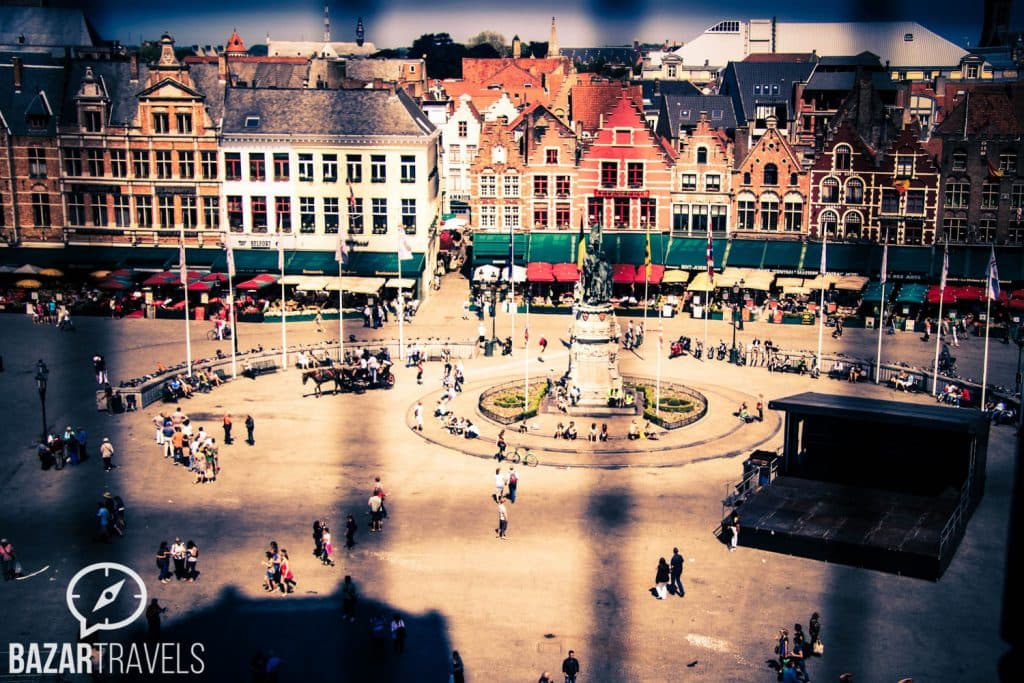
Belfry of Bruges
Markt 7, 8000 Brugge, BelgiumOverview
The Belfry of Bruges rises from the Markt like a Gothic needle, 83 meters tall, its bell chamber visible from nearly every corner of the medieval city center. Walk into the square on any morning and the tower's presence is absolute: narrow brick shaft, crenellated crown, that distinctive octagonal upper section that makes it instantly recognizable across centuries of paintings and photographs. It is one of the most intact belfries in Flanders, a working bell tower with a carillon of 47 bells that still rings out across Bruges several times a day. The tower sits in the heart of the Markt, the main square, surrounded by guild halls and market stalls that have occupied this space since the 13th century.
Why this place matters
The Belfry is more than a tall building. It represents medieval civic power in its most physical form: a tower built to house the city's treasures, its archives, and its claim to autonomy. When Bruges was a prosperous trading city in the Low Countries, the belfry stood as a symbol that the merchants and craftspeople who governed here answered to no lord but the city itself. The tower was constructed starting in the 13th century and substantially rebuilt after a fire in 1280. What you see today is that medieval structure, reinforced and restored over the centuries but fundamentally the same stone and timber that watched over the city during its golden age.
The carillon bells are a living part of the tower. They ring at set times during the day, a custom that connects the present city to its past. In 2000, the tower and its neighboring buildings were designated a UNESCO World Heritage Site as part of the Belfries of Flanders and Wallonia group, recognizing their outstanding universal value as medieval civic monuments.
Quick facts
- Height: 83 meters (272 feet)
- Built: Starting in the 13th century, substantially rebuilt after 1280
- Carillon bells: 47 bells
- Entry: Climb 366 steps to the top
- Hours: Open most days; closed certain holidays
- Location: Markt 7, in the city center
Getting there
The Belfry stands on the Markt, the main square in Bruges's city center. If you arrive by train, the station is about 15 minutes' walk southwest. Head north from the station through Sint-Pieterskaai and follow signs toward the Markt. Once you enter the medieval quarter, the tower is visible above the rooflines.
If you come by bus or car, the city center is largely pedestrian. Park in one of the lots on the periphery (Steen, Poort, Centrum) and walk in. The Markt is the gravitational center of the old town, and you cannot miss it.
The layout and experience
Entry to the tower is at ground level, where you purchase tickets inside a small ticketing booth. From there, you begin climbing. The 366 steps are steep, narrow, and uneven in places. Medieval staircases were not designed for modern comfort. The climb is the experience: you move through different chambers and levels, each one revealing how the tower actually functioned.
The lower section houses the treasury chamber, where the city's charters and valuables were once stored. As you climb higher, you pass through the bell chamber itself, where you can see the carillon mechanism up close. The bells hang in the octagonal chamber at the top, and if you time your visit right, you may hear them ring while you are there. The final stretch leads to the open-air gallery near the crown, where you step out onto the parapet and see Bruges spread below you in all directions.
The light at the top changes throughout the day. Morning light comes from the north and east, illuminating the flat medieval roofscape. By late afternoon, the shadows of the tower's own crenellations stripe the surrounding buildings. The view extends well beyond the city center to the surrounding countryside and, on clear days, toward the coast.
Main highlights
The carillon bells themselves are the heart of the tower. You can see them hung in the bell chamber and, depending on the time of day, hear them ring. The mechanism that plays them is largely mechanical, though it has been upgraded over the centuries. The oldest bells in the carillon date back several centuries.
The view from the top is the most immediate reward for the climb. From the parapet, you see the full layout of the medieval city: the network of canals, the pattern of streets, the spires of other churches and civic buildings. On a clear day, the view extends for kilometers.
The treasury chamber in the lower part of the tower contains historical displays that explain the tower's role in Bruges's civic life. The exhibits are modest but informative, focusing on the documents and treasures that were once locked away here.
History and background
The Belfry was built in stages. The lower section dates to the 13th century, when Bruges was establishing itself as a major trading center. After a fire destroyed much of the tower in 1280, it was substantially rebuilt. The distinctive octagonal bell chamber at the top was added in the 14th century and reflects the Gothic style of the period.
During the Napoleonic Wars and the period of French rule, the tower was damaged and its bells were taken down. After Belgium's independence in 1830, the Belfry was restored to its current state. The carillon was reinstalled in the 19th century and has been maintained ever since.
The tower has always been tied to the civic identity of Bruges. It held the city's charters, its seal, and its treasury. It was the highest point in the medieval city, a place from which the city's officials could look out and see their domain. When the city declined economically in later centuries, the tower remained as a physical reminder of what Bruges had been.
Tickets and entry
General admission grants you access to climb the 366 steps to the top and visit the bell chamber and treasury displays. Tickets are purchased at the ground floor booth. Guided tours are available and provide context for what you see as you climb. Both options are timed entry to manage the flow of people on the narrow staircases.
Combination tickets that include entry to other nearby museums (such as the Bruges City Museum in the building adjacent to the Belfry) are sometimes available. Ask at the ticket counter about any packages.
Best time to visit
The tower is open year-round, but the experience varies by season and time of day. Morning visits, particularly in spring and early summer, offer the best light for views from the top. The square itself is quieter before 10 am, though the climb is busy most days during summer tourist season.
Winter visits are shorter in daylight, but the low angle of the sun creates dramatic shadows. Rainy days are not ideal for the climb, as the stone steps become slippery. If you visit in the afternoon, the sun is behind you on the western side of the tower, which affects the light in the photos you take from the parapet.
The carillon rings several times daily. Ask at the ticket desk for the ringing schedule so you can time your climb to be in the bell chamber when the bells sound.
Photography tips
The exterior is most photogenic from the opposite side of the Markt, where you can capture the full height of the tower against the sky. Early morning or late afternoon light is gentler than midday sun. The surrounding guild halls frame the tower nicely from street level.
From the top, you have a 360-degree view, but the parapet is narrow and crowded during peak hours. Bring a wide-angle lens if you have one. The views to the north and west toward Sint-Janshospitaal and the canal ring are particularly strong. Avoid shooting into the midday sun if possible.
The interior of the bell chamber is dim and requires a fast shutter speed or higher ISO. The mechanism is intricate and worth photographing if you have steady hands or a tripod.
Facilities and preparation
The climb is long and steep. Wear comfortable shoes with good grip. The staircases are narrow, and you will need to turn your shoulders to pass people coming down while you are going up. If you have mobility issues or are uncomfortable on steep stairs, this climb may not be for you.
There are no facilities inside the tower (no restrooms, no water, no seating). Use the facilities at ground level before you begin climbing. The tower can be cool and drafty, particularly higher up, so bring a layer even if it is warm outside.
The climb takes most people 20 to 30 minutes. Budget additional time if you want to spend time at the top enjoying the view or if you are climbing at a leisurely pace.
Combining with nearby attractions
The Markt is surrounded by significant buildings. The Bruges City Museum occupies the building directly adjacent to the Belfry (the old Civiele Griffie). Many visitors combine a climb of the Belfry with a visit to the museum. The Church of Our Lady (Onze-Lieve-Vrouwekerk) is a five-minute walk south, and the Basilica of the Holy Blood (Sint-Baafskathedraal) is nearby to the northeast.
The Markt itself is the social center of the city. Cafes and restaurants surround the square, and market stalls operate here most days. After climbing the Belfry, many people sit at one of the cafes on the square to rest and absorb the atmosphere.
The canal ring that surrounds the medieval city center is a short walk from the Markt. A boat tour of the canals is a popular complement to visiting the Belfry, as it gives you a different perspective on the same medieval landscape you saw from the top of the tower.
Sample visit plan
Arrive at the Markt by 9 am to purchase tickets and begin your climb before the crowds arrive. Spend 30 minutes climbing to the top and exploring the bell chamber and treasury. If the carillon is ringing during your visit, stay in the bell chamber to hear it. Spend 20 to 30 minutes at the top taking in the view.
After descending, sit at one of the cafes on the Markt for a coffee or light snack. If you are interested in more history, visit the Bruges City Museum in the adjacent building. If you prefer to move on, walk to one of the nearby churches or toward the canal ring for a boat tour.
Practical tips
- Visit early in the day to avoid the largest crowds and to have the best light for photographs.
- Ask the ticket seller for the carillon ringing schedule so you can time your climb accordingly.
- Wear sturdy shoes with good grip on the soles. The steps are worn and can be slippery.
- Bring a light layer. The tower is cool, and there is a wind at the top even on calm days below.
- The climb is steep and uninterrupted. If you have any concerns about your fitness or balance, consider whether this climb is right for you.
- The parapet at the top is narrow. Be mindful of other visitors and keep your footing secure.
- Combination tickets with the Bruges City Museum are typically available and offer value if you plan to visit both.
FAQ
How long does it take to climb the Belfry?
Most people take 20 to 30 minutes to reach the top, depending on fitness level and how often you pause to look around. Add time if you want to spend time at the top or in the bell chamber.
Is the climb difficult?
The 366 steps are steep and narrow. It is not a technical climb, but it requires a reasonable level of fitness and comfort on stairs. The interior is unlit in some sections, so bring a phone flashlight or headlamp if you are sensitive to dim light.
Can I see the carillon bells up close?
Yes. The bell chamber is accessible during the climb, and you can see the bells hung in the octagonal chamber. If you time your visit with a ringing, you can hear them from inside the chamber.
Is there a lift or elevator?
No. The climb is entirely by stairs. There is no alternative route to the top.
What is the best view from the Belfry?
The view is 360 degrees, but the most distinctive views are to the north and west, toward the canal ring and the surrounding countryside. The view south toward Sint-Janshospitaal is also strong. The view east shows the city center and nearby church spires.
Opening hours
Reviews
Sign in and mark this place visited to leave a review.
No reviews yet.
Free Trip Planner
Plan your Bruges trip with our free planner
Build a day-by-day itinerary with AI suggestions, hand-picked places, and friends. Free forever — no credit card.