Overview
De Burg sits at the civic heart of Brugge, a sprawling medieval complex that has served as the seat of local power for nearly a thousand years. The moment you step into the courtyard, you're surrounded by centuries of architecture stacked one atop another: Gothic, Renaissance, Baroque facades all facing inward toward a square of pale stone. It's the kind of place where you understand why Brugge matters not through plaques but through the sheer weight of the buildings themselves.
The site comprises multiple structures built and rebuilt across different eras, each reflecting the city's shifting fortunes and allegiances. Today it functions as both a working government building and a tourist destination, which means you'll see officials moving through certain corridors while visitors explore the more public areas. De Burg is not a museum in the conventional sense, but rather a living institution that happens to be housed in buildings of immense historical significance.
Why this place matters
De Burg represents the evolution of civic authority in the Low Countries from the medieval period onward. This was never a royal residence or a military fortress. It was where merchants and magistrates conducted business, where laws were made, where the city governed itself. For centuries, the power to tax, judge, and regulate flowed from these buildings.
The architectural layers tell the story of Brugge's rise and transformation. The oldest core dates to the 10th century, when Brugge was a fortified trading post. By the 14th and 15th centuries, when Brugge rivaled Venice as a commercial power, the civic buildings expanded to match the city's ambitions. Later additions from the 17th and 18th centuries show how Baroque aesthetics reshaped medieval stone. Each era left its fingerprints, making De Burg a physical record of how a city changes without erasing what came before.
Quick facts
- Located at Burg 15, the central square in medieval Brugge's Old Town
- The complex contains structures dating back to the 10th century, with major additions through the 18th century
- Home to the City Hall (Stadhuis), the Bruges Magistrate's Court, and several museums
- Free access to the Burg courtyard itself; individual buildings have separate admission fees
- Walking distance from Markt Square (approximately 2 minutes) and the Belfry of Bruges
- Open year-round, though hours vary by building
Getting there
De Burg lies in Brugge's medieval core, accessible on foot from nearly anywhere in the Old Town. If you're arriving by train, the station is about 20 minutes' walk north of the city center. Most visitors arrive via Markt Square, which sits two minutes' walk to the north. From Markt, head south through the narrow passages between buildings; locals know the way, and small signs point toward Burg.
If you're coming from the station, walk south on Xavierstraat or Zuidzandstraat until you reach the canal network, then follow the waterside paths eastward. Once you cross into the medieval quarter, street signs become less reliable, but the density of tourists walking in the same direction makes it hard to get truly lost.
There is limited parking nearby in the surrounding streets, though most of the Old Town is pedestrianized. Bicycles are ubiquitous in Brugge, and bike parking is available at several points near the square.
The layout and experience
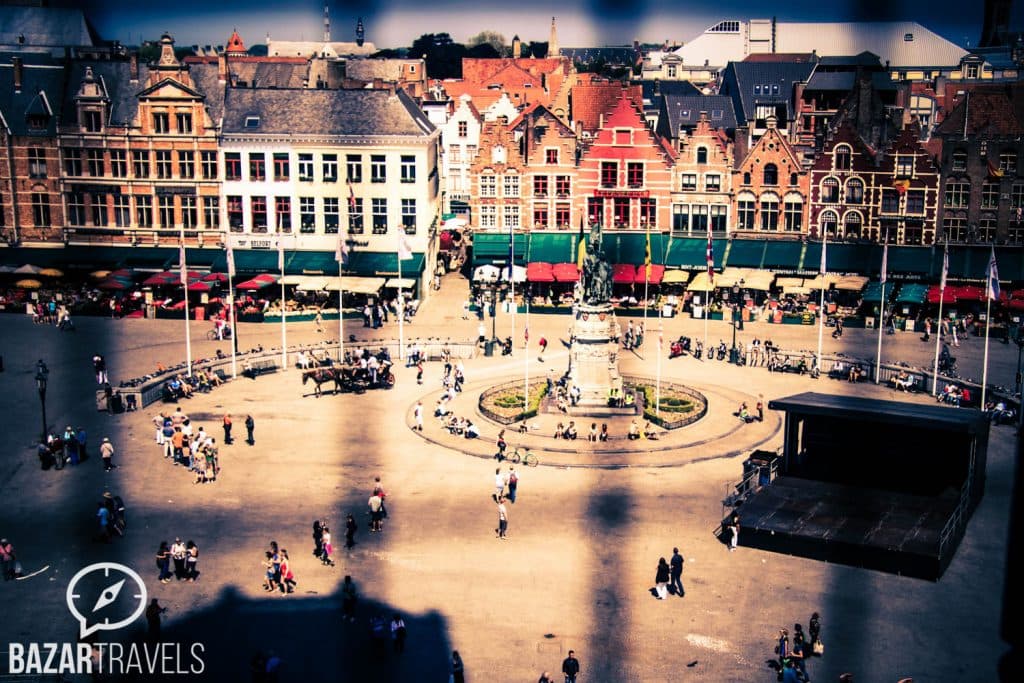
The Burg is not a single building but a compact urban plaza ringed by facades. The courtyard itself is open to the public at all times and costs nothing to enter. Walking into the square, you're immediately struck by the asymmetry: buildings of different heights and styles face each other across pale cobblestones, creating a sense of accumulated history rather than planned Renaissance harmony.
The south side is dominated by the City Hall (Stadhuis), a Gothic structure with a distinctive facade and ornamental spire. Its ground floor opens onto the courtyard, and if you enter, you move from bright daylight into the cool interior spaces where the city still conducts business. The north side holds the Renaissance facade of the Palace of the Liberty of Bruges, a more refined and symmetrical design that contrasts sharply with the Gothic exuberance opposite.
The east and west sides are less monumental but no less textured. You'll notice how the stonework varies, how windows are set at different levels, how doorways lead into shadowed passages. This is not a designed square in the way a Renaissance piazza is designed. It evolved, and that evolution is visible in every meter of wall.
Most visitors spend 20 to 40 minutes in the courtyard itself, reading plaques and taking photographs from various angles. If you enter any of the museums or the City Hall interior, add another hour or more.
Main highlights
The City Hall (Stadhuis) is the architectural centerpiece. Its Gothic facade, completed in the 15th century, displays intricate stonework and an ornate spire that draws the eye upward. The interior contains period rooms and a functioning council chamber. Visitors with a ticket can see the original Gothic hall, which retains its timber ceiling and sense of civic solemnity.
The Palace of the Liberty of Bruges stands on the north side. Built between the 16th and 18th centuries, it housed the administrative machinery of the surrounding rural territory. Its Renaissance facade is more restrained than the City Hall opposite, and inside it contains a small museum focused on local history and the evolution of the city's governance.
The Basilica of the Holy Blood (Sint-Basiliuskerk) occupies the eastern edge of the square. This church is renowned for its relic of the Holy Blood, housed in a Romanesque chapel on the lower level and a late Gothic chapel above. The contrast between the austere Romanesque ground floor and the ornate Gothic upper chapel is one of Brugge's most striking architectural moments.
The courtyard itself, viewed as a whole, is worth photographing from multiple angles. The interplay of light across the facades changes throughout the day, and the quality of stone varies with the hour. Early morning tends to be quieter, with softer light on the western facades. By midday, the square fills with tourists and tour groups.
History and background
The Burg emerged as a fortified settlement in the 9th and 10th centuries, when Viking raids made a defended trading post essential on the Flemish coast. The name itself derives from the Old English and Dutch word for fortress or stronghold. Early structures were built of wood and stone, positioned on a slight rise near the Reie River.
By the 12th century, Brugge had transformed into a major wool and cloth trading center. The merchant class accumulated wealth and power, and they invested in civic buildings to match their status. The City Hall began as a simple administrative structure in the 13th century and was gradually rebuilt and expanded. The Gothic facade visible today was largely completed by 1420, representing the height of Brugge's prosperity during the Burgundian period.
The 15th and 16th centuries saw Brugge at its zenith. The city's textile merchants and banking families were among the richest in Europe. The buildings around the Burg were expanded and ornamented to reflect this wealth. When the Spanish Habsburgs took control of the Low Countries in the 16th century, they added their own architectural touches, and later the Baroque period left its mark as well.
The 17th century brought decline as Antwerp's harbor proved superior and trade routes shifted. The buildings around the Burg remained largely unchanged after this period, which is partly why so much medieval and Renaissance structure survives today. By the 19th century, Brugge had become a backwater, and the Burg a somewhat forgotten municipal square. The 20th century brought tourism and restoration, and today the buildings are carefully maintained.
Tickets and entry
The Burg courtyard is free and open to the public at all times. You can walk around the square, photograph the facades, and examine the architectural details without paying anything.
Individual buildings have separate admission fees. The City Hall interior can be visited on a guided tour, which costs a modest fee. The Basilica of the Holy Blood charges a small admission to see the relic and the chapels. The Palace of the Liberty of Bruges also has a separate ticket if you wish to enter the museum inside.
Many visitors purchase a combined ticket that covers multiple Bruges attractions, which can offer savings if you plan to visit several sites. These are available at tourist information centers and at individual venues. Hours vary by building, but most are open from morning through early evening, with shorter hours on Sundays or during winter months.
Best time to visit
The Burg is busy year-round, but the experience differs considerably by season. Summer brings crowds, especially midday from June through August. Tour groups cluster in the courtyard, making it difficult to get a photograph without people in the frame. If you prefer solitude, aim for early morning before 9 am or late afternoon after 5 pm.
Spring and autumn offer moderate crowds and pleasant weather. The light is often excellent for photography, and the temperature makes walking around the Old Town comfortable. Winter is quieter but can be gray and damp, and some buildings reduce their hours.
Weekdays are quieter than weekends. If you have flexibility, Tuesday through Thursday mornings tend to have fewer visitors than Saturday and Sunday.
Photography tips
The Burg's appeal is architectural, and the buildings reward careful photography. The facades are best lit in early morning (when the east and north sides glow) or late afternoon (when the west side catches warm light). Midday sun creates harsh shadows that obscure detail.
Shoot from multiple positions within the courtyard. The Gothic detail of the City Hall is clearest from the north side of the square, looking south. The Renaissance symmetry of the Palace of the Liberty is best appreciated from the south, looking north. The Basilica's Romanesque entrance is most visible from the eastern corner.
If you want shots without crowds, arrive before 8:30 am or after 5 pm. The courtyard is small, and even moderate foot traffic fills the frame. Wide-angle lenses work well for capturing the entire square; telephoto lenses help isolate architectural details on distant facades.
The stone itself varies in color and texture depending on the angle of light and the time of day. Spend time observing how the facades change as clouds pass overhead.
Facilities and preparation
The Burg itself has no restroom facilities in the courtyard. If you need facilities, the nearby Markt Square has a public restroom, and most cafes and restaurants in the surrounding streets will allow visitors to use their facilities if you make a small purchase.
There are no benches in the Burg courtyard, so standing or sitting on the cobblestones is the only option. If you plan to spend time here, wear comfortable shoes and dress for the weather, as you'll be exposed to the elements.
The cobblestones are uneven and can be slippery when wet. Wear shoes with good grip, especially if you're visiting after rain. The square is not particularly accessible for mobility devices due to the uneven surface and the steep entrance steps into some of the buildings.
There is no food or drink available directly in the courtyard, but cafes and restaurants surround the Burg on all sides, within 30 seconds' walk in any direction.
How it compares to similar places
The Burg differs from other major European civic squares in that it evolved organically rather than being designed as a unified whole. Compare it to a Renaissance piazza like the Piazza San Marco in Venice or the Place de la Concorde in Paris, which were conceived as singular compositions. The Burg is messier and more accidental, which many find more interesting.
The density of medieval and Renaissance architecture is comparable to places like the Markt in Brugge itself or the Grand Place in Brussels, but the Burg's smaller scale and the mix of civic buildings (rather than guild halls and commercial facades) gives it a different character. It feels more institutional, less mercantile.
As a medieval civic complex, it's similar in function to the Palazzo Pubblico in Siena or the Rathaus in Hamburg, though those buildings are often housed in a single monumental structure rather than a collection of interconnected buildings around a square.
Combining with nearby attractions
The Burg sits at the intersection of Brugge's most important sites. Markt Square, home to the famous Belfry, is a two-minute walk north. The Cathedral of Saint Salvator is five minutes' walk east. The network of canals that makes Brugge famous begins three minutes' walk in any direction.
A logical route would be to start at the Burg, explore the courtyard and perhaps one of the interior buildings, then walk north to Markt Square and the Belfry. From there, you can head to nearby museums, walk along the canals, or explore the residential streets of the Old Town.
If you're visiting the Basilica of the Holy Blood as part of a religious pilgrimage or art history tour, it's naturally positioned to combine with other Gothic churches in the city. The Cathedral of Saint Salvator and the Church of Our Lady are both within a 10-minute walk.
Sample visit plan
A focused visit to the Burg itself takes 30 to 45 minutes. Arrive at 8:30 am, walk into the courtyard, and spend time observing the architecture from different positions. If the light is good, take photographs. Read the plaques and informational signs.
If you want to visit an interior, spend an additional 45 minutes to an hour in the City Hall or the Basilica of the Holy Blood. The City Hall tour typically takes 30 to 40 minutes. The Basilica is quicker, perhaps 20 to 30 minutes if you move at a leisurely pace.
A fuller morning could include the Burg (45 minutes), the Basilica (30 minutes), and a walk to Markt Square and the Belfry (another 45 minutes to an hour if you climb the tower). This gives you a strong grounding in medieval Brugge's civic and religious architecture.
Afterward, lunch at one of the many restaurants surrounding the square, then spend the afternoon on canal walks or in museums.
Practical tips
- Arrive before 9 am if you want to photograph the square with minimal crowds and good light
- Wear comfortable shoes with good grip on cobblestones, especially in wet weather
- The courtyard is open 24 hours, so you can visit at night if you wish, though most interior buildings close by early evening
- Bring a camera or phone with adequate battery, as there are many architectural details worth documenting
- If you plan to enter multiple buildings, ask about combination tickets at the tourist information center near Markt Square
- The City Hall interior is only accessible via guided tour; check tour times in advance if you plan to visit
- English and Dutch signage is present, but detailed architectural guides are available for purchase
- Nearby cafes offer good views of the facades; sitting at an outdoor table for coffee is a pleasant way to observe the square
FAQ
How long does it take to visit the Burg? The courtyard alone takes 20 to 45 minutes depending on your interest in architecture. If you enter interior buildings, add 30 minutes to an hour per building.
Is the Burg free to visit? The courtyard is free. Individual buildings (City Hall, Basilica of the Holy Blood, Palace of the Liberty) charge separate admission fees.
What's the best time of day to visit? Early morning (before 9 am) or late afternoon (after 4 pm) are quietest. Light is best for photography in early morning or late afternoon.
Can I visit the interior of the City Hall? Yes, but only via a guided tour. Tours are offered at scheduled times; check with the visitor information center for current schedules and booking.
Is the Basilica of the Holy Blood worth seeing? If you're interested in religious art, Gothic architecture, or medieval reliquaries, yes. The contrast between the Romanesque lower chapel and the Gothic upper chapel is architecturally striking.
Final thoughts on De Burg
De Burg works because it never tried to be a masterpiece. It's a working civic square that has absorbed centuries of change without losing its essential character. You come here to understand how a medieval city organized itself, how power flowed through buildings, how architecture changed as the world shifted. The Burg in Brugge is not a museum exhibit. It's a square where business is still conducted, where tourists mix with locals, where the past and present exist in the same cobblestones.
Opening hours
Reviews
Sign in and mark this place visited to leave a review.
No reviews yet.
Free Trip Planner
Plan your Bruges trip with our free planner
Build a day-by-day itinerary with AI suggestions, hand-picked places, and friends. Free forever — no credit card.