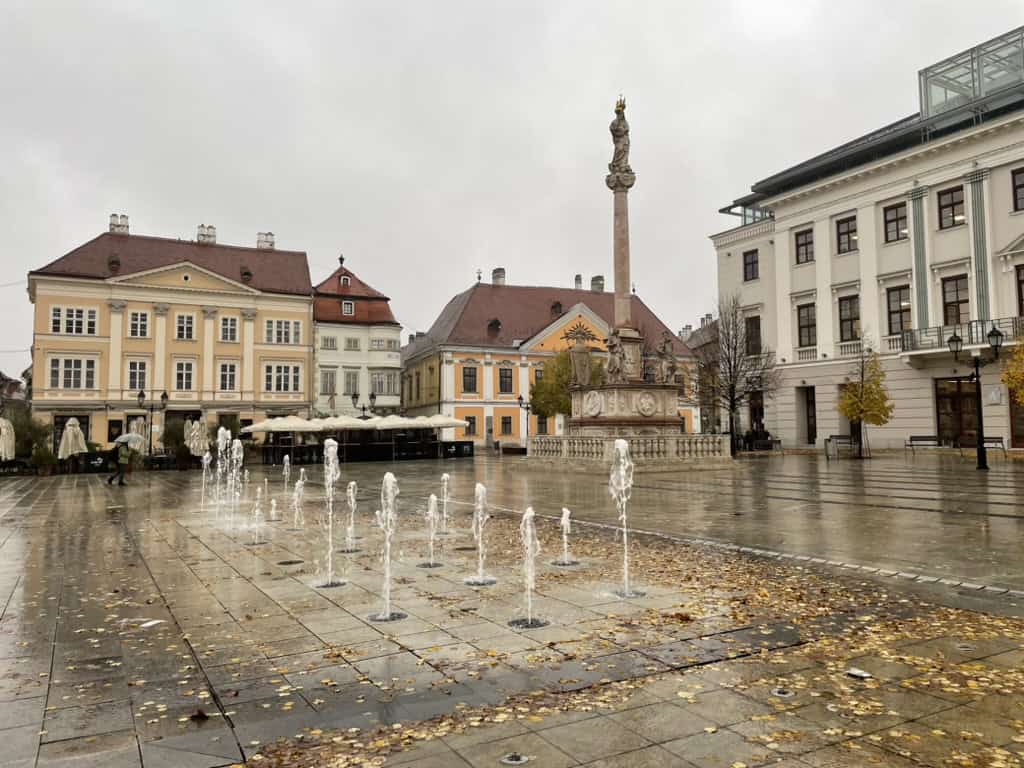
Bishop-Lookout Tower Gyor
Kaptalandomb 1, Gyor Hungary Posted by Brandon B.Admin
Overview
Bishop-Lookout Tower stands on Kaptalandomb, one of Gyor's oldest hills, offering sweeping views across the Danube Valley and the city's baroque rooftops. This 13th-century structure serves as both a historical landmark and a vantage point for understanding how Gyor sits at the intersection of three rivers. The tower is one of Hungary's oldest surviving religious fortifications, and climbing its narrow stone staircase rewards you with perspectives that help orient you within the city's layout.
Why this place matters
Gyor's strategic position on the Danube made it a crucial stronghold in medieval Hungary. The tower was built as part of the bishop's defensive complex, reflecting the considerable power the Catholic Church held over the region. Its survival through centuries of Ottoman occupation, wars, and urban development is itself remarkable. For visitors, it represents an accessible window into Gyor's layered past without requiring a museum visit.
Quick facts
- Location: Kaptalandomb 1, on the hill above the city center
- Originally built in the 13th century as part of episcopal fortifications
- The climb involves approximately 100 stone steps in a narrow spiral staircase
- Tower height allows views extending to the surrounding countryside on clear days
- Accessible year-round during daylight hours
Getting there
Kaptalandomb sits just north of Gyor's historic center, roughly a 10-minute walk from Szechenyi Square. If you're coming from the main train station, head northwest through the old town streets. The most direct approach is from the Jedlik Ányos utca side, where you'll notice the hill rising noticeably above the surrounding buildings. There's no cable car or shuttle, so you're walking uphill on cobblestone and paved paths. The ascent is moderate and takes about five minutes from street level to the tower entrance.
The layout and experience
The tower itself is compact, perhaps 12 meters in diameter. The interior staircase is genuinely narrow, and in places the steps are worn smooth and uneven from centuries of use. If you're taller than average, you'll need to watch your head in a few sections. The climb is steady but not strenuous for most visitors.
Once you emerge at the top, you're standing on a small platform with a low stone parapet. The exposure is real. Wind can be stronger up here than you'd expect, and the platform isn't large enough for groups to spread out comfortably. Most people spend 15 to 20 minutes at the summit, taking photographs and orienting themselves.
The surrounding hilltop area, beyond the tower itself, includes the remnants of the old episcopal complex and some peaceful green space. You can walk around the base and explore the broader Kaptalandomb neighborhood, which retains a quiet, residential character despite being so close to the city center.
Main highlights
The primary draw is the view. From the platform, you can trace the course of the Danube to the north and east. On clear days, the three rivers that define Gyor (the Danube, Raba, and Rabnitz) become visually distinct. The city's baroque spires, particularly those of the Cathedral, stand out against the rooflines below.
The tower itself, as a structure, rewards close observation. The stonework shows different periods of repair and fortification. Medieval building techniques are visible in the wall construction and the way the staircase was carved directly into the stone.
The hill provides context that's difficult to grasp from street level. Gyor's position between water and hills becomes tangible in a way that no map quite captures.
History and background
Gyor emerged as a significant settlement in large part because of its geography. The convergence of three rivers provided water, defense, and trade routes. When the Bishopric of Gyor was established in the 11th century, the church began fortifying the highest point of the settlement. The current tower dates to the 13th century, though the site was fortified earlier.
The tower served multiple purposes over time. It functioned as a lookout point for early warning of attacks, a bell tower for the cathedral complex, and a symbol of episcopal authority. During the Ottoman occupation of Hungary (16th to 17th centuries), Gyor remained in Christian hands, partly due to its fortified position. The bishop's tower played a role in that defense, though later modifications altered much of the original military architecture.
By the 18th and 19th centuries, as military technology changed and Gyor expanded, the tower's defensive function became obsolete. It was preserved more as a historical curiosity and landmark than as an active fortification. Today it stands as one of the oldest structures in the city.
Best time to visit
The tower is accessible most of the year, but weather matters significantly on such an exposed platform. Spring and autumn offer mild temperatures and generally clearer air for photography. Summer can be hot on the climb, and the platform provides little shade. Winter visits are possible but can be windy and slippery if there's ice on the steps.
Early morning light tends to favor photography looking west across the city. Late afternoon light works better if you're photographing the tower itself from the surrounding hill. Weekday visits are quieter than weekends, though the site rarely becomes crowded.
Photography tips
The tower's exterior is most photogenic from the paths circling the base of the hill. Step back to include the surrounding landscape and the city below rather than trying to frame just the tower alone. The stonework details are worth close-up shots if you have a telephoto lens.
From the top, wide-angle shots work best for capturing the panorama, but the platform is small enough that you'll find it difficult to get far enough back for a truly wide perspective. Bringing a phone or compact camera is more practical than a large DSLR with multiple lenses, simply because space is limited.
The cobblestone paths on the hill itself are picturesque, especially in soft light. Include them in foreground shots if you want to convey the experience of the ascent.
Facilities and preparation
There are no facilities inside the tower itself. No restroom, no water, no shop. Bring water if you're visiting in warm weather, especially if you plan to explore the surrounding hill afterward. Wear comfortable walking shoes with good grip, as the cobblestone paths can be slippery when wet. The staircase is manageable for most fitness levels, but it's steep and narrow, so people with mobility concerns should consider whether climbing feels safe.
The tower has no lighting inside, so if you're visiting in late afternoon or on an overcast day, you'll be climbing in dimmer conditions. A phone flashlight is helpful. There's no entrance fee or ticketing process, and no specific opening hours are enforced, though the site is best visited during daylight.
Combining with nearby attractions
Kaptalandomb places you steps away from several major sites. The Cathedral of Gyor is at the base of the hill, and you can easily visit it before or after climbing the tower. The Abby Church, also called the Carmelite Church, is another baroque structure worth seeing. Both churches are within a five-minute walk of the tower's base.
The small streets of the old town, particularly around Szechenyi Square, contain baroque townhouses, courtyards, and local cafes. Plan to spend an hour or two exploring these neighborhoods before or after the tower visit. The nearby Danube Museum is housed in a historic building and offers more context about the region's geography and history.
Sample visit plan
Arrive at Szechenyi Square in the morning, spend 30 minutes exploring the square itself and the surrounding streets. Walk north toward Kaptalandomb, allowing 10 minutes to reach the hill. Spend 5 to 10 minutes climbing the tower and 15 to 20 minutes at the top. Descend and walk around the base of the hill for another 15 minutes. This leaves your afternoon free for the Cathedral, museums, or wandering the old town. A complete visit to the tower and immediate surroundings takes roughly 90 minutes without rushing.
Practical tips
- The climb is one-way only, so you enter and exit through the same narrow staircase. If the tower is busy, you may encounter people coming down while you're going up.
- The platform is small and exposed. Secure any loose items like hats or scarves before ascending.
- The view is best in the late morning or early afternoon when the sun illuminates the city rather than backlighting it.
- If you're sensitive to heights, the platform's low parapet might feel exposed, though you're not particularly high above the surrounding hill.
- The neighborhood around the tower is quiet and mostly residential, so plan your visit for daylight hours when the area feels active.
- No admission is charged, making this an accessible stop even if you're on a tight budget.
FAQ
How long does the climb take? Most people take 5 to 10 minutes to climb the staircase, depending on fitness and pace. The descent takes about the same time.
Is the tower accessible for people with mobility issues? The narrow, spiral staircase with uneven medieval steps is not suitable for wheelchairs or walkers. People with knee or joint problems should consider whether they feel comfortable with the climb.
Can you see the Danube from the top? Yes, the Danube is visible to the north and east, and on clear days you can see several kilometers along the river valley.
Is there a guide or tour available? The tower is self-guided. No formal tours or interpretive signage are provided inside.
What's the best season to visit? Spring and autumn offer pleasant weather and good visibility. Summer can be hot on the exposed climb and platform, while winter can be windy or slippery.
Reviews
Sign in and mark this place visited to leave a review.
No reviews yet.
Free Trip Planner
Plan your Hungary trip with our free planner
Build a day-by-day itinerary with AI suggestions, hand-picked places, and friends. Free forever — no credit card.