
Buda Castle
Szent Gyorgy Ter, Budapest 1014 Hungary Posted by Brandon B.Admin
Buda Castle: Budapest's Hilltop Landmark
Buda Castle sits on Castle Hill above the Danube, commanding one of the most dramatic views in Central Europe. The sprawling palace complex has shaped Budapest's skyline for centuries, and standing on its terrace on a clear morning, with the Chain Bridge below and Pest spreading flat to the horizon, you understand immediately why this place matters. It is not just a building. It is the physical center of Hungary's long, complicated history.
The address, Szent György tér 2 in the 1st district, places you in the Várhegy neighborhood, where the streets narrow and the tourist cafes give way to a quieter, older city. Most visitors arrive here as part of a broader Castle District day, but Buda Castle itself deserves more time than most people give it.
Why Buda Castle Matters
Few royal palaces in Europe have been destroyed and rebuilt as many times as this one. The original fortifications on Castle Hill date to the 13th century, following the Mongol invasion of 1241, when King Béla IV recognized how defensible the hilltop position was. Over the following centuries, the castle grew from a medieval stronghold into a grand royal palace under the Anjou and later the Hunyadi rulers. It reached a cultural peak during the reign of Matthias Corvinus in the 15th century, when it was considered one of the finest Renaissance courts in Europe.
Then came the Ottomans, then the Habsburgs, then the devastating siege of 1686, then another rebuilding, then the Second World War, which reduced much of it to rubble again. What you see today is largely a postwar reconstruction, completed through the 1960s and 1970s, though significant original stonework and underground medieval remains survive beneath the surface. UNESCO added the Castle District, including Buda Castle, to the World Heritage List in 1987.
Quick Facts
Location: Castle Hill (Várhegy), 1st district, Budapest 1014
The palace complex covers roughly 4.5 hectares of built area
Home to the Hungarian National Gallery and the Budapest History Museum
Castle Hill itself rises about 60 meters above the Danube
The funicular (Budavári Sikló) from Clark Ádám tér takes roughly 3 minutes
The complex faces east toward the Pest side of the river, so morning light hits the façade directly
Getting There
You have several options, and the one you choose shapes how your visit begins. The funicular from Clark Ádám tér at the base of the Chain Bridge is the most popular and genuinely enjoyable, though the queue can stretch long in summer. It deposits you right at the castle terrace with no effort and a decent view on the way up.
If you prefer to walk, the staircase path from Várkert Bazár on the riverside takes about 10 minutes at a moderate pace and gives you a more gradual sense of arrival. There is also a bus route (the 16 and 16A from Széll Kálmán tér) that drives up through the Castle District if you want to skip the climbing entirely. Driving is restricted in much of the area, so most visitors come on foot or by public transit.
The Layout and Experience
Buda Castle is not a single building you walk through from entrance to exit. It is a complex of wings, courtyards, terraces, and separate institutions, and understanding that upfront saves confusion. The main palace structure runs in a long arc, divided into labeled wings designated by letters in Hungarian planning documents, though you will not need to know that to navigate it.
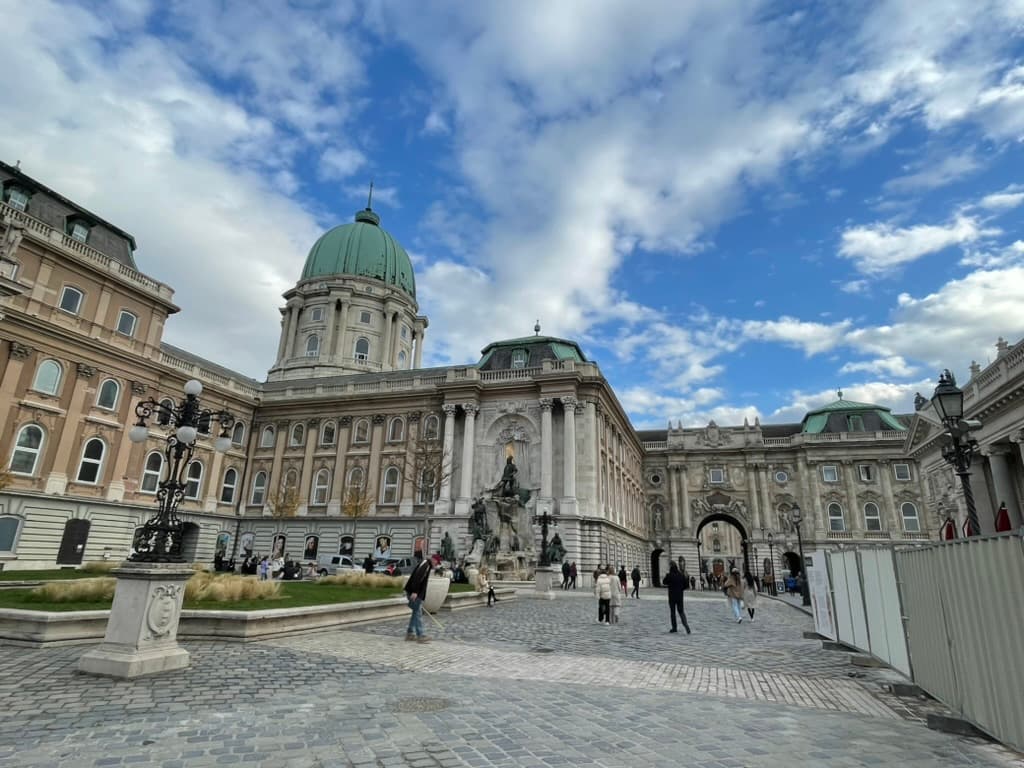
The central courtyard is where most visitors naturally end up, gathered around the bronze equestrian statue of Prince Eugene of Savoy. The views from the eastern terrace here are the ones you have seen in every Budapest photo. To your left and right, the palace wings house the two main museums: the Hungarian National Gallery occupies the central and largest section, while the Budapest History Museum (also called the Castle Museum) sits in the southern wing.
Below the main palace, the medieval remains are accessible through the Budapest History Museum. The underground chambers and Gothic halls down there feel entirely different from the Baroque exterior above, and they are some of the most atmospheric spaces in the entire complex.
Main Highlights
Hungarian National Gallery
The national collection of Hungarian fine art lives here, spanning medieval stone carvings through 19th-century Romantic painting and into the 20th century. The late Gothic altarpieces are extraordinary, and the gallery's holdings of Mihály Munkácsy's monumental canvases draw visitors specifically for those works. The building is vast enough that you can spend two or three hours and still feel like you moved quickly.
Budapest History Museum
This is where the castle's own layered past becomes tangible. The permanent collection traces Budapest from Roman Aquincum through the medieval kingdom and Ottoman period to the modern city. The Gothic rooms in the basement, only rediscovered during postwar reconstruction work, feel genuinely medieval rather than reconstructed.
The Terraces and Views
You do not need a museum ticket to walk the outer terraces and take in the panorama. On a clear day you can see across the Danube to the Hungarian Parliament Building, down to the bridges, and north toward Óbuda. This is also where the Matthias Fountain stands, a large bronze group on the western courtyard that tells the story of a legendary royal hunt.
Tickets and Entry
Walking the castle grounds, courtyards, and exterior terraces is free. The Hungarian National Gallery and the Budapest History Museum each charge separate admission. Both offer general admission tickets, and reduced rates typically apply for students, seniors, and EU citizens under a certain age. Guided tours in English are available for both institutions, usually bookable at the entrance or through the museums' own websites. If you plan to visit both museums in one day, check whether a combined ticket is currently offered, as this has been available in the past.
The Budavári Sikló funicular is ticketed separately, with a different price for the upward versus round-trip journey.
Best Time to Visit
The castle is busy year-round, but summer mornings before 10am give you the courtyards at their quietest. In July and August, tour groups arrive steadily from mid-morning onward. Spring and early autumn tend to be the most comfortable for extended outdoor wandering on the terraces.
Winter is underrated here. The crowds thin considerably, the city below sometimes shows a dusting of snow, and the interior museums become more appealing when the weather pushes you inside. If you visit around late December, the Christmas markets in the Castle District add a specific atmosphere to the surrounding streets.
Photography Tips
The eastern terrace facing Pest is the obvious shooting position, and it is obvious for good reason. For the classic view with the Parliament building visible across the river, position yourself near the central railing in the morning when the light comes from behind you and hits the Pest bank directly.
The western courtyard around the Matthias Fountain tends to be less crowded and offers interesting compositions with the fountain's figures against the palace walls. The underground Gothic halls in the History Museum are dim and require either a wide aperture or patience with slower shutter speeds. Tripods are generally not permitted inside the museums.
Combining with Nearby Attractions
Castle Hill rewards a full half-day rather than an hour-long stop. Within easy walking distance of the castle complex you will find Matthias Church, a Gothic structure with a wildly patterned tile roof, and the Fisherman's Bastion immediately behind it, which offers a different but equally dramatic viewpoint over the Danube. Both are within 10 minutes on foot from the main castle courtyard.
If you descend via Várkert Bazár, the neo-Renaissance garden terraces along the riverbank are worth a slow walk before you cross back to Pest. From there, the Chain Bridge is a short walk north along the embankment.
Practical Tips
Wear comfortable shoes. The cobblestones throughout Castle Hill are uneven and the museums involve significant walking on hard floors.
The funicular closes for maintenance periodically. Check before planning your descent around it.
Both museums have cloakrooms where you can leave large bags, which helps if you are carrying luggage between sights.
There is a café inside the National Gallery, useful for a midday break without having to leave and re-enter.
If you are visiting with children, the History Museum's underground sections tend to hold their attention better than the painting galleries.
Mobile data can be patchy in the underground chambers, so download any maps or audio guides before you descend.
FAQ
Can you visit Buda Castle without going into the museums?
Yes. The courtyards, terraces, and exterior areas are publicly accessible without any ticket. You can walk the grounds, see the Matthias Fountain, and enjoy the views over the Danube without paying anything.
How long should you plan for a visit?
If you want to visit both the National Gallery and the History Museum properly, allow at least four to five hours. A terrace-and-courtyard visit with one museum could work in two to three hours.
Is Buda Castle accessible for visitors with mobility limitations?
The funicular provides step-free access to the hill itself. Inside the palace complex, the terrain is uneven in places, but the museums have elevator access to most floors. It is worth checking the specific museums' accessibility pages before your visit for current details.
What is the difference between Buda Castle and the Castle District?
The Castle District (Várnegyed) refers to the entire hilltop neighborhood, including Matthias Church, Fisherman's Bastion, and the old residential streets. Buda Castle is the royal palace complex specifically, occupying the southern part of the hill.
Reviews
Sign in and mark this place visited to leave a review.
No reviews yet.
Free Trip Planner
Plan your Budapest trip with our free planner
Build a day-by-day itinerary with AI suggestions, hand-picked places, and friends. Free forever — no credit card.
Things to see near Buda Castle



Places to eat or drink near Buda Castle

Rutin

Zazie Bistro

VIRTU Restaurant


