Campanile di Giotto
Piazza del Duomo Historical Center, 50122, Florence Italy Posted by Brandon B.Admin
Florence's Most Elegant Tower: The Campanile di Giotto
The Campanile di Giotto stands at the southwestern corner of the Piazza del Duomo, pressed so close to the Florence Cathedral that you can almost reach out and touch Brunelleschi's dome from its upper terrace. It is one of the most recognizable structures in Italy, and yet visitors still crowd the base and tilt their necks upward as if seeing it for the first time. The white, green, and pink marble cladding catches the Tuscan light differently at every hour, which means the tower you photograph at nine in the morning looks almost nothing like the one you see at sunset.
Giotto di Bondone, the painter who revolutionized Western art, was appointed to design the campanile in 1334. He died just three years into the project. The work was continued by Andrea Pisano and later completed by Francesco Talenti, who finished the bell tower around 1359. The finished structure rises roughly 85 meters above the piazza, making it one of the tallest buildings in Florence and one of the finest examples of Italian Gothic architecture anywhere in the country.
Why the Campanile di Giotto Deserves More Than a Glance
Most visitors to the Piazza del Duomo spend their energy on the Cathedral of Santa Maria del Fiore or queue for the dome climb. The campanile tends to draw shorter lines and receives less attention than its neighbor, which is genuinely puzzling once you've made the ascent. The view from the top is arguably better than the one from the dome, because from up here you can see the dome itself, the baptistery, the terracotta roofscape of central Florence, and on a clear day, the hills of Fiesole to the northeast.
The decorative program on the exterior is also worth slowing down for at street level. The lower registers feature hexagonal and diamond-shaped marble reliefs depicting the liberal arts, the planets, the sacraments, and the activities of human life. The originals were removed for conservation and replaced with high-quality casts, so what you're looking at today are copies, but the originals are on display in the Museo dell'Opera del Duomo directly across the piazza, which makes for a natural pairing visit.
A Tower Built by Three Architects
Understanding the three-phase construction helps you read the building from bottom to top. Giotto's section at the base is the most restrained, with flat surfaces and minimal window openings. Pisano added the next tier, and Talenti opened up the tower with large Gothic biforate and triforate windows as the structure climbed higher, giving the upper sections a much lighter, more airy feeling. The architectural ambition visibly increases as your eye travels upward.
Quick Facts
- Location: Piazza del Duomo, Florence, adjacent to the Cathedral of Santa Maria del Fiore
- Height: approximately 85 meters
- Construction period: 1334 to 1359
- Architects: Giotto di Bondone, Andrea Pisano, Francesco Talenti
- Climb: 414 steps to the top terrace, no elevator
- Managed by: Opera di Santa Maria del Fiore (the same body that oversees the dome, baptistery, and museum)
- Ticket type: included in the combined Duomo Complex pass (timed entry applies to some elements)
Getting There
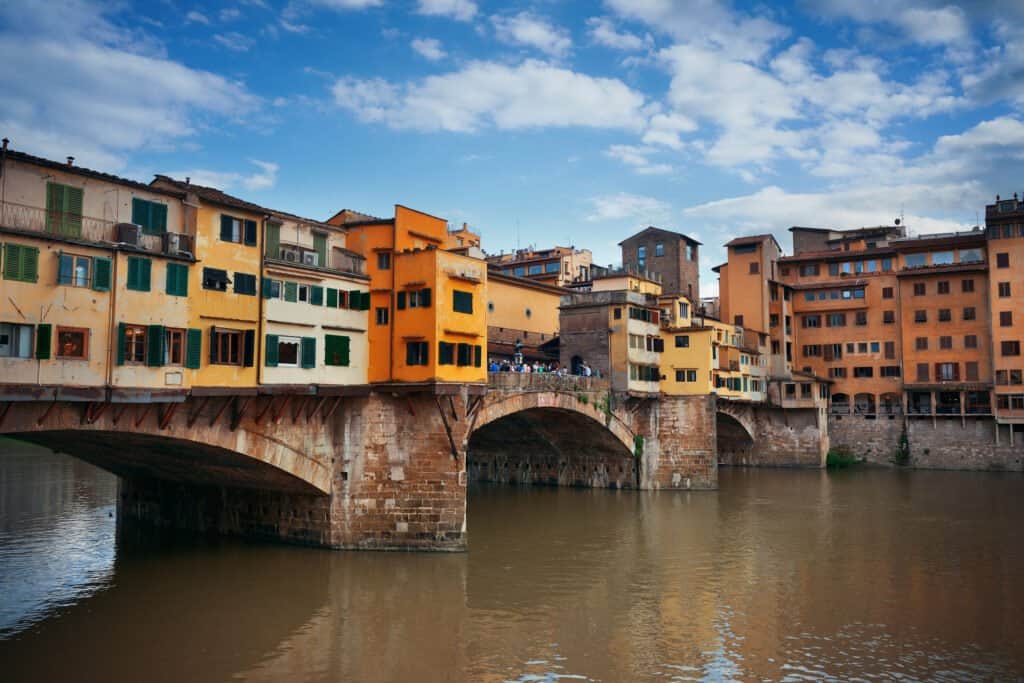
The Piazza del Duomo is walkable from most of central Florence. From the Ponte Vecchio it takes roughly 10 to 15 minutes on foot heading north through the tight streets of the historic center. From Santa Maria Novella train station, allow about 12 to 15 minutes walking east along Via dei Cerretani. There is no dedicated car park nearby, and driving into the ZTL (restricted traffic zone) without a permit will result in a fine, so arriving on foot or by public bus is strongly recommended.
The campanile entrance is on the side facing the cathedral. Look for the queue barrier near the base of the tower rather than the cathedral doors, as first-time visitors often line up at the wrong entrance.
The Climb and What to Expect
There are 414 steps. They are not brutally steep, but the staircase is narrow and the stone worn smooth in places, so take your time. There are no elevators and no shortcuts. The ascent passes several landings with increasingly spectacular window views, and most people stop at each one, which means the pace of the climb is naturally staggered. On busy days in summer, the stairwell can feel warm and close, so a small bottle of water and light clothing are sensible choices.
The top terrace is open-air and surrounded by a metal safety railing. The platform is not enormous, and on peak days it fills quickly, so you may have a few minutes of jostling before you find your angle. Still, the 360-degree panorama is genuinely spectacular. The dome of the cathedral fills the view to the east. The baptistery sits just below you to the north. The red-tiled roofscape stretches in every direction, broken by the occasional tower of a medieval family palazzo.
Tickets and Entry
The campanile is part of the broader Duomo Complex ticket managed by Opera di Santa Maria del Fiore. A single combined pass covers entry to the campanile, the cathedral, the baptistery, the crypt, and the Museo dell'Opera del Duomo. You cannot purchase a standalone campanile-only ticket. Booking in advance online is strongly recommended, especially between April and October, when queues at the on-site ticket office can be long. The dome climb requires a separate timed reservation even within the combined pass, but the campanile does not currently require a timed slot in the same way, meaning you have more flexibility on when you go up.
Best Time to Visit
Early morning, before ten o'clock, tends to offer the shortest queues and the softest light on the marble facade. The piazza gets genuinely crowded by mid-morning in summer, and by early afternoon the stairwell can feel claustrophobic. Late afternoon light is beautiful on the exterior and the dome, but the crowds don't thin until after five or six in the evening, depending on the season.
If you're visiting in November through February, expect shorter queues and cooler temperatures, though the upper terrace can be cold and windy. The marble still looks extraordinary in overcast winter light, and the views are often clearer on crisp days than in the summer haze.
Photography Tips
For exterior shots of the full campanile, the best angle is from the piazza directly in front, or from the narrow streets to the south where you can frame the tower against the sky without the crowd in the foreground. Early morning is when you'll find the piazza most empty.
From the top, a wide-angle lens or your phone's ultrawide setting helps capture the dome and the surrounding city in the same frame. The eastern railing gives you the cathedral dome close up. The northern side gives you the baptistery and a longer view toward the hills. Midday light tends to wash out the terracotta tones, so golden hour shots from the terrace, if you can time your visit to late afternoon, are worth the effort.
Combining with Nearby Attractions
The Piazza del Duomo alone could absorb a full morning. After the campanile, the Museo dell'Opera del Duomo across the square is where the original marble reliefs from the tower's lower register are displayed, alongside Ghiberti's original Gates of Paradise panels and Michelangelo's unfinished Bandini Pieta. It is consistently one of the most underrated museums in Florence and rarely as crowded as the Uffizi.
From the piazza, the Mercato Centrale is about a 10-minute walk northwest, useful if you need lunch. The Accademia Gallery, where Michelangelo's David is housed, is roughly 10 minutes northeast on foot. The baptistery of San Giovanni sits directly in front of the cathedral and is included in the same combined ticket, so there's no reason to skip it.
Practical Tips
- Book your combined Duomo Complex ticket online before you arrive, especially in spring and summer.
- Wear comfortable, closed-toe shoes. The steps are uneven in places and the stone can be slippery when worn.
- The campanile has no café, no shop, and no seating at the top. Bring water.
- Children and adults with mobility concerns should know there is no elevator and the staircase is a continuous climb.
- The piazza is a ZTL zone. Do not attempt to drive or drop off directly in front.
- Photography is permitted throughout. Tripods are generally not practical in the narrow stairwell.
- If your main goal is the view, the campanile terrace offers a perspective of the dome that you simply cannot get from inside the dome itself.
FAQ
Can I visit the campanile without climbing the dome?
Yes. The campanile and the dome are separate elements of the combined pass. The dome requires a timed reservation slot, while the campanile is more flexible. You can visit the tower on the same ticket without booking a dome time at all.
How long does the visit take?
Allow 45 minutes to an hour for the full experience, including the climb, time at the top, and the descent. If you stop to look at the exterior reliefs at the base, add another 15 minutes.
Is the campanile accessible for visitors with limited mobility?
Not in the traditional sense. There is no elevator, and the 414-step climb is the only way up. The exterior and the ground-level reliefs are fully accessible from the piazza.
Are the marble reliefs on the outside original?
No. The originals were moved to the Museo dell'Opera del Duomo for conservation. The reliefs currently on the tower are high-quality casts. The museum is the place to see the authentic panels up close.
Is the Campanile di Giotto the tallest structure in Florence?
At roughly 85 meters, it is one of the tallest, though the dome of the cathedral reaches higher. For many visitors, the campanile's height is enough to offer the most rewarding panoramic view in the city center.
Reviews
Sign in and mark this place visited to leave a review.
No reviews yet.
Free Trip Planner
Plan your Florence trip with our free planner
Build a day-by-day itinerary with AI suggestions, hand-picked places, and friends. Free forever — no credit card.
Related reading
Things to see near Campanile di Giotto

La Lizza Market

Museo dell’Acqua

Porta Camollia