Historium Bruges
Markt 1, 8000 Brugge, BelgiumOverview
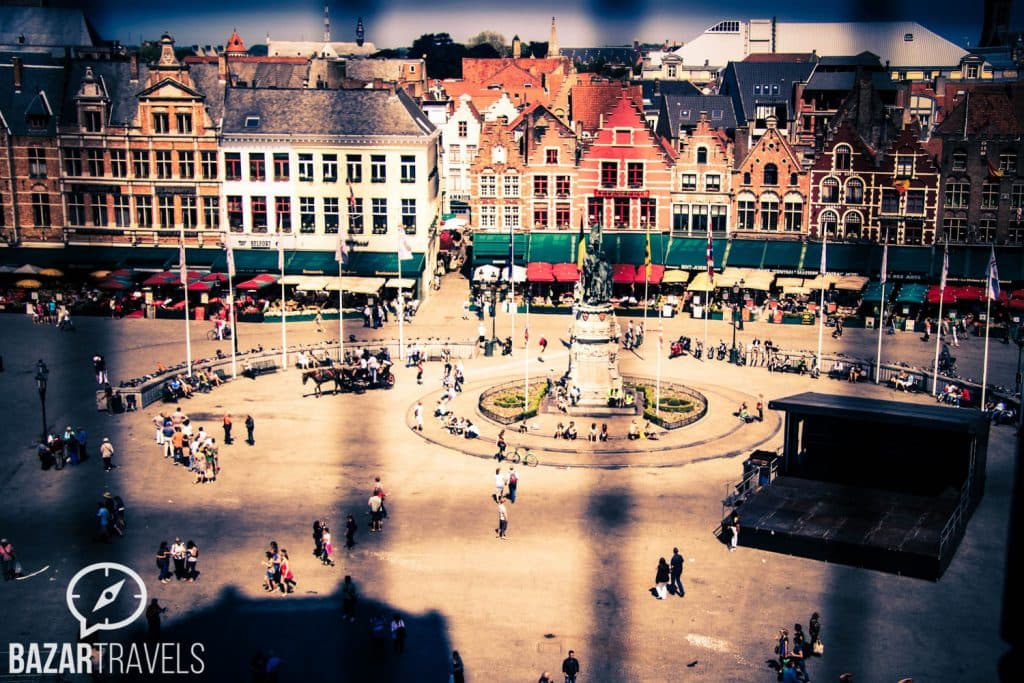
Historium Bruges sits on the Markt, the city's main square, in a restored 14th-century building that once belonged to the Bruges merchant elite. Inside, you move through a series of immersive rooms where actors in period costume guide you through five centuries of the city's story, from its rise as a medieval trading hub to its slow decline and eventual revival. The production design is meticulous: narrow staircases creak under your feet, candlelit chambers smell of aged wood, and the dialogue switches between Dutch, English, French, and German depending on your language track.
This is not a conventional museum. There are no display cases, no placards, no glass barriers. Instead, you're walked through tableaux vivants and video sequences that dramatize key moments: a merchant's office, a plague-stricken alley, a printing press in action, a weaver's workshop. The entire experience lasts roughly 75 to 90 minutes, and you move as a group at a set pace.
Why this place matters
Bruges' medieval prosperity is abstract until you stand in the rooms where that wealth was made and spent. Historium makes that tangible. Rather than reading about the Hanseatic League or the Burgundian court, you see the spaces where merchants negotiated deals, where disease ravaged the population, where guild masters trained apprentices. The city's peculiar trajectory (from Europe's wealthiest port in 1450 to a backwater by 1600, then rediscovered as a living museum in the 20th century) is woven into the narrative.
For visitors pressed for time or seeking context before exploring the actual medieval streets outside, Historium compresses centuries into a focused, theatrical experience. It's also one of the few attractions in Bruges that explicitly connects past to present, asking how a city dies and is reborn.
Quick facts
- Located on the Markt, Bruges' central square, in a 14th-century merchant house
- Visitor experience is approximately 75 to 90 minutes
- Multilingual audio guides available in Dutch, English, French, German, Spanish, Italian, and others
- Entry is by timed ticket; advance booking is strongly recommended during peak season
- The building has multiple staircases and narrow passages, so mobility may be a consideration
- Tickets are mid-range in price
Getting there
The Markt is Bruges' geographical heart and impossible to miss. If you arrive by train, walk north from Bruges Central Station (Brugge Centraal) for about 10 minutes, or take a local bus. The route is flat and well-signposted. From any hotel in the city center, the Markt is a 5 to 15-minute walk depending on your starting point.
Historium's entrance is on the ground floor of the building, directly facing the square. Look for the signage and queue area. There is no separate entrance; you enter through the street-level doorway.
The layout and experience
You begin in a small foyer where staff check your timed ticket and assign you to a language channel. From there, you ascend a narrow stone staircase typical of Flemish merchant houses. The building's original structure is preserved, so you're moving through an authentic 14th-century shell.
The experience unfolds across multiple rooms and levels. Early scenes are set in the merchant quarter and docks, establishing Bruges as a conduit for Baltic amber, English wool, and Mediterranean spices. Actors in wool and linen explain their trades; background sound design includes ship bells, haggling voices, and the creak of cargo. You move through a series of interconnected chambers, each representing a different era or social sphere.
Midway through, the tone shifts. A plague sequence uses dim lighting, haunting music, and the sight of actors portraying the sick and dying. This is the darkest moment in the narrative, reflecting Bruges' actual population collapse in the 15th century. The experience then moves forward through the Spanish occupation, the silting of harbors, and the city's near-abandonment by the 17th century.
Final rooms address the 19th-century romantic rediscovery of Bruges as a "Venice of the North" and the rise of tourism. The narrative concludes on an ambiguous note: Bruges survives as a living museum, but at what cost to authenticity? You exit into the daylight of the Markt with that question hanging.
Main highlights
The merchant's office tableau is visually striking. You stand in an intimate chamber lined with ledgers, bolts of fabric, and scale weights. An actor in a fur-trimmed wool tunic explains the mechanics of credit, double-entry bookkeeping, and the spice trade. The language track is clear and engaging, and the material is surprisingly technical without feeling academic.
The plague sequence is the most emotionally intense moment. The lighting drops, the temperature seems to fall, and actors in dark cloth move silently through a dimly lit alley. There is no gore or explicit horror, but the psychological weight is real. Children under 8 may find it unsettling.
The printing press room demonstrates the arrival of Gutenberg's technology in Bruges and its impact on the city's information economy. An actor operates a working replica press, and you can see (and hear) the mechanical process. This room is often a favorite among visitors interested in technology history.
The final chamber, addressing Bruges as a tourism destination, is reflexive and slightly satirical. The curators are aware that you, the visitor, are part of the phenomenon the museum is describing. This meta-awareness prevents the experience from feeling like simple nostalgia.
History and background
Historium opened in 2016 in a building with documented ownership records back to the 14th century. The structure itself is a primary source: the masonry, the timber framing, the layout of rooms all reflect authentic medieval commercial architecture. The curators worked with historians and archaeologists to ensure the historical narrative is accurate, though the theatrical presentation is necessarily selective and dramatized.
The building's original function was as a merchant house and warehouse. Bruges' prosperity rested on a handful of families who controlled the cloth trade, the spice routes, and credit networks. These houses were both offices and residences, designed to impress visiting traders and store valuable goods. Historium preserves that dual function: you're seeing a real space, but it's been reinterpreted as a stage.
The city of Bruges itself declined sharply after 1500 as the Zwin estuary silted up, making the harbor inaccessible to large ships. By 1600, Bruges was a secondary city. It remained economically depressed until the 19th century, when Romantic-era travelers rediscovered it as a living relic of medieval Christendom. That rediscovery, paradoxically, saved the city by turning it into a cultural asset rather than allowing it to be demolished for modern development. Historium engages with this paradox directly.
Tickets and entry
Entry is by timed ticket purchased in advance or at the box office. General admission grants access to the full experience. No separate child rate or group discount is advertised on-site, so you'll need to check current pricing policies directly.
Tickets are released for specific time slots, usually starting at 9:00 AM or 9:30 AM and running through late afternoon. Peak times (late morning, early afternoon) fill quickly during summer and school holidays. Off-season visits (November to March) have more availability and shorter queues.
The experience is self-paced within the group. If you move slowly or want to linger in a particular room, staff will accommodate this, though the overall flow is group-based. If you arrive at your assigned time slot and are running late, inform staff; they may be able to slot you into a later group.
Best time to visit
Summer (June to August) is peak season. The Markt is crowded, queues are long, and the building itself is warm and sometimes stuffy. If you visit in summer, arrive early or book an early-morning slot. Evening slots (if available) tend to be less crowded.
Spring (April to May) and fall (September to October) are ideal. Weather is mild, tourism is heavy but manageable, and the lighting inside the building benefits from longer daylight hours (which, paradoxically, makes the candlelit rooms feel more atmospheric by contrast).
Winter (November to March) is quiet and contemplative. The building is chilly, which actually enhances the medieval atmosphere. Crowds are minimal. If you're visiting Bruges for Christmas markets or winter atmosphere, Historium fits well into that mood.
Rainy days are fine. The experience is entirely indoors, and bad weather outside actually keeps crowds lower.
Photography tips
Flash photography is prohibited, and dim lighting makes handheld shots difficult. A smartphone with a good low-light mode will outperform a compact camera in most rooms. Tripods are not permitted.
The most photogenic moments are the merchant's office (rich textures and candlelight) and the printing press room (dramatic lighting and mechanical detail). The plague sequence is too dark for useful photography, and the dramatic effect is better experienced firsthand than captured.
The real photography opportunity is outside on the Markt itself, before or after your visit. The building's facade, the square's medieval guild halls, and the Belfry in the background offer excellent wide shots. The hour before sunset provides warm, flattering light for exterior shots.
Facilities and preparation
The building has toilet facilities on the ground floor and upper levels. They are small and sometimes busy, so use them before or after your time slot if possible.
There is no bag storage, though small backpacks are permitted. Large luggage or coats can be awkward on narrow staircases, so travel light if possible.
The experience involves walking up and down multiple flights of stairs. If you have mobility limitations or knee problems, consider whether this is feasible. There is no elevator, and the stairs are steep and narrow by modern standards. Staff cannot assist with mobility aids or wheelchairs.
The building is unheated in winter and can be chilly. Layers are a good idea. In summer, it remains cool, which is actually comfortable.
The audio guide is provided via headphones or earplugs with a small receiver clipped to your belt. Sound quality is good, and you control the volume. The language track is selected when you enter.
Combining with nearby attractions
The Markt itself is surrounded by significant buildings. The Belfry (Belforten) stands at the north end and is worth visiting separately for the 366 steps up and views across the city. The Town Hall (Stadhuis) occupies the south side and has a small historical museum inside. Both are within sight of Historium.
The Church of Our Lady (Onze-Lieve-Vrouwekerk) is a 10-minute walk south and houses a Michelangelo sculpture. The Groeninge Museum (Flemish and Belgian art) and the Memling Museum (in a medieval hospital) are both within walking distance east of the Markt.
If you're interested in medieval commercial history after Historium, the Bruges Brewery (Brouwerij De Halve Maan) offers tours explaining the city's beer-making heritage. The Lace Centre (Kantkantoor) demonstrates traditional Bruges lacemaking. Both are short walks from the Markt.
A logical half-day itinerary: Historium in the morning, lunch on the Markt or in the side streets, then the Belfry or Town Hall, followed by a canal-side walk or a visit to one of the smaller museums.
Sample visit plan
If you have a morning slot (9:30 AM to 11:00 AM), you'll finish with the rest of the day ahead. Grab coffee or breakfast on the Markt afterward, then climb the Belfry while energy is high. Lunch in one of the restaurants facing the square. Afternoon can be devoted to the Groeninge Museum or a leisurely canal walk.
If you have an afternoon slot (2:00 PM to 3:30 PM), spend the morning exploring the backstreets of Bruges, visiting smaller churches or the Lace Centre, then come to Historium with fresh legs. Afterward, the light will be good for sunset photography from the Markt or a nearby bridge. Evening can be spent in a restaurant or beer hall.
For a full day centered on medieval Bruges, start with Historium to get historical context, then visit the actual medieval sites it references: the merchant quarter near Sint-Janshuisplein, the harbor area near Sint-Annadal, and the guild halls around the Markt. Historium provides the narrative framework; the city itself provides the evidence.
Practical tips
- Book tickets online in advance, especially during summer months
- Arrive 10 to 15 minutes before your assigned time slot
- Wear comfortable shoes; you'll be on your feet for 75 to 90 minutes, mostly walking up and down stairs
- The building is cool even in summer; bring a light layer
- If you don't speak the language your ticket is assigned to, inform staff upon entry and they may be able to switch you to another language group
- The experience is designed for adults and older teens; children under 8 may find the plague sequence disturbing
- Do not expect to move at your own pace; the experience is group-based and timed
- Photography inside is permitted without flash; bring a phone with good low-light performance if you want to capture images
FAQ
How long does Historium take? The full experience is 75 to 90 minutes from entry to exit. This includes the time spent in each room and the pace of the group.
Can I leave early or come back later if I don't finish? No. Once you enter, you're committed to the full experience. If you need to leave early due to an emergency, staff can assist, but there is no refund or restart option.
Is it worth visiting if I don't speak English well? Yes. The audio guide is available in multiple languages, and the visual and theatrical elements convey meaning even if you miss some dialogue. However, the experience is enhanced if you understand the language track, so choose your language carefully at entry.
Are there any outdoor or open-air parts? No. The entire experience is indoors in the medieval building. You enter and exit on the Markt, but the Markt itself is not part of the attraction.
Can I visit with a stroller or wheelchair? The building has no elevator, multiple narrow staircases, and tight passages. Strollers and wheelchairs are not practical and are not accommodated. If mobility is a concern, this attraction may not be suitable.
Opening hours
Reviews
Sign in and mark this place visited to leave a review.
No reviews yet.
Free Trip Planner
Plan your Bruges trip with our free planner
Build a day-by-day itinerary with AI suggestions, hand-picked places, and friends. Free forever — no credit card.