Hofskirkja Church
Hof Road, Hof Iceland Posted by Brandon B.Admin
Iceland's Last Turf Church: Hofskirkja in the East
Hofskirkja Church stands at the edge of the Skeiðarársandur glacial plain in southeast Iceland, a small turf-and-stone building that has been in continuous use longer than almost any other church in the country. It sits near the hamlet of Hof, roughly 30 minutes east of Skaftafell along the Ring Road, and it looks exactly the way you might imagine an ancient Icelandic church should look: low, grassy, and almost buried into the landscape around it. If you are driving the south coast, stopping here takes less than 20 minutes and leaves an impression that stays with you long after the bigger glacier viewpoints do not.
The church is widely considered the last turf church built in Iceland using traditional methods, constructed in 1884. That detail matters. Turf churches were the dominant form of rural religious architecture across Iceland for centuries, but by the late 19th century the tradition was already dying out, replaced by wooden and concrete structures. Hofskirkja arrived at the tail end of that era, and the fact that it survived intact makes it genuinely rare.
Why Hofskirkja Matters
There are older turf churches in Iceland, and there are more visited ones. But Hofskirkja is the last one built with the full traditional construction technique: a timber frame wrapped in layers of cut turf blocks, the whole structure merging visually with the earth around it. The grass on the roof is not decorative. It is structural insulation, the same as it was when the building went up.
The churchyard surrounding Hofskirkja is still an active burial ground, and the graves you see there span generations of families from this part of Iceland. That continuity gives the place a weight that a museum replica simply cannot replicate. This is not a preserved relic behind glass. People still worship here.
Quick Facts
- Built in 1884, making it the last turf church constructed using traditional Icelandic methods
- Located on Hof Road near the hamlet of Hof, approximately 30 minutes east of Skaftafell
- Listed as a protected cultural heritage site under Icelandic law
- The interior seats a small congregation, typical of rural Icelandic churches of its era
- Free to visit the exterior and churchyard at any time
- Interior access is sometimes available during summer months, depending on scheduled services
- Part of the broader Vatnajökull National Park region
Getting There
Hofskirkja sits just off Route 1, the Ring Road, near the Hof farm area in the Öræfi region. If you are heading east from Vík or Kirkjubæjarklaustur, the turn is well-signed. From Skaftafell visitor center, the drive is around 25 to 30 minutes east along Route 1. From the town of Höfn, you are looking at roughly an hour westward.
There is a small gravel parking area close to the church. Most visitors arrive by rental car, which is by far the easiest option on this stretch of the south coast. Public bus services along the Ring Road do stop in this general region during summer, but the schedule is infrequent and you would need to confirm current timetables before relying on it.
The Layout and Experience
The church is small. That is not a caveat, it is the point. Walking up to Hofskirkja, what strikes most people first is how organically it sits in the ground, the turf roof blending almost seamlessly into the field behind it. The white-painted timber gable at the front is the only element that announces itself clearly against the surrounding green and grey landscape.
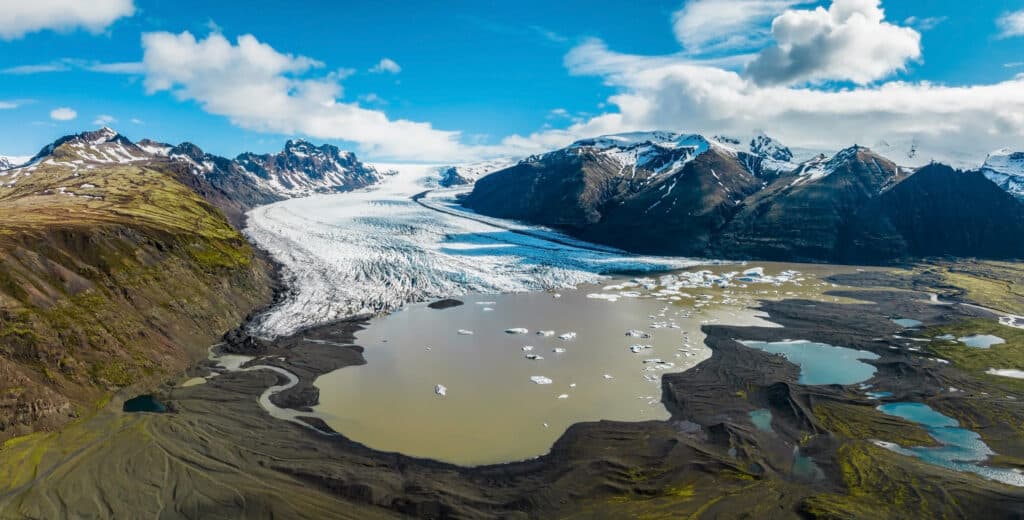
The churchyard wraps around the building, enclosed by a low stone wall. Old headstones lean at various angles, some weathered to near-illegibility. The Vatnajökull glacier and its outlet tongues are visible in the distance on clear days, which gives the whole scene an almost theatrical backdrop that feels entirely unearned by how quietly the place presents itself.
If the interior is open when you visit, step inside. The space is intimate, with wooden pews and a simple altar. The ceiling follows the pitched roofline closely and the light through the small windows is low and calm. It takes only a few minutes to see everything, but those minutes feel different from the rest of a busy Ring Road day.
History and Background
Turf construction was not a choice of poverty in Iceland. It was a practical response to a treeless landscape and a harsh climate. Timber had to be imported or salvaged from driftwood, and turf was abundant, insulating, and durable when built correctly. Churches across Iceland were built this way from the earliest days of Christian settlement, and the technique persisted in rural areas long after it disappeared elsewhere in Scandinavia.
By the time Hofskirkja was built in 1884, most Icelandic parishes were already shifting to imported timber frame construction. The Hof congregation built theirs the old way regardless, and that decision is the reason the building looks the way it does today. Icelandic authorities have designated it a protected structure, and restoration work has been carried out carefully over the years to maintain the original construction methods rather than modernize the fabric of the building.
The Öræfi region where the church stands has its own difficult history. The 1362 eruption of the Öræfajökull volcano, one of the largest in Iceland's recorded history, destroyed much of the populated land in this area. The name Öræfi translates roughly as wasteland, a name given after that eruption. The region was resettled, and Hofskirkja is in many ways a marker of that long, quiet rebuilding of community life here.
Best Time to Visit
The church exterior is accessible year-round. Summer, roughly June through August, gives you the best chance of finding the interior open and the churchyard easy to walk around without ice or snow underfoot. The long daylight hours of midsummer also mean you can stop here in the evening and still have full light, when the crowds from the nearby glacier viewpoints have thinned out.
Winter visits have their own appeal if you are prepared for it. Snow on the turf roof deepens the sense of the building belonging entirely to the landscape. The road is generally passable in winter, though conditions on Route 1 in this region can change quickly, so always check road conditions before you set out.
Photography Tips
The classic shot is from slightly in front and to one side, low enough to show the turf roof merging into the grass behind. Early morning or late afternoon light works best, when the low sun picks out the texture of the turf and the stone wall. Overcast days actually suit the place well too since the soft light matches the muted palette of the building.
If Vatnajökull is clear, try a wider frame that includes the glacier in the background. The contrast between the tiny ancient church and the vast ice cap behind it is one of those compositions that does not need any help to work. A 24mm or 35mm focal length tends to give you the most natural sense of scale.
Be respectful in the churchyard. It is an active burial ground, not a photo backdrop, and the graves deserve the same consideration you would give any cemetery.
Combining with Nearby Attractions
Hofskirkja sits in one of the most attraction-dense stretches of the Icelandic Ring Road. Skaftafell, within Vatnajökull National Park, is about 30 minutes to the west and offers glacier hikes, waterfall walks to Svartifoss, and a well-equipped visitor center. Jökulsárlón glacier lagoon is roughly 45 minutes east, and the adjacent Diamond Beach, where ice chunks wash ashore on black sand, is one of the most photographed spots in Iceland.
Combining Hofskirkja with a stop at Svínafellsjökull glacier, just a few minutes further toward Skaftafell, makes for a morning that moves from human scale to geological scale and back again. It is a pairing that works well.
Practical Tips
- The church exterior can be visited any time, but interior access varies. Check with local guides or the Skaftafell visitor center if interior access matters to you.
- Wear waterproof footwear. The churchyard grass is often wet, and the ground around the building can be muddy after rain.
- There are no facilities on site. The nearest services are at the Skaftafell area, about 30 minutes west.
- Do not walk on the turf roof or touch the turf walls. The building is fragile and actively protected.
- If you are visiting during a church service, be respectful and wait until it concludes before approaching closely.
- The parking area is small. In peak summer, arrive early or later in the day to avoid congestion.
- Road conditions in this region can change rapidly in winter. Check vegagerdin.is before driving.
FAQ
Is Hofskirkja free to visit?
The exterior and churchyard are free to access at any time. Interior access, when available, is typically also free, though donations are welcomed.
Can you go inside the church?
The interior is sometimes open to visitors, particularly during summer months. It is not guaranteed, so treat it as a welcome bonus rather than a certainty. The exterior alone is worth the stop.
Is Hofskirkja still an active church?
Yes. Services are still held here, and the surrounding churchyard remains in active use as a burial ground.
How long should I plan to spend here?
Most visitors spend 15 to 25 minutes. If the interior is open and you want to sit quietly for a while, you might stretch that to 30 or 40 minutes. It is not a place that demands a long visit, but it rewards a slow one.
Is it accessible for visitors with mobility limitations?
The parking area is close to the church, but the churchyard ground is uneven grass and gravel, which can be challenging. The exterior view from the entrance is largely achievable without needing to walk far into the yard.
Reviews
Sign in and mark this place visited to leave a review.
No reviews yet.
Free Trip Planner
Plan your Hof trip with our free planner
Build a day-by-day itinerary with AI suggestions, hand-picked places, and friends. Free forever — no credit card.