Kairaouine Mosque (Mosque of al-Qarawiyyin)
Fes el-Bali Qayruwan quarters, Fes 30030 Morocco Posted by Brandon B.Admin
The Kairaouine Mosque and the World's Oldest University
Few places on earth carry the weight that the Kairaouine Mosque does. Sitting deep inside Fes el-Bali, the medieval medina of Fez, this is not simply a mosque. It is the spiritual and intellectual center of a city that shaped Islamic scholarship for centuries, and attached to it is the University of al-Qarawiyyin, widely recognized as the oldest continuously operating university in the world, founded in 859 CE. You can walk its surrounding lanes, peer through carved cedar doorways, and feel the pull of something genuinely ancient without a single word of explanation from a guide.
Most visitors to Fez make it to the tanneries or the souks and consider the medina explored. The Kairaouine Mosque demands a different kind of attention. It rewards slowness.
Why the Kairaouine Mosque Matters
The mosque was founded by Fatima al-Fihri, the daughter of a wealthy Tunisian merchant who emigrated from Kairouan. That founding in 859 CE predates Oxford University by roughly 250 years. The institution grew into one of the most significant centers of learning in the medieval world, attracting scholars across theology, grammar, rhetoric, and astronomy. Ibn Khaldun, the historian often called the father of sociology, studied here. So did, according to some accounts, the medieval scholar Gerbert of Aurillac, who later became Pope Sylvester II.
The building itself has been expanded and renovated by successive dynasties, including the Almoravids and Merinids, which is why the architecture layers different periods on top of each other in a way that rewards close looking. The prayer hall reportedly holds up to 22,000 worshippers.
Quick Facts
- Founded: 859 CE by Fatima al-Fihri
- Location: Qayruwan quarter, Fes el-Bali (the old medina)
- Entry for non-Muslims: not permitted inside the mosque or university
- Exterior viewing: free, from the surrounding lanes and doorways
- Nearest landmark: Place Seffarine, a few minutes' walk away
- Library: the al-Qarawiyyin Library holds manuscripts dating back over a thousand years and was restored and opened to researchers in 2016
Getting There
There is no easy address in the way you might type one into a map. Fes el-Bali does not permit cars in most of its interior, so you will be walking regardless of where you start. From Bab Bou Jeloud, the blue-tiled gate that most visitors enter through, the mosque is roughly 15 to 20 minutes on foot through the main artery of Talaa Kebira. Keep heading deeper into the medina, past the Bou Inania Madrasa, and follow signs or ask as you go.
A better approach for a first visit is to hire a licensed guide from the official guides office near Bab Bou Jeloud. The lanes around the Kairaouine are genuinely disorienting, and a guide will also point out doorway details and courtyard glimpses you would otherwise miss entirely.
Alternatively, come from the direction of Place Seffarine, the brass-workers' square. From there the mosque's exterior is just a short walk and the acoustic atmosphere of hammering metal adds something to the approach.
The Layout and Experience
Because non-Muslims cannot enter, the experience is one of threshold and suggestion rather than full access. That is not a complaint. The carved plaster and cedarwood visible through open doorways, the sound of water from interior fountains, the murmur of students reciting text, these glimpses feel more honest than many fully accessible tourist sites.
The mosque covers roughly 3,000 square meters of prayer space and has multiple doorways spread across the surrounding quarter. Each doorway offers a slightly different angle. The one near Place Seffarine tends to give you the clearest look into the courtyard, depending on how wide the doors are open at any given time. There is no single "front" in the conventional tourist sense.
The streets directly around the mosque are among the quietest in the medina. Vendors thin out, the lanes narrow, and the stone underfoot becomes worn smooth. This part of Fes el-Bali feels closest to how the city might have felt several hundred years ago.
History and Background
Fatima al-Fihri used her inheritance to fund both the mosque and the adjacent educational institution, an act of religious endowment called a waqf. The university grew organically from Quranic study circles into a full institution offering advanced learning. By the 10th and 11th centuries it was drawing scholars from across North Africa, the Iberian Peninsula, and the broader Islamic world.
The Merinid dynasty, which ruled Morocco from the 13th to the 15th century, undertook major renovations and built several of the madrasas immediately adjacent to the mosque, including the Attarine Madrasa. These buildings functioned as student residences and supplementary study spaces. You can enter the Attarine Madrasa for a small admission fee and get a sense of the architectural vocabulary that surrounds the mosque without being able to enter the mosque itself.
The library attached to al-Qarawiyyin holds one of the most important collections of Islamic manuscripts in existence. After a major restoration led by Moroccan-Canadian architect Aziza Chaouni, it reopened in 2016. Access is restricted to researchers, but the fact of its survival and restoration is itself worth knowing before you arrive.
Best Time to Visit
Early morning, before the souks fully open, gives you the quietest lanes and the best chance of hearing the call to prayer echo through the quarter. The light in the medina is also more manageable before midday, when it becomes harsh and the alleys can feel crowded.
Friday midday is when the mosque sees its largest congregation, and the surrounding streets fill with worshippers. It can be a powerful thing to witness, but expect the lanes to be busy and some doorways to be less accessible to non-Muslim visitors during that window.
Ramadan changes the atmosphere of the entire medina significantly. After iftar, the streets around the Kairaouine come alive in a way that is unlike any other time of year. If you are visiting during Ramadan, plan to be in this area after sunset.
Photography Tips
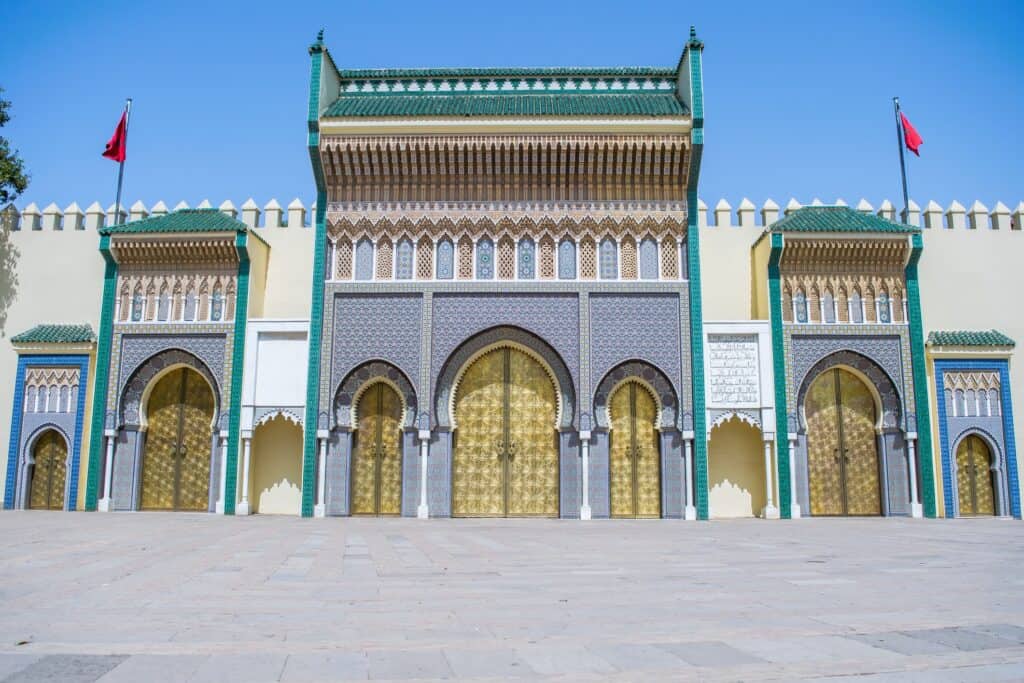
You cannot photograph the interior, but the doorways themselves are worth serious attention. The carved cedar lintels and zellige tilework visible from outside are some of the finest examples of Moroccan craft anywhere in the medina. A wide-angle lens helps in the narrow lanes. Come before 9am if you want people-free exterior shots.
Place Seffarine, just a few minutes away, is one of the most photogenic corners of the medina and makes a natural pairing. The reflective brass bowls and the ambient noise of metalworking give you something active and textured to photograph after the quieter approach to the mosque.
Combining with Nearby Attractions
The Attarine Madrasa sits almost directly adjacent to the mosque's main entrance side and is one of the most ornate Merinid buildings you can actually walk through. The Bou Inania Madrasa, closer to Bab Bou Jeloud, is another excellent example and has a working water clock on the street outside. Both charge a modest admission fee.
The Chouara tanneries are a 10-minute walk northeast of the mosque and are usually combined with a visit by most itineraries. The tanneries are best viewed from the leather shop balconies overlooking the vats, where you get a clear aerial perspective. Most shops allow access for free with the expectation that you will at least browse.
Practical Tips
- Dress conservatively regardless of the season. Covered shoulders and knees are appropriate and will make interactions in the quarter easier.
- Do not attempt to enter the mosque or university. The rule is firm and widely enforced.
- Unofficial "guides" will approach near Bab Bou Jeloud. Hiring through the official guides association costs more but avoids being steered toward commission-paying shops.
- The lanes directly around the mosque can be hard to find without help. Save an offline map of Fes el-Bali before you enter.
- Bring cash. Almost everything in this part of the medina operates on cash only.
- Give yourself at least two to three hours for this quarter. Rushing through it is a waste of the trip.
FAQ
Can non-Muslims enter the Kairaouine Mosque?
No. The mosque and university are closed to non-Muslim visitors. This policy has been consistently in place for many years. The experience for non-Muslim visitors is through the doorways and surrounding lanes.
Is there an entry fee for the exterior area?
No. The streets and lanes surrounding the mosque are public and free to walk. You pay only if you enter adjacent sites like the Attarine Madrasa.
How long should I spend in this area?
Most visitors find that two to three hours covers the mosque exterior, Place Seffarine, and one or two of the nearby madrasas comfortably. Add more time if you plan to reach the tanneries on the same walk.
Is it possible to visit the al-Qarawiyyin Library?
Access is restricted to researchers and is not open for general tourist visits. The building itself is not visible from the public lanes in any significant way.
Is the medina around the mosque safe to walk alone?
Generally yes, including for solo travelers. The quarter immediately around the mosque is quieter and less hustler-heavy than the main souk arteries. Standard medina awareness applies: keep your belongings close and be confident in your movement.
Reviews
Sign in and mark this place visited to leave a review.
No reviews yet.
Free Trip Planner
Plan your Fes trip with our free planner
Build a day-by-day itinerary with AI suggestions, hand-picked places, and friends. Free forever — no credit card.