
Llaqtapata
Machu Picchu Peru Posted by Brandon B.Admin
Llaqtapata: The Inca Site Most Visitors Never See
Llaqtapata sits on a ridge directly across the Aobamba Valley from Machu Picchu, close enough that on a clear morning you can make out the terraces of the famous citadel without binoculars. Yet almost nobody comes here. While thousands of visitors queue at the Sun Gate or jostle for the classic postcard shot on Huayna Picchu, Llaqtapata offers something increasingly rare in this part of Peru: genuine quiet, and a perspective on Machu Picchu that the citadel itself cannot give you.
The site is not a secondary attraction in the way that phrase usually implies. Archaeologists believe it functioned as a way station and ceremonial complex directly related to Machu Picchu, positioned so that its central plaza aligns with the winter solstice sunrise over the larger site. That relationship, astronomical and logistical, is what makes Llaqtapata worth the effort.
Why Llaqtapata Matters
Most Inca sites in the Machu Picchu area are understood in isolation, but Llaqtapata forces you to think about the whole landscape as an intentional design. The site was likely used by pilgrims and travelers arriving along the Inca Trail from the Santa Teresa valley, and its terraced platform would have been among the first purpose-built stops before reaching Machu Picchu itself.
Gary Ziegler and archaeologist Johan Reinhard documented the site more thoroughly in the early 2000s, clarifying its extent and the precision of its astronomical alignments. Before that work, Llaqtapata was known mainly as a rough cluster of ruins partially cleared by Hiram Bingham in 1912, the same year he brought Machu Picchu to international attention. The fact that Bingham noted it and the world still largely forgot it tells you something about how thoroughly Machu Picchu dominates the surrounding region.
Quick Facts
- Location: Above the Aobamba Valley, roughly 4 to 5 kilometers west of Machu Picchu as the crow flies
- Elevation: Approximately 2,700 meters above sea level
- Access: Reached via the Santa Teresa trekking route or as part of the Salkantay Trek in its final stages
- Typical visit duration: 1 to 2 hours on site, not counting the trek in and out
- Crowds: Very light year-round compared to Machu Picchu and even Choquequirao
- Facilities: None on site. Aguas Calientes is the nearest town with food, lodging, and services
Getting There
Llaqtapata is most commonly visited as a stop on the Salkantay Trek, specifically on the descent toward Aguas Calientes via the Hydroelectric Station. If you are walking that route, your guide will typically lead you off the main path and down to the site before continuing to the valley floor. The detour adds roughly 2 hours to that day's walk, depending on the group's pace.
You can also approach from the Hydroelectric Station side, following the rail line toward Aguas Calientes and then climbing up to the ruins. This approach is less common but manageable for fit hikers who want to visit without committing to the full Salkantay route. Either way, the trail is not paved and involves uneven terrain, so proper footwear matters.
There is no road access. That is precisely why the site remains uncrowded.
The Layout and Experience
Llaqtapata is smaller than Machu Picchu in both area and architectural complexity, but it is not a ruin in the crumbled, overgrown sense. The main platform includes stone terraces, a central plaza, and several structure foundations that retain their walls to waist height or above. The stonework is classic Inca construction, fitted without mortar, and holds up well enough that you can read the layout without much imagination required.
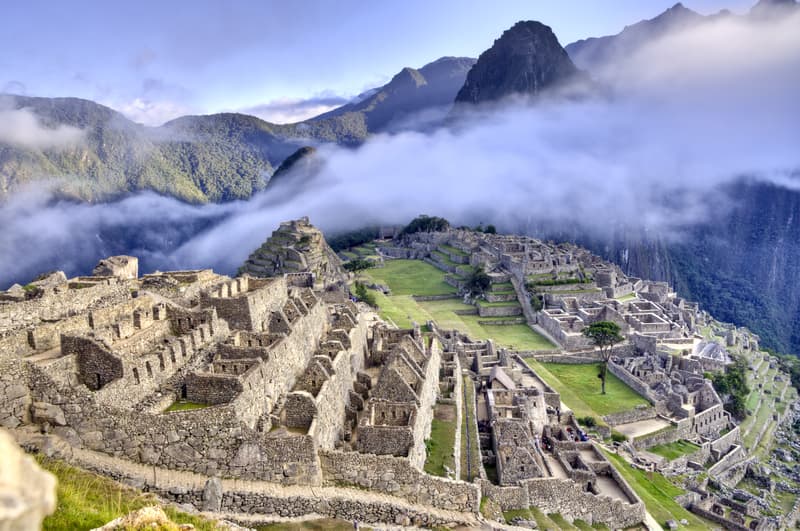
What distinguishes the experience most is the view. Standing on the main terrace, Machu Picchu appears across the valley on the opposite ridge, framed by cloud forest and often wrapped in mist during morning hours. It is arguably the best external view of Machu Picchu available anywhere, showing the citadel in its full landscape context in a way that standing inside it never allows. Photographs from here capture the relationship between the site and the surrounding mountains that the standard postcard angles completely miss.
The site tends to be silent except for birds. If you arrive as part of a trekking group, you will likely have it to yourselves for the entire visit.
History and Background
Hiram Bingham recorded Llaqtapata in 1912 but focused his resources and attention almost entirely on Machu Picchu. The name itself means roughly "high flat place" or "town on the hill" in Quechua, a description that fits the topography accurately. For most of the 20th century, the site appeared in academic literature as a footnote.
The more detailed surveys carried out in the early 2000s reframed it significantly. Researchers found that the orientation of the main structure aligns with the winter solstice sunrise as it crests over Machu Picchu, suggesting the two sites were understood as a coordinated sacred landscape rather than independent constructions. This kind of inter-site astronomical relationship is found elsewhere in the Inca world, but the directness of the Llaqtapata-to-Machu Picchu alignment is considered unusually precise.
The site also sits at a junction of Inca road networks connecting the Sacred Valley to the jungle lowlands, which reinforces the theory that it served both ceremonial and practical transit functions.
Best Time to Visit
The dry season, running roughly from May through October, gives you the most reliable trail conditions and the clearest views across to Machu Picchu. During the wet season from November through April, the cloud forest closes in quickly, and the path to the site can become slippery and difficult. That said, the wet season also brings dramatically lush vegetation and, on mornings when the clouds briefly part, some of the most atmospheric views of the valley.
Solstice dates, particularly around June 21, are worth considering if the astronomical alignment interests you. Arriving early enough to catch the sunrise over Machu Picchu from the Llaqtapata terrace requires planning your trek day carefully, but the light at that hour is worth the effort regardless of the date.
Photography Tips
The main terrace faces northeast toward Machu Picchu, which means morning light works in your favor. Midday tends to flatten the scene, and by afternoon the citadel across the valley often disappears into cloud shadow. If you have any flexibility in your trek schedule, push to arrive before 9am.
A wide lens helps capture the full sweep from the Llaqtapata stonework in the foreground to Machu Picchu and Huayna Picchu on the far ridge. The depth of that composition is what separates this shot from anything you can take inside the main site. A telephoto allows you to isolate specific terraces on Machu Picchu from this vantage, which can be surprisingly detailed on a clear day.
Combining with Nearby Attractions
Almost everyone who visits Llaqtapata does so as part of a multi-day trek, most often the Salkantay Trek, which finishes in Aguas Calientes. From there, the obvious next stop is Machu Picchu itself, which takes on a different meaning after you have seen it from the outside at Llaqtapata. The contrast between the two experiences, the quiet ridge with its handful of structures versus the managed crowds of the main site, is genuinely striking.
If you have an extra day in the area, the town of Aguas Calientes offers hot springs, a small archaeological museum, and the practical comfort of proper food and a bed. The train journey back to Ollantaytambo or Cusco from Aguas Calientes passes through scenery that continues to reward attention even after several days of trekking.
Practical Tips
- Hire a licensed guide or join an organized trek. The trail to Llaqtapata is not well signposted and the site itself benefits enormously from contextual explanation.
- Carry all water and food you need for the day. There are no vendors anywhere near the site.
- Acclimatize in Cusco for at least two days before attempting any multi-day trek in this region. The elevation difference between Cusco and the Salkantay pass is significant.
- Trekking poles make the descent from Llaqtapata toward the valley floor noticeably easier on the knees.
- Check with your trek operator about current trail conditions before departure, particularly if traveling between December and March.
- Llaqtapata does not currently require a separate entry ticket beyond what may be included in your trek permit, but confirm this with your operator as regulations in the Machu Picchu area change periodically.
- Layers are essential. The ridge can be cold in early morning and warm by midday, and rain can arrive quickly at any hour.
FAQ
Do I need a special permit to visit Llaqtapata?
Most trekkers visit as part of an organized tour that handles any required permissions. If you plan to arrive independently, check current requirements with Peru's Ministry of Culture or a reputable local operator before you go, as permit rules in the broader Machu Picchu area are updated regularly.
Is Llaqtapata suitable for children?
The trail is long and uneven, and the approach involves significant elevation change. Older children who are comfortable with full-day hikes on rough terrain can manage it, but it is not a casual family outing. Most guided treks that include the site are designed for reasonably fit adults.
Can I visit Llaqtapata and Machu Picchu on the same day?
In practical terms, most people visit Llaqtapata during a multi-day trek and then continue to Aguas Calientes to spend the night before visiting Machu Picchu the following morning. Attempting both in a single day would require very early starts and strong fitness. It is possible but not the typical approach.
How does the site compare to Machu Picchu?
Llaqtapata is smaller, less excavated, and architecturally less complex than Machu Picchu. The reason to visit is not to compare grandeur but to see the landscape these sites share, and to understand Machu Picchu as part of a wider Inca network rather than an isolated wonder.
Reviews
Sign in and mark this place visited to leave a review.
No reviews yet.
Free Trip Planner
Plan your Machu Picchu trip with our free planner
Build a day-by-day itinerary with AI suggestions, hand-picked places, and friends. Free forever — no credit card.
Related reading

Things to see near Llaqtapata


Places to eat or drink near Llaqtapata

Tampu Restaurant at Sanctuary Lodge

Tinkuy Restaurant

Peru Cafe Machupicchu


