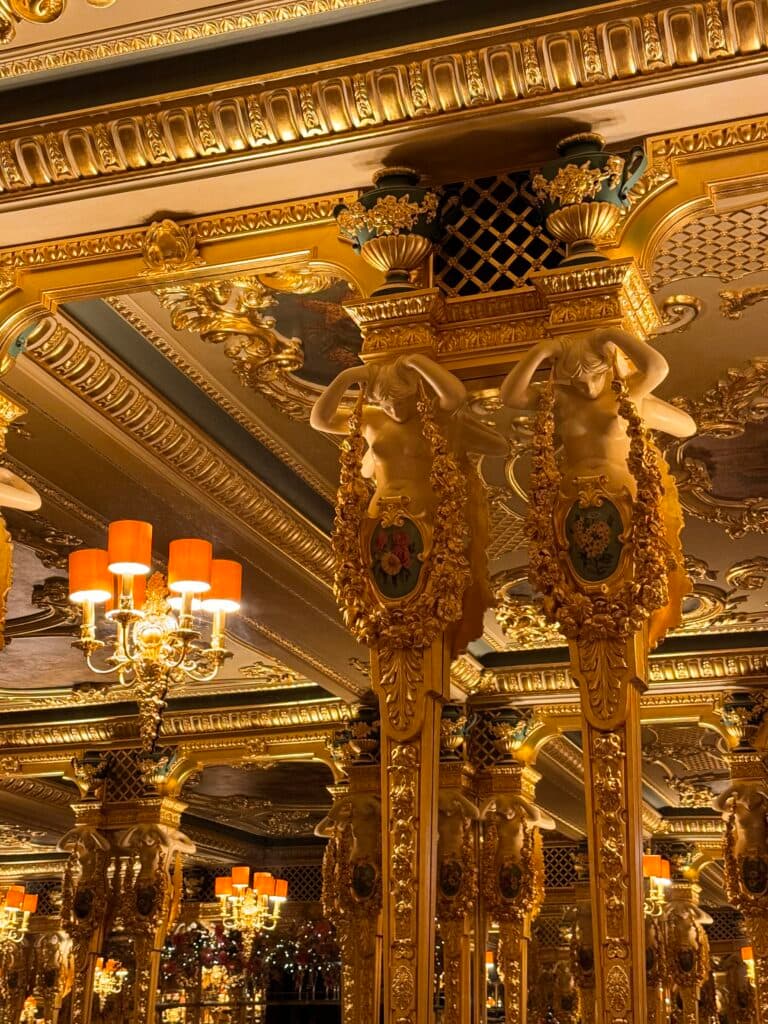
London Mithraeum sits seven meters below the modern floor of Bloomberg's European headquarters on Walbrook, in the square mile that makes up the City of London. It's a Roman temple, built around 240 AD and dedicated to the god Mithras, that was discovered by chance in 1954 and has since become one of the more unusual free museums in the city. You descend a spiral staircase from a glass-fronted lobby into near darkness, and the temple reassembles itself around you through light and sound rather than glass cases and wall text.
The site is officially called London Mithraeum Bloomberg SPACE, reflecting its dual role as an archaeological reconstruction and a small gallery of Roman finds unearthed during construction of the Bloomberg building itself.
Why London Mithraeum matters
Few Roman sites in London let you stand inside the actual footprint of a 3rd-century building rather than look at it from behind a rope. The temple's foundations, lower walls, and the base of its columns are original Roman stonework, not replicas. What has been reconstructed above that line is a deliberate, semi-abstract suggestion of the temple's original form, using timber and metal to hint at columns and roofline without pretending to recreate something nobody can be certain about.
The cult of Mithras arrived in Roman Britain from Persia by way of the eastern Mediterranean and the army. It was a mystery religion, meaning initiates kept its rites secret, so a lot of what's known comes from artifacts rather than texts. That mystery is part of why the site still draws people who have no particular interest in Roman history otherwise.
Quick facts
- Address: 12 Walbrook, London EC4N 8AA
- Original construction date: around 240 AD
- Discovered: 1954, by archaeologist W.F. Grimes during post-war building work
- Reopened at original depth: November 2017, after Bloomberg's redevelopment of the site
- Admission: free, but entry is by timed ticket
- Nearest stations: Bank, Cannon Street, and Mansion House, all within about 5 to 8 minutes on foot
Getting there
Bank station is the most straightforward approach, served by the Central, Northern, Waterloo & City, and DLR lines, with the walk down Queen Victoria Street taking roughly 5 minutes. Cannon Street station, on the District and Circle lines and with mainline rail connections, is even closer, just a couple of minutes along Walbrook itself. If you're coming from the south side of the river, Mansion House on the District and Circle line works well too. There's no dedicated parking at the site, which sits in the middle of the City's pedestrian-heavy financial district, so driving in isn't really practical on a weekday.
The layout and experience
You enter through the ground floor of the Bloomberg building, a striking piece of contemporary architecture in its own right, designed by Foster + Partners. A small display area on the way down holds a selection of the roughly 14,000 Roman objects recovered during the Walbrook Discovery Programme, one of the largest archaeological excavations ever carried out in London. Look for the writing tablets, some of the earliest handwritten documents found in Britain, along with leather shoes, pottery, and small personal items that survived because the waterlogged ground of the old Walbrook river preserved organic material unusually well.
From there, a staircase takes you down to the temple level. The room is kept dark until a timed sequence begins: mist, shifting light, and a low chant-like soundscape gradually reveal the temple's outline, evoking the sense of a ritual taking place in the space. It's a theatrical touch rather than a strictly academic one, and it runs on a loop every twenty minutes or so, meaning you can time your visit around it if you want to see the full sequence rather than catch it mid-way.
The whole underground area is compact. Most visitors spend somewhere between 40 minutes and an hour there, including the artifact gallery upstairs.
History and background
The temple was uncovered in September 1954 during construction work on a bomb-damaged site near Walbrook, at the time known as Bucklersbury House. W.F. Grimes led the dig, and the discovery caused a genuine public sensation, with reports of queues stretching for blocks as Londoners came to see a marble head of Mithras and other sculpture pulled from the mud. The pressure to save the find led to the temple's remains being lifted and relocated a short distance away, reconstructed above ground on a rooftop terrace in a form that bore little resemblance to its original setting.
When Bloomberg acquired the site decades later to build its European headquarters, the company worked with the Museum of London Archaeology to return the temple to something close to its original location and depth, rebuilding it there as part of the new development. That project is what visitors see today, a rare instance of a major archaeological monument going back into the ground it came from rather than into a museum vitrine.
Tickets and entry
Entry is free, which is unusual for a site of this quality in central London, but you do need to book a timed ticket in advance through the Mithraeum's website, especially for weekend slots or during school holidays when demand runs higher. Walk-up entry sometimes works on a quiet weekday afternoon, but it's not something to count on if your schedule is tight. Group visits and guided tours can also be arranged separately.
Best time to visit
Weekday mornings tend to be the quietest, particularly outside of school holiday periods, since the City itself is a business district with relatively low weekend foot traffic. That quiet extends to the museum, meaning you're less likely to be sharing the small temple chamber with a large group. The site closes on Sundays and Mondays most weeks, so plan around a Tuesday to Saturday visit, and check the current schedule before you go since hours shift periodically.
Facilities and preparation
The site is fully accessible by lift for visitors who can't use the spiral staircase, and staff at the entrance can point you to it. There's no cafe on site, though the surrounding streets around Bank and Cannon Street have plenty of options, from chain coffee shops to City pubs serving lunch. Bags are generally fine to bring in, but it's worth checking current security guidance if you're carrying anything large, given the building's dual use as a working corporate headquarters.
Combining with nearby attractions
The Bank of England Museum is a short walk away and free as well, making a natural pairing if you want two contrasting slices of City history in one visit. St Paul's Cathedral is roughly 10 minutes on foot to the west, and the Guildhall Art Gallery, which itself sits above the remains of London's Roman amphitheatre, is about the same distance north. If you're building a Roman London theme into your day, the Museum of London's collection (currently relocating to its new Smithfield site) ties in well too, though it's worth checking where it currently operates from before you go.
Practical tips
- Book your timed slot online ahead of your visit rather than relying on walk-up availability
- Arrive a few minutes early so you're not rushing through the artifact display upstairs
- Wear layers, the temple chamber is kept cool and dim year-round
- Time your descent to catch the start of the light and sound sequence rather than joining midway
- Combine the visit with a walk along Queen Victoria Street to see where the Walbrook river once ran, now entirely built over
FAQ
Is London Mithraeum free to visit?
Yes, admission is free, though you need a timed ticket booked in advance.
How long should I spend there?
Most visits run between 40 minutes and an hour, covering both the ground-floor artifact display and the temple itself.
Is the temple the original Roman structure?
The lower walls and foundations are original 3rd-century Roman stonework. The upper structure is a modern interpretation suggesting the temple's original form.
Is it suitable for children?
The dim lighting and sound installation appeal to older kids and teenagers more than very young children, though families do visit regularly.
What's the closest Underground station?
Bank and Cannon Street are both within a short walk, with Bank offering the widest range of connecting lines.
London Mithraeum remains one of the few places in the city where you can stand inside a Roman religious building on the exact ground where Roman Londoners once gathered to worship. Between the free admission, the compact scale, and its location deep beneath a modern City skyscraper, it's a stop worth building into any walk through this part of London.
Opening hours
Reviews
Sign in and mark this place visited to leave a review.
No reviews yet.
Free Trip Planner
Plan your London trip with our free planner
Build a day-by-day itinerary with AI suggestions, hand-picked places, and friends. Free forever — no credit card.
Related reading



Things to see near London Mithraeum | Bloomberg SPACE

Fulham Palace

Treetop Walkway Richmond
Stand On The Prime Meridian