Overview
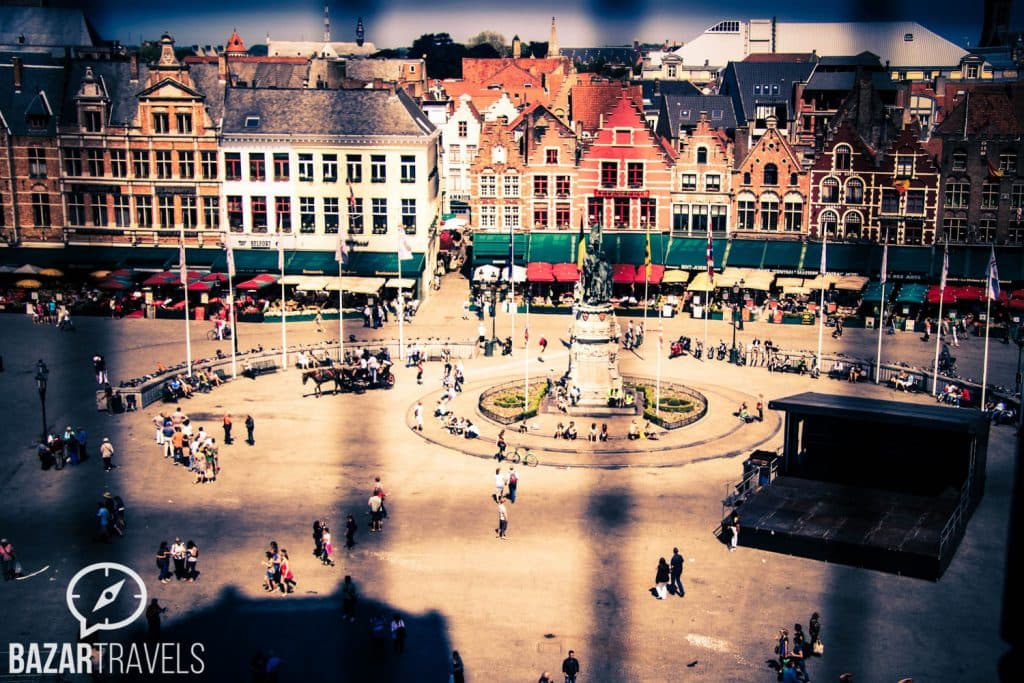
The Markt in Bruges sits at the city's nerve center, a sprawling medieval square ringed by guild houses and dominated by the Belfry tower that rises 83 meters above the cobblestones. On any given afternoon, the square fills with people nursing coffee at pavement cafes, families posed for photos, and locals cutting through on their way somewhere else. The light changes constantly here depending on the hour and season, catching the facades at different angles and turning the brick from rust to gold to gray.
This is not a quiet square. The Markt functions as both museum and marketplace, both tourist stage and living town center. You can spend an hour here and see nothing but crowds and souvenir shops. You can also spend an hour and feel the weight of seven centuries of Flemish power and commerce, the accumulated presence of people who lived and died within view of this same tower.
Why this place matters
The Markt has been Bruges' commercial and civic heart since at least the 13th century, when the city was one of the richest ports in Northern Europe. The square's shape and purpose have remained largely unchanged since medieval times. The Belfry, completed in 1482, served as both watchtower and treasure vault for the city's merchant guilds. When you look at the building line around the square, you are looking at centuries of accumulated wealth rendered in brick and stone.
The square's current form tells a story of destruction and recovery. Much of what you see today was rebuilt after World War I, when shelling damaged the medieval fabric. The post-war reconstruction kept the original street plan and rooflines but updated interiors to modern standards. This mixture of period authenticity and practical modernization makes the Markt feel both historical and inhabited, rather than purely preserved.
Quick facts
- The Belfry tower stands 83 meters tall and dates to the 14th century (the spire was added in the 16th century)
- The square has been Bruges' main marketplace since the 13th century
- The surrounding guild houses were largely rebuilt between 1920 and 1940 after World War I damage
- Timed entry tickets to the Belfry are available in winter and summer; the tower is closed certain days
- The square covers roughly 1,000 square meters and is entirely pedestrianized
- Budget to mid-range restaurants and cafes line all four sides
Getting there
The Markt sits in the old town, within walking distance of Bruges' main train station. From the station, follow Sint-Jansstraat north for about ten minutes on foot. The walk climbs gradually and passes through residential streets before opening suddenly onto the square.
If you arrive by bus, the main transit hub is close by. Taxis and ride-share services can drop you on the perimeter, but vehicles are not allowed on the square itself.
Parking near the Markt is limited and expensive. Most visitors park in one of the large garages on the square's edge or in the lot near the Beguinage, then walk. The square is entirely pedestrianized, so once you are there, navigation is straightforward.
The layout and experience
The Markt is roughly rectangular, with the Belfry occupying the northern side and guild houses forming a continuous wall on the other three sides. The square slopes subtly; if you stand at the south end and look north, the Belfry appears to sit slightly higher than you.
The ground level of the surrounding buildings is almost entirely given over to restaurants, cafes, and small shops. The upper floors contain apartments and offices. This mixed-use arrangement means the square is never truly empty, even late at night.
Crowds build steadily through the morning and peak between noon and 5pm. If you want to photograph the square with fewer people, arrive by 8am or after 6pm. The light is best in late afternoon, when the western sun strikes the eastern facades of the guild houses.
The Belfry anchors everything visually. Its weathered brick, Gothic details, and soaring height draw your eye no matter where you stand. The tower includes a carillon of 47 bells, which ring on the hour and play longer sequences several times daily.
Main highlights
The Belfry tower is the obvious draw. You can climb the 366 steps to the top for a view across the rooftops of Bruges to the flat countryside beyond. The ascent is narrow and winding, and the stairs grow steeper near the end. At the top, the carillon chamber fills most of the space, and windows open on all sides. The view encompasses Sint-Salvatorskerk to the east, Sint-Janshospitaal to the south, and the spire of Sint-Godeleva to the west.
The guild houses themselves reward close looking. Each bears distinctive stonework, carved details, and a date marking when it was rebuilt. The façades tell you something about their original purpose, though most are now restaurants or shops. Number 18 (on the south side) was the Waterhalle, where fish merchants sold their catch. Number 28 has a stepped gable typical of early-16th-century Flemish style.
The square's character changes with the season. In summer, the cafes spread across the cobblestones with tables and umbrellas. In winter, the space opens up again. Spring brings tour groups; autumn brings locals back.
History and background
Bruges was a major trading city in the 13th and 14th centuries, with connections to the Mediterranean via the Rhine and to London via the North Sea. The Markt developed as the center of this commerce, a place where Hanseatic merchants, Venetian traders, and local cloth sellers conducted business. The square's size reflects the city's ambitions and wealth during this period.
The Belfry was built to house the city's treasuries, weights and measures, and records. The tower also served as a watchtower and a symbol of civic autonomy. When the Spanish ruled the region, they imprisoned political prisoners in the Belfry's upper chambers. The tower survived sieges, fires, and centuries of wear.
The medieval guild system organized craft production in Bruges. Weavers, brewers, masons, and bakers each had their own guildhalls on or near the Markt. These guilds controlled apprenticeships, set prices, and enforced standards. The buildings you see today are successors to those original structures.
World War I devastated Bruges. The city changed hands multiple times between 1914 and 1918, and shelling damaged many medieval buildings. The post-war reconstruction was careful and conservative by the standards of the time. Builders restored the historic street plan and façade lines while modernizing interiors for electricity, plumbing, and central heating. This approach preserved the square's medieval character while making it livable for the 20th century.
Tickets and entry
Entry to the Markt itself is free. The square is public space, open at all hours.
Climbing the Belfry requires a timed entry ticket, purchased at the base of the tower or online. Tickets are available year-round, though hours and availability vary by season. Children under a certain age may enter free or at a reduced rate. The climb takes 20 to 30 minutes depending on fitness and crowd levels. The tower is occasionally closed for maintenance or events, so check ahead if the Belfry is your primary goal.
Several museums occupy buildings on or adjacent to the Markt, including Groeningemuseum and Sint-Janshospitaal. These require separate admission.
Best time to visit
Early morning, before 9am, gives you the square nearly to yourself. The light is soft and even, and the cafes are just opening. This is the best time to photograph the Belfry and guild houses without crowds.
Late afternoon, after 5pm, brings a second quiet window as day-trippers depart for other towns. The western sun at this hour creates dramatic shadows and highlights the brick facades.
Avoid midday in summer if you want to avoid crowds. The square can feel overwhelming between noon and 4pm, with tour groups, families, and casual visitors all competing for space.
Winter is quieter overall. Fewer tourists visit Bruges in December through February, and the square feels more like a functioning town center than a destination. The cold can be damp and penetrating, but the light is often clearer.
The Belfry's carillon plays longer sequences on certain days and at specific times. If you want to hear the bells properly, ask locally about the schedule.
Photography tips
The Belfry's height makes it impossible to photograph the entire tower from ground level without tilting the camera back sharply. Wide-angle lenses exaggerate this effect. For a balanced shot, step back to the south side of the square and frame the tower against the guild houses.
The guild house facades photograph best in soft morning light or late afternoon light. Midday sun creates harsh shadows and bleaches the colors. Overcast days produce even, flat light that is less dramatic but more forgiving for architectural detail.
Crowds are unavoidable in the square, but they can work compositionally. A frame showing the Belfry with people on the cobblestones conveys the place's function and energy more honestly than an empty square ever could.
From the top of the Belfry, the view outward is constrained by the narrow windows, but the carillon chamber itself offers interesting textures and details worth documenting. Bring a tripod if you are interested in long-exposure work, though the light changes quickly at height.
Facilities and preparation
Bathrooms are available in restaurants and cafes around the square, usually with a purchase required. The Bruges visitor center is a short walk away on Concertgebouwplein and has facilities.
The climb up the Belfry involves narrow, steep steps. It is not suitable for people with severe mobility issues, and children should be comfortable on stairs. There is no elevator.
Cafes on the Markt range from budget-friendly to mid-range in price. You can sit down for coffee and a sandwich or spend an hour over a more substantial meal. Most operate from breakfast through dinner. Food quality is variable; some spots cater primarily to tourists, while others serve locals and offer better value.
The square has no shade except what the guild houses provide along the edges. Bring sunscreen and a hat if you plan to spend hours here in summer.
WiFi is available in most cafes and restaurants. Phone signal is reliable throughout the square.
How it compares to similar places
The Markt resembles other great medieval squares in Northern Europe, like the Grote Markt in Antwerp or the Rynek Starego Miasta in Warsaw. What distinguishes Bruges' Markt is its compactness and the quality of the surrounding architecture. The guild houses are smaller and more densely packed than in larger cities, creating a more intimate sense of enclosure. The Belfry is also finer and more prominent than the civic towers of many peer cities.
Unlike some European medieval squares that have been heavily modernized or commercialized, the Markt retains a relatively authentic layout and building fabric. The post-war reconstruction respected the original character rather than replacing it wholesale with contemporary design.
Compared to other Bruges attractions like Sint-Salvatorskerk or the Beguinage, the Markt is busier and more openly commercial. It functions as a living square as well as a historic monument, which appeals to some visitors and overwhelms others.
Combining with nearby attractions
The Markt is within five minutes' walk of several major sites. Sint-Salvatorskerk, the cathedral, sits one block to the east. The Groeningemuseum and Sint-Janshospitaal occupy buildings on the south side of the square. The Beguinage is a ten-minute walk south.
A typical morning itinerary might begin with coffee on the Markt, followed by a climb up the Belfry, then a visit to one of the nearby museums. The square works well as both a starting point and a place to decompress between other activities.
The Rozenhoedkaai, famous for its picturesque view of the Belfry reflected in the canal, is a five-minute walk west. Most visitors photograph that view after spending time on the Markt itself.
Sample visit plan
Arrive at the Markt by 8am. Grab coffee at one of the cafes and spend 20 minutes photographing the square in the early light. The crowds have not yet arrived, and the facades are beautifully lit.
Between 8:30 and 10am, climb the Belfry if you have booked a timed ticket. The stairs are less crowded in the morning. Spend 15 to 20 minutes at the top taking in the view and listening to the bells if they are playing.
After descending, walk east to Sint-Salvatorskerk for an hour inside the cathedral. This gives you a change of pace and a chance to sit in quiet.
Return to the Markt around noon for lunch at one of the restaurants. The square is busier now, but this is also when the cafes serve their best-executed meals.
Spend the early afternoon exploring the Groeningemuseum or Sint-Janshospitaal, both of which are close by. These visits typically take 90 minutes to two hours.
Return to the Markt by 4pm or 5pm. The afternoon light is warm and the crowds are beginning to thin. Spend a final hour sitting on the square, watching the light change, before dinner or departure.
Practical tips
- Book Belfry tickets online in advance during peak season to avoid long queues at the base of the tower
- Arrive early if photographing the square is your priority; crowds build steadily through the morning
- The cafes on the Markt are convenient but often pricier than restaurants one block away; explore the surrounding streets for better value
- Wear comfortable walking shoes; the cobblestones are uneven and can be slippery when wet
- The square is never truly quiet, even late at night, due to restaurant activity and foot traffic
- Check the Belfry's opening hours before you go; the tower closes certain afternoons and some winter days
- If you visit in summer, bring sunscreen and a hat; there is limited shade on the open square
- The light is best for photography in early morning or late afternoon; midday sun creates harsh shadows
FAQ
How long does it take to climb the Belfry? The ascent takes 20 to 30 minutes depending on fitness and how many people are on the stairs. The descent is faster, usually 10 to 15 minutes. Budget an additional 15 to 20 minutes to spend at the top taking in the view.
Is the Markt accessible for people with mobility issues? The square itself is flat and pedestrianized, making it accessible for wheelchairs and people with walking difficulties. The Belfry tower is not accessible; there is no elevator and the stairs are narrow and steep.
Can I bring a bike to the Markt? The square is pedestrianized and bikes are not permitted. There are bike racks on the surrounding streets where you can lock your bicycle.
What is the best time of day to visit the Markt? Early morning before 9am or late afternoon after 5pm offer the best combination of light and fewer crowds. Midday in summer is the most crowded and least pleasant time to visit.
Are there free bathrooms on the Markt? Bathrooms in restaurants and cafes are available for customers. The Bruges visitor center, a short walk away, has public facilities.
Reviews
Sign in and mark this place visited to leave a review.
No reviews yet.
Free Trip Planner
Plan your Bruges trip with our free planner
Build a day-by-day itinerary with AI suggestions, hand-picked places, and friends. Free forever — no credit card.