
Merrion Square South is the southern stretch of one of Dublin's grandest Georgian squares, a short walk from Trinity College and St Stephen's Green. The square itself, laid out in 1762, remains one of the best-preserved examples of 18th-century urban planning in the city, and its south side gives you a good vantage point over the central park, with its flower beds, winding paths, and scattered statues. If you're mapping out a day in Georgian Dublin, this is one of the anchor points.
Why Merrion Square South matters
Dublin has a handful of Georgian squares left, and Merrion Square is arguably the most complete of them. The red-brick terraces that wrap around three sides of the park were built for the city's wealthy at a time when Dublin was still a provincial capital trying to look like London. What makes the south side worth lingering on is the combination of domestic architecture and literary association. This was a residential square first, a civic landmark second, and you can still feel that in the doorways and fanlights even now that most of the houses have become offices or institutional headquarters.
The square also sits at a hinge point in the city. Walk west and you're at Leinster House and the museum quarter. Walk east and you're heading toward the Grand Canal and the more residential Georgian streets of Baggot Street and Fitzwilliam Square. Few spots in Dublin let you pivot so easily between the tourist trail and the quieter, lived-in parts of the city.
Quick facts
- Location: Merrion Square South, Dublin 2, on the southern edge of Merrion Square Park
- Laid out: 1762, as a Georgian residential development
- Admission: Free to enter the park and walk the square
- Nearby landmarks: Leinster House, National Gallery of Ireland, National Museum of Natural History, Trinity College
- Known for: Georgian townhouses, the Oscar Wilde statue, Sunday outdoor art displays
Getting there
Merrion Square sits south of the River Liffey, within easy walking distance of most of central Dublin's main sights. From Grafton Street it's roughly a 10 to 12 minute walk east through Trinity College or along Nassau Street. The nearest public transport stops are on Nassau Street and Leinster Road, both served by regular city bus routes. If you're coming by taxi or rideshare, the square's perimeter streets make for straightforward drop-off, though traffic on weekday mornings can slow things down around the Leinster House side.
Parking is rarely an issue on weekends, when the city centre quiets down. On weekdays, though, you're better off walking or taking public transport, since on-street spaces near the square fill quickly with office traffic from the surrounding government and institutional buildings.
The layout and experience
Merrion Square South is one of four sides enclosing the central park, and it has a slightly different character from the north and west sides. The terraces here are largely intact Georgian housing, many still with their original brightly painted front doors and fanlights, a detail that's become something of a visual shorthand for Dublin itself. Walking the south side at a slow pace, you'll notice the rhythm of the brickwork, the ironwork boot scrapers by the front steps, and the small historic plaques marking which writer or politician once lived behind a particular door.
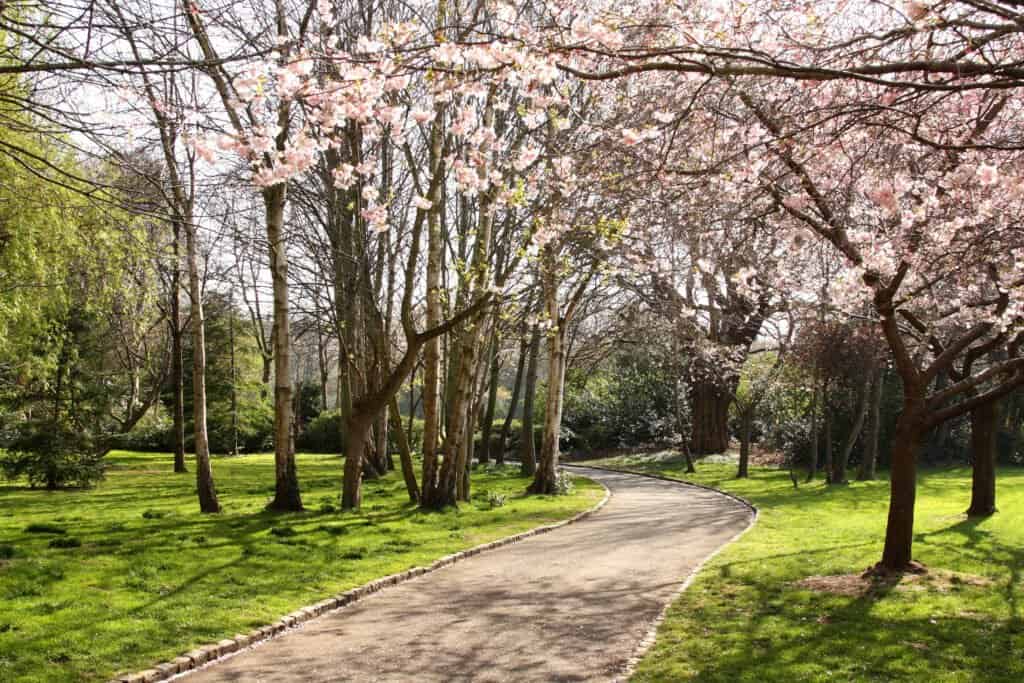
Cross into the park itself and the mood shifts. Merrion Square Park is laid out with curving paths through shrub and flower beds, with mature trees shading most of the interior by summer. It's one of the more peaceful green spaces in central Dublin, popular with office workers at lunchtime and visitors looking for a break between museum visits.
Main highlights
The Georgian houses themselves are the obvious draw along the south side, but the park holds most of the square's specific points of interest.
- Georgian townhouses: Some of Dublin's best-preserved 18th-century facades line three sides of the square, many with brightly coloured doors and decorative fanlights above the entrances.
- Oscar Wilde statue: A reclining statue of Wilde sits in the park facing his childhood home at 1 Merrion Square, a short distance from the south side. It's one of the more photographed pieces of public sculpture in the city.
- Statue of Michael Collins and other memorials: The park holds several statues and busts of significant Irish historical figures, a reminder that the square has long doubled as an informal civic memorial space.
- Jerome Connor's "Eire": This sculpture is one of the more striking pieces dotted through the park, worth seeking out if you're interested in early 20th-century Irish sculpture.
- Bust of Bernardo O'Higgins: A nod to the square's less expected international connections, honouring the Chilean independence leader.
- Leinster House: On the west side of the square, this building is linked to the National Museum of Natural History and the National Gallery of Ireland, both popular stops if you're continuing your visit with indoor collections.
- Historic plaques: Houses around the square carry plaques noting former residents, including Daniel O'Connell and W.B. Yeats, giving the walk a layer of literary and political history beyond the architecture itself.
- Sunday art displays: On Sundays, local artists hang paintings and prints along the park railings, turning the perimeter into an informal open-air gallery.
History and background
Merrion Square was laid out in 1762 on what had previously been farmland at the southern edge of Dublin. It was conceived as a fashionable address for the city's aristocracy, part of a broader wave of Georgian development that pushed Dublin's wealthy residential quarter south and east of the medieval core. The square's scale and symmetry were meant to signal refinement, and for much of the 18th and 19th centuries it succeeded, drawing residents whose names still turn up on the plaques today.
Oscar Wilde grew up at 1 Merrion Square, on the north side, and the statue of him in the park (sculpted by Danny Osborne and unveiled in the 1990s) faces back toward the house, reclining on a boulder of quartz in a pose that's become a minor pilgrimage stop for literary visitors. W.B. Yeats lived at number 82 for several years in the 1920s. Daniel O'Connell, the 19th-century political leader known as "The Liberator," is also associated with the square. Over time, as Dublin's wealthy moved further out and many Georgian houses were subdivided or converted to offices, the square shifted from purely residential to a mixed civic and institutional address, which is largely how it functions today.
Tickets and entry
There's no entrance fee for Merrion Square Park or for walking the square itself. It's open to the public free of charge, year-round. If you plan to visit the National Gallery of Ireland or the National Museum of Natural History nearby, check separately for their admission policies, since entry arrangements for those institutions are handled independently of the square.
Best time to visit
The park is open daily throughout the year, with longer hours in the warmer months. Daytime visits let you appreciate the architecture and the garden layout properly, since the Georgian facades read best in good light. Weekends bring a more relaxed atmosphere and easier parking, while the Sunday art displays along the railings are worth timing your visit around if you're interested in picking up local work. Midweek, especially during office hours, the square sees more foot traffic from nearby workplaces, which isn't a bad thing if you want a livelier sense of how Dubliners actually use the space.
Photography tips
The painted doors along the south and north terraces are the obvious shot, best captured in soft morning light when the colours hold without harsh shadow. Inside the park, the mix of mature trees, flower beds, and statues gives you plenty of foreground interest if you're photographing the Georgian rooftops behind. The Wilde statue photographs well from a few different angles given its reclining pose, though it tends to draw a small crowd on busier days.
Combining with nearby attractions
Merrion Square sits close enough to several major sights that it works naturally into a longer walking route. The National Gallery of Ireland and National Museum of Natural History are both associated with Leinster House on the square's west side. Trinity College and Grafton Street are a short walk northwest, and St Stephen's Green is roughly 15 minutes on foot to the southwest. If you're spending a day in this part of Dublin, the square makes a sensible midpoint between museum visits and a stroll through the city's main shopping streets.
Sample visit plan
Start on the south side to take in the Georgian terraces, then cut into the park to see the statues, including Wilde and "Eire." Loop the perimeter if you're there on a Sunday to browse the art along the railings. From there, head west toward Leinster House and the museum buildings, or continue on to Trinity College if you're working your way back toward the city centre. Allow 30 to 45 minutes for the square itself, more if you're stopping at the museums.
Practical tips
- Visit on foot or by public transport midweek, since parking gets tight around office hours.
- Sundays bring an open-air art market along the park railings, a good time to browse local work.
- Check the local events calendar before you go, as the square hosts a year-round cultural programme, including a Christmas market and candlelit evening events.
- Wear comfortable shoes if you're planning to continue on to Trinity College or St Stephen's Green afterward, since this part of Dublin rewards walking.
- Avoid touching or leaning on the statues and older ironwork, much of which is original to the Georgian period.
FAQ
Is there an entrance fee for Merrion Square South?
No. The park and the square itself are free to walk and visit at any time.
What's the easiest way to get there without a car?
Walk from Grafton Street or Trinity College, both about 10 to 12 minutes away, or take a bus to the stops on Nassau Street or Leinster Road.
Is the Oscar Wilde statue actually in Merrion Square?
Yes, it's in the central park, positioned facing his childhood home at 1 Merrion Square.
Can I visit the museums from the square directly?
The National Gallery of Ireland and National Museum of Natural History are associated with Leinster House on the west side of the square, so you can walk straight there after exploring the park.
Is Merrion Square South worth visiting if I've already seen Trinity College?
Yes. It's a different kind of Dublin experience, more residential and architectural than academic, and it pairs well as a quieter follow-up stop.
Reviews
Sign in and mark this place visited to leave a review.
No reviews yet.
Free Trip Planner
Plan your Dublin trip with our free planner
Build a day-by-day itinerary with AI suggestions, hand-picked places, and friends. Free forever — no credit card.
Things to see near Merrion Square South

Glendalough Cathedral

Powerscourt House & Gardens

Saint Stephen's Green

The Little Museum of Dublin
Places to eat or drink near Merrion Square South

The Happy Pear

Boxty House – Tallaght

Dicey's Garden
Toners Pub
More places in Dublin

Murphys Ice Cream
Merrion Square Park

Corcomroe Abbey