Montmartre
Montmartre, 75018 Paris, France Posted by bazartravelsTraveler
Montmartre sits on a steep hill in the 18th arrondissement of Paris, rising 130 meters above the surrounding city, which makes it one of the few places in Paris where you actually feel elevation change under your feet. The neighborhood has been Paris's artistic and bohemian heart since the late 1800s, when painters, writers, and musicians made their homes in its narrow streets and affordable studios. Today it remains one of the most visited areas in the city, though underneath the tourist crowds lies genuine character: small cafes where locals still gather, vintage shops tucked into ground floors, and the white dome of the Sacré-Cœur basilica watching over everything from the summit. Montmartre is not a single monument you tick off and leave. It's a place where you wander, climb, rest in squares, and stumble into unexpected corners. The neighborhood rewards slow exploration more than any itinerary, and it punishes anyone trying to see it in a single rushed hour.
Why Montmartre matters
Montmartre's cultural weight comes from its role as the birthplace of modern art. Between roughly 1880 and 1920, nearly every significant artist in Paris spent time here: Picasso, Van Gogh, Toulouse-Lautrec, Modigliani. The Bateau-Lavoir, a ramshackle studio building on Rue Ravignan, hosted the birth of Cubism. The Moulin Rouge cabaret opened in 1889 and became the template for nightlife across the world. These weren't accidents of geography. Montmartre was cheap, uncensored by official Paris, and full of people reinventing themselves.
That history shapes what you feel when you walk the streets today. The neighborhood carries memory in its stones, even where the original buildings are gone or rebuilt. It's worth remembering, too, that Montmartre existed long before the artists arrived. It was a rural village with windmills and vineyards, annexed into Paris only in 1860 as the city expanded northward and swallowed the villages ringing it. The hill's religious history goes back further still, with legends tying the name to martyred saints, which is where the "mont des martyrs" etymology likely comes from.
Quick facts
- Elevation: 130 meters above central Paris, accessible by foot or the Montmartre funicular (Funiculaire de Montmartre)
- Main basilica: Sacré-Cœur Basilica, built 1875 to 1914, free entry to the interior with optional paid access to the dome and crypts
- Nearest Metro stations: Abbesses (Line 12), Pigalle (Lines 2 and 12), Anvers (Line 2)
- Heart of the neighborhood: Place du Tertre, where street artists display work daily
- Key artistic landmark: Bateau-Lavoir on Rue Ravignan, though the original building burned in 1970 and was rebuilt
Getting there
The easiest entrance is from Abbesses Metro station, which puts you at street level in the heart of lower Montmartre. Exit onto Rue des Trois Frères and you're surrounded by cafes, boutiques, and the neighborhood's rhythm immediately. If you arrive at Pigalle station instead, you're at the foot of the hill facing the seedier, more commercial strip of Rue Pigalle, though this route works fine if you want to climb gradually and see that contrast firsthand.
The Montmartre funicular runs from the base of the hill near Saint-Pierre de Montmartre church to the top near Sacré-Cœur. It operates daily and uses a standard Metro ticket. The climb takes about 5 minutes by funicular versus 15 to 20 minutes on foot depending on your pace and which streets you choose. Many people ride up and walk down, which gives you time to notice the neighborhood as you descend rather than huffing past it on the way up.
If you're coming from the Right Bank or central Paris, walking works too. The neighborhood's northern edge is roughly 10 to 15 minutes from Gare du Nord, depending on where you start, which makes Montmartre an easy add-on if you're arriving in Paris by train from the north or from the UK via Eurostar.
The layout and experience
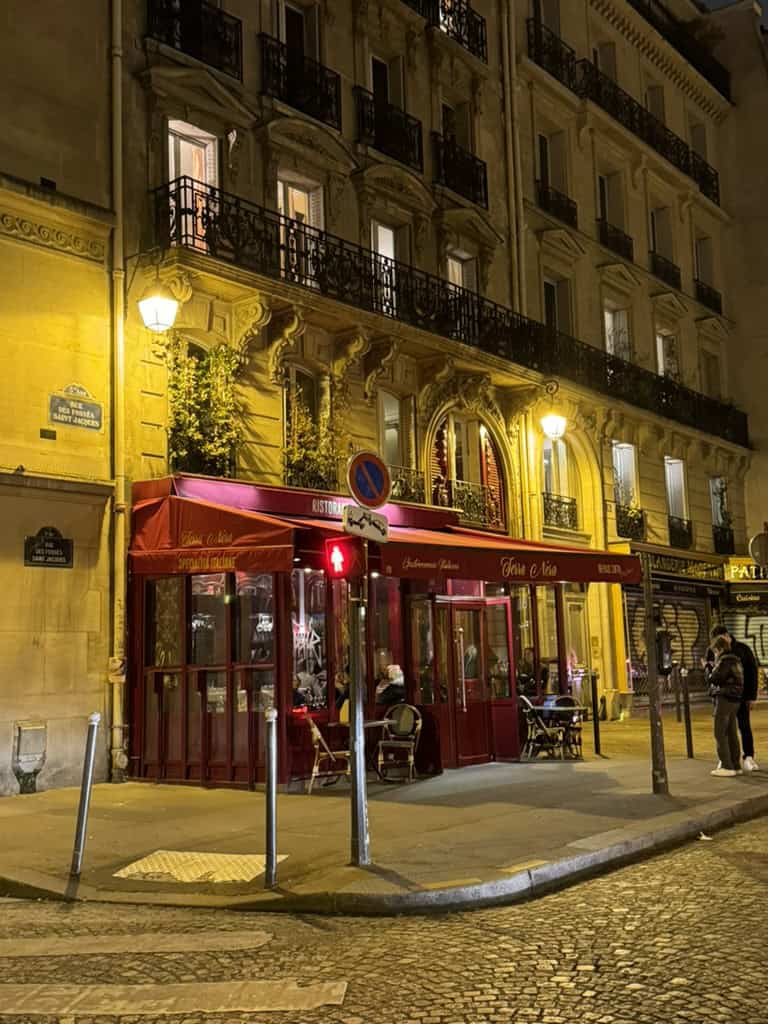
Montmartre divides naturally into lower and upper sections. The lower part, around Abbesses, is residential and village-like. Streets curve and intersect at odd angles, a holdover from when this was a cluster of farm paths rather than a planned district. Cafes spill onto pavements. You'll see people buying bread at bakeries, children in school uniforms, locals reading newspapers at corner tables. This is where you get a sense of how Parisians actually live in the neighborhood, not just how tourists pass through it.
The upper part, crowned by Sacré-Cœur, becomes denser with tourism. Place du Tertre fills with portrait artists, souvenir stalls, and restaurant touts. The basilica itself draws crowds year-round. But even here, if you step off the main square into side streets like Rue Lepic or Rue des Trois Frères, the intensity drops and you find genuine neighborhood life again within two or three minutes of walking.
The slopes are steep enough to notice, and some streets turn into staircases without much warning. Wear comfortable shoes. Most visitors spend 3 to 4 hours here, though you could easily stretch it to a full day if you linger in cafes, browse shops, or sit in a park.
Main highlights
Sacré-Cœur Basilica dominates the skyline. The white Romano-Byzantine dome is visible from across Paris, a deliberate design choice meant to be seen from the city below. The interior is vast and ornate, with a golden mosaic above the altar and cool stone that feels monumental after the crowded streets outside. You can climb the dome for views across the city, though this requires a separate ticket and involves narrow spiral stairs. The crypt below is quieter and less visited. Entry to the basilica itself is free, but many people make the climb primarily for the city views from the steps outside, which are panoramic and free to access and arguably the best reason to come up here at all.
Place du Tertre is the tourist heart of Montmartre. It's a small square packed with artists selling portraits, caricatures, and paintings. Prices tend toward the upscale side, and the quality varies widely. If you want a quick souvenir portrait done, expect to sit for 15 to 30 minutes. The restaurants surrounding the square are convenient but mediocre and overpriced. The square itself is worth seeing for the atmosphere and the people-watching, but don't feel obligated to spend money there.
The Moulin Rouge cabaret sits at the base of the hill on Place Blanche. You can see its red windmill roof from several blocks away. The venue still hosts performances, primarily aimed at tourists and evening visitors. Tickets are available but tend toward fine dining prices. The exterior and the immediate surroundings are worth photographing, and you get the full Moulin Rouge experience just walking past it, even if you never go inside.
Street art and murals appear throughout the neighborhood. Rue Lepic has a famous mural of a girl with a heart-shaped balloon by the artist Clet Abraham. Rue Foyatier and other steep streets have colorful character. These aren't official galleries but rather organic parts of the neighborhood's visual culture, the kind of thing you find by accident rather than by searching.
The Bateau-Lavoir, on Rue Ravignan, is a modest building that looks unremarkable from outside, but its history is enormous. Picasso painted Les Demoiselles d'Avignon here, one of the foundational works of modern art, in a cramped studio with poor light and no heating in winter. Max Jacob reportedly gave the building its nickname, comparing its creaking wooden structure to the laundry boats moored on the Seine. The original structure burned in 1970. Today the site has been rebuilt and contains studios and galleries, though access is limited unless you're attending a specific event or exhibition. Many visitors simply stand outside and acknowledge the history, which is honestly enough.
History and background
Montmartre was a rural village and religious site until Paris expanded northward in the 1800s. The Sacré-Cœur Basilica was built starting in 1875 as a votive church, a response to France's defeat in the Franco-Prussian War and the trauma of the Paris Commune, which had used the hill as a stronghold in 1871. Its construction took nearly 40 years, funded in large part by public subscription rather than state money, which is part of why it still carries a slightly penitential, grassroots character compared to more state-sponsored Parisian monuments.
By the 1880s, the neighborhood had become a working-class area with cheap rents, which attracted artists and bohemians fleeing the center of Paris. The Moulin Rouge opened in 1889 and created a new template for cabaret entertainment, built around the can-can and a deliberately scandalous reputation. It made Montmartre famous internationally and attracted a flood of visitors, performers, and hangers-on.
By the early 1900s, the neighborhood was the epicenter of avant-garde art in Europe. Picasso's studio in the Bateau-Lavoir became a pilgrimage site for anyone serious about modern painting. The Belle Époque energy was real, documented in posters by Toulouse-Lautrec and paintings by countless others who used the cabarets, dance halls, and street life of Montmartre as subject matter rather than just backdrop.
World War II and urban renewal changed Montmartre. Many artists moved elsewhere as rents rose, drifting toward neighborhoods like Montparnasse. The neighborhood became more touristy and less genuinely bohemian. Today it's a mixture: real residents living alongside tourist infrastructure, genuine cafes alongside tourist traps, history alongside commerce. This tension is part of what makes it interesting rather than something to apologize for.
Best time to visit
Spring and fall offer the best combination of pleasant weather and manageable crowds. April through May and September through October tend to be ideal. Summer is hot, crowded, and sometimes unpleasantly packed on Place du Tertre. Winter is quieter and atmospheric, though the steep streets can be slippery and you'll need a coat.
Mornings are significantly less crowded than afternoons and evenings. If you arrive by 9 or 10 am, you'll find the neighborhood much more livable. By 2 pm, tourist buses have disgorged their passengers and the main squares become congested. This is worth planning around if you dislike crowds. Avoid weekends if possible, especially in summer. A weekday visit feels entirely different from a weekend one.
Photography tips
The white Sacré-Cœur dome against a blue sky is an iconic shot, best captured from the square in front of the basilica or from Rue Lepic looking north. Early morning light is golden and the crowds are minimal. The dome is also beautifully lit at night if you want to photograph it after dark.
The steep streets themselves are photogenic. Rue Foyatier, with its colored doors and staircase, is a popular subject. Rue Lepic has interesting corners and local cafes. The trick is stepping away from the main tourist routes onto quieter streets where you'll find authentic Parisian moments: laundry hanging between buildings, corner cafes with a handful of locals, narrow passageways.
Place du Tertre is crowded and chaotic, which can work for atmospheric shots but often feels touristy. Better to photograph the surrounding architecture and the artists at work rather than trying to capture the square itself. Avoid photographing street artists without permission. Many are working professionals and appreciate being asked before you take their picture.
Facilities and preparation
- Public restrooms are limited. The Sacré-Cœur Basilica has facilities, as do most cafes and restaurants if you're a customer. There's a small public toilet near Place du Tertre, though it requires coins.
- The neighborhood is hilly and the streets are uneven. Comfortable walking shoes are essential.
- If you have mobility issues, the funicular helps with the steepest section, and the lower part of Montmartre around Abbesses is relatively flat.
- WiFi is available in most cafes. Cell service is generally reliable.
- You don't need any special apps or tickets in advance unless you're planning a specific museum visit or Moulin Rouge show.
- Water fountains appear throughout the neighborhood. Bringing a refillable bottle is practical and you can top it up at any cafe if you ask politely.
Combining with nearby attractions
Montmartre sits close to several other significant neighborhoods. Pigalle, directly south, is the historic red-light district. It's grittier and more adult-oriented than Montmartre proper, with sex work still visible on the streets. Many visitors combine a quick walk through Pigalle with their Montmartre visit, though it's optional and not for everyone.
The Musée de Montmartre, located on Rue Cortot, documents the area's artistic history and occupies one of the oldest buildings on the hill, a house where Renoir and other painters once lived and worked. It's a modest museum, worth an hour if you're interested in Belle Époque Paris and the artists who lived here. Entry requires a ticket.
More practically, Right Bank attractions like the Louvre and Opéra Garnier are 15 to 20 minutes south by Metro, which makes Montmartre easy to pair with a morning or afternoon in central Paris rather than treating it as an isolated day trip.
Sample visit plan
Arrive by 9 am at Abbesses Metro. Spend an hour exploring the lower neighborhood: cafes, boutiques, and residential streets around Rue des Trois Frères and Rue Lepic. Grab coffee at a local cafe and watch the neighborhood wake up.
Walk uphill or take the funicular to the Sacré-Cœur area by 10:30 am. Spend 45 minutes inside the basilica and climbing the dome if you wish, or simply sit on the steps outside for views. The light is still good and crowds are manageable.
Explore Place du Tertre and the surrounding streets for an hour. Browse the artists, take photographs, and accept that this part is touristy. Eat lunch at a side-street cafe rather than on the square itself. Budget mid-range prices.
Spend the final hour walking back downhill slowly, discovering smaller streets you missed on the way up. Stop at a late-afternoon cafe to rest. Depart by 2 or 3 pm if you want to avoid the worst of the afternoon crowds, or stay into evening if you enjoy the energy.
Practical tips
- Arrive early to beat crowds. 9 to 11 am is far more pleasant than noon to 4 pm.
- Bring cash. Some small cafes and artists accept cards, but cash is still king in Montmartre.
- Skip the touristy restaurants on Place du Tertre. Walk two blocks in any direction and find better food at lower prices.
- The funicular uses a standard Metro ticket. One journey costs the same as a single Metro ride.
- Pickpocketing happens in crowded areas, especially near Sacré-Cœur and the Moulin Rouge. Keep bags close and valuables secure.
- Street artists on Place du Tertre will quote high prices. Negotiate if interested, or simply walk away. No one is obligated to buy.
- The neighborhood is best explored on foot. You'll miss details if you try to rush or use a car.
FAQ
Is Sacré-Cœur free to enter?
Yes, the basilica interior is free. The dome and crypts require separate paid tickets. The steps outside the basilica are free and the views are excellent.
How long should I spend in Montmartre?
Most people spend 3 to 4 hours and feel satisfied. You could spend a full day if you visit museums or linger in cafes. A rushed visit of 1 to 2 hours is possible but feels hurried.
Is Montmartre safe?
Yes, it's generally safe and well-policed. Petty theft occurs near major attractions. Use normal city precautions.
Can I visit Montmartre in winter?
Absolutely. Winter is quieter and atmospheric, though streets can be slippery and weather is cold. Dress warmly.
What's the best way to get from central Paris to Montmartre?
Take the Metro to Abbesses (Line 12) for the most pleasant entry into the neighborhood. Pigalle (Lines 2 and 12) works too but puts you at the foot of a steep hill. Either way, Montmartre is one of those Paris neighborhoods that rewards arriving without a fixed plan and letting the streets decide your route.
Reviews
Sign in and mark this place visited to leave a review.
No reviews yet.
Free Trip Planner
Plan your Paris trip with our free planner
Build a day-by-day itinerary with AI suggestions, hand-picked places, and friends. Free forever — no credit card.
Related reading
Things to see near Montmartre

The Trianons & The Hamlet

Galerie des Carrosses

The Royal Chapel – Versailles