
 Posted by Brandon B.Admin
Palatine Hill: Rome's First Neighborhood, Still Standing
Palatine Hill is where Rome began. Not metaphorically, not approximately. According to ancient tradition, Romulus drew the first furrow here in 753 BC, and archaeologists have found evidence of occupation stretching back even further. Today, the hill rises above the Roman Forum on one side and the Circus Maximus on the other, covering roughly 25 hectares of ruins, gardens, and views that stop you mid-sentence. If you only have time for one site in the city, this is the argument for making it Palatine Hill.
Most visitors arrive through the Forum and barely make it up the slope. That's a mistake. The hill rewards the people who actually climb it.
Why Palatine Hill Matters
For most of the Roman Republic and all of the early Empire, this was the most expensive real estate on earth. Augustus was born here and built his house here, deliberately modest by imperial standards. His successors had fewer inhibitions. Tiberius, Domitian, and the Flavian emperors added palace after palace until the hill was essentially one enormous layered complex. The Latin word "palatium," meaning palace, comes directly from this place. Every European language that has a word for palace owes it to this hill.
That weight of history is still legible in the stones. You can stand in what was the private stadium of the Domus Flavia and look up at walls that once stood four or five stories tall. The scale is genuinely hard to process.
Quick Facts
- Address: Piazza Santa Maria Nova 53, near the Arch of Titus at the edge of the Roman Forum
- The site shares a combined ticket with the Colosseum and Roman Forum
- Timed entry tickets are available and strongly recommended in peak season
- Open daily except January 1st and December 25th
- The hill covers roughly 25 hectares and a thorough visit takes two to three hours
- Audio guides and guided tours are available on site
- The Palatine Museum (Museo Palatino) is included with general admission
Getting There
The most straightforward entrance is through the Roman Forum, entering from Via Sacra near the Arch of Titus. If you're coming from the Colosseum, which is about a five-minute walk west along Via Sacra, this is the natural path. There is also a separate entrance on Via di San Gregorio on the hill's southwestern side, which gives you more direct access to the imperial palaces without walking through the entire Forum first. Depending on your itinerary, that entrance can save significant time.
The nearest Metro stop is Colosseo on Line B. Buses along Via dei Fori Imperiali stop within easy walking distance. If you're coming from Trastevere, the walk up through the Circus Maximus side takes around 15 minutes on foot and gives you a completely different first impression of the site.
The Layout and Experience
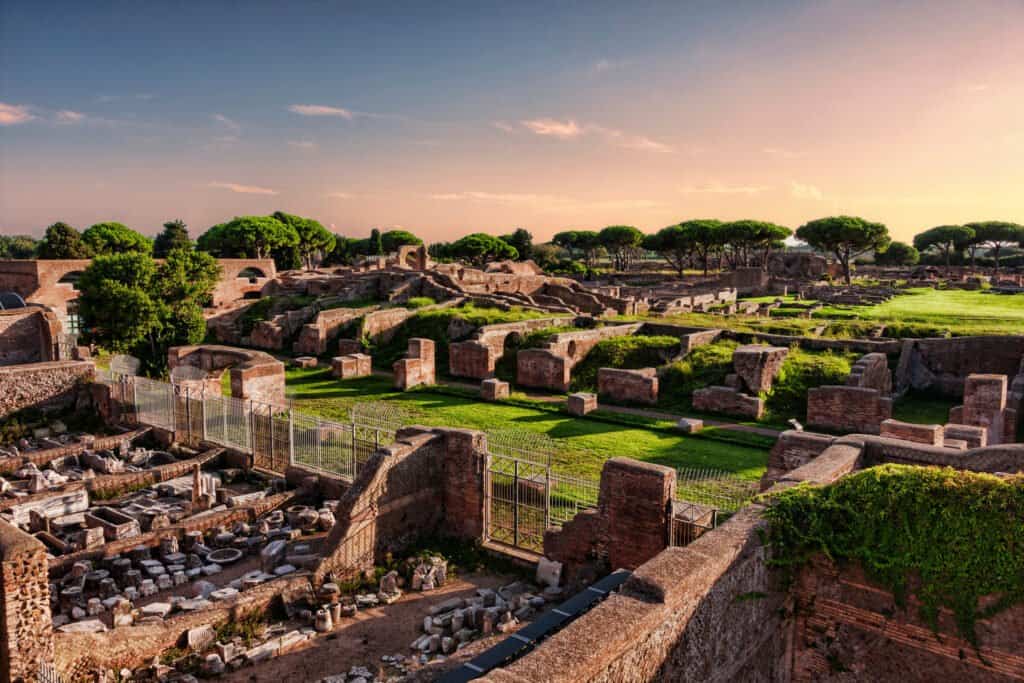
Palatine Hill is not a single monument. It's a compressed archaeological landscape where Republican-era houses sit beneath Augustan additions, which sit beneath Flavian palace complexes, which are themselves topped by the Farnese Gardens, planted in the 16th century. The layers are visible almost everywhere you look.
The western half of the hill holds the oldest remains, including the Casa di Augusto (House of Augustus) and the Casa di Livia (House of Livia), his wife. Both contain some of the finest surviving Roman wall paintings anywhere in the world, vivid and surprisingly intact after two millennia. Access to these structures is sometimes limited to small groups at scheduled times, so check availability when you book.
The eastern side is dominated by the Domus Flavia and the Domus Augustana, the public and private wings of Domitian's vast palace complex, completed around 92 AD. The sunken garden that served as the emperor's private stadium is one of the most atmospheric spots on the hill, especially in the late afternoon when the light drops low.
The Farnese Gardens, near the northern end, are a genuine relief after hours of ruins. The formal garden terraces were laid out in the 1500s by Giacomo Vignola for Cardinal Alessandro Farnese, and the views from the belvedere over the Forum below are among the best in Rome. Plan to spend a few minutes here. It's also shaded, which matters more than you'd think in July.
The Palatine Museum
The Museo Palatino sits roughly in the center of the hill and is easy to miss if you're moving quickly. Don't skip it. The museum holds finds from excavations across the hill, including sculpture, decorative fragments, and artifacts from the earliest Iron Age settlements on the site. The displays help make sense of what you're walking through outside. It's a compact space, manageable in about 45 minutes.
History and Background
The hill's habitation predates the traditional founding date of Rome. Archaeologists have found hut foundations on the southwestern slope, the so-called Capanne Romulee, dating to the 9th or 8th century BC. The area was prestigious enough that by the late Republic, Rome's wealthiest citizens built their homes here. Cicero had a house on the Palatine. So did his political rival Crassus.
Augustus changed the character of the hill permanently when he chose to live here rather than on the Capitoline or Aventine. His residence was relatively small, but the association between the Palatine and imperial power was established. After Augustus, the hill became synonymous with the emperor himself. Successive rulers expanded the complex until little of the earlier fabric remained visible.
The decline came gradually after the 3rd century, accelerated through the medieval period, and by the Renaissance the hill was largely overgrown farmland. The Farnese acquisition in the 16th century brought renewed attention and the first systematic excavations. Serious archaeological work has continued in waves ever since, and active digs are still ongoing in parts of the site.
Best Time to Visit
Spring and autumn are the most comfortable seasons. March through May and September through November offer reasonable temperatures and thinner crowds than the summer peak. If you visit in summer, arrive when the site opens or in the last two hours before closing. Midday in August on an exposed hilltop with minimal shade is genuinely unpleasant.
The Farnese Gardens are leafy enough to offer shade, and the museum provides a cool break. Still, a hat and water bottle are not optional from June through August. The site has a café, but water fountains (the Roman nasoni) are scattered throughout and the water is safe to drink.
Photography Tips
The Forum panorama from the northern edge of the hill, near the Farnese belvedere, is the signature shot. It works best in the morning when the light comes from the east and the Forum is still relatively clear of crowds. The Domus Flavia's sunken garden photographs well in late afternoon, when the angled light catches the texture of the brick. The Casa di Livia's painted rooms are dimly lit, so adjust your settings before entering rather than relying on flash, which is not permitted.
Combining with Nearby Attractions
The combined ticket covers the Colosseum, Roman Forum, and Palatine Hill, and all three are within a few minutes of each other on foot. Most people attempt all three in a single day, which is possible but tiring. A more sustainable approach is the Colosseum and Forum on one day, with Palatine Hill getting its own morning on a second day.
The Circus Maximus is directly below the hill's southern slope, visible from the terrace above the Domus Augustana. It's free to enter and worth a brief stop if you're heading toward the Aventine Hill or the churches of that neighborhood. The Capitoline Museums, about a 10-minute walk north, make a strong pairing if you want to see the sculptural finds that once decorated these imperial spaces displayed in context.
Practical Tips
- Book timed entry tickets in advance, especially between April and October. Walk-up availability is unreliable on busy days.
- The combined Colosseum ticket is the standard way to enter. Standalone Palatine tickets are also available but less common.
- Wear shoes with grip. The paths are uneven, and some areas have loose stone or gravel surfaces.
- Bring water. The site is large and exposed, and the on-site café has limited locations.
- The Casa di Augusto and Casa di Livia often have restricted entry windows. Check the schedule at the ticket office when you arrive.
- An audio guide significantly improves the visit. The ruins are not heavily labeled in English.
- If you have mobility concerns, the Via di San Gregorio entrance has a gentler approach than the Forum route.
FAQ
Do I need a separate ticket for Palatine Hill?
Palatine Hill is included in the combined ticket that also covers the Colosseum and Roman Forum. You do not need to purchase a separate admission. Timed entry slots apply to the Colosseum portion of the ticket.
How long should I budget for the visit?
A thorough visit, including the Palatine Museum and the main palace areas, takes most people two to three hours. If you're combining it with the Roman Forum on the same day, budget a full morning or afternoon for both together.
Is Palatine Hill accessible for visitors with reduced mobility?
Parts of the site are accessible, but Palatine Hill is fundamentally a hillside with uneven ancient surfaces. The Via di San Gregorio entrance and some paved paths are more manageable, but full accessibility throughout is not possible. Check with the ticketing office for current accessibility maps.
Can children visit comfortably?
Yes, though the site involves a fair amount of walking over rough ground. Older children who enjoy outdoor spaces tend to find the scale and the ruins genuinely engaging. Strollers are difficult to manage on most of the paths.
Reviews
Sign in and mark this place visited to leave a review.
No reviews yet.
Free Trip Planner
Plan your Italy trip with our free planner
Build a day-by-day itinerary with AI suggestions, hand-picked places, and friends. Free forever — no credit card.
Things to see near Palatine Hill



Places to eat or drink near Palatine Hill
Arianna al Borghetto

La Pietra Scheggiata – Osteria/Pizzeria

Pasticceria Barberini

Trattoria Da Enzo
More places in Rome

Magia a Campo de' Fiori

Museo Storico della Liberazione

The Colosseum
