
Positano on the map
7 places from this guide. Tap a pin to open the listing.
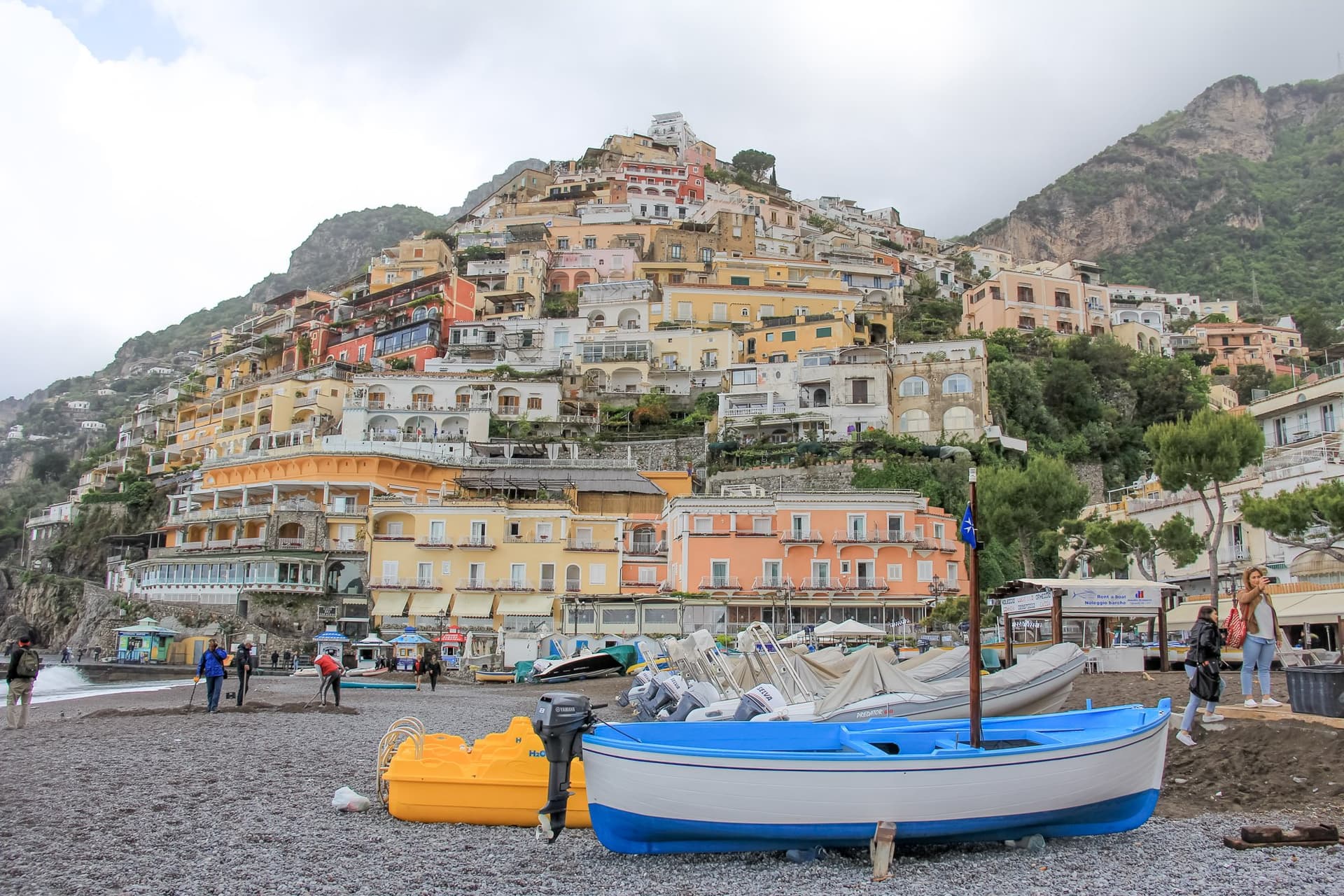
Positano sits on a steep hillside above the Tyrrhenian Sea, its pastel houses stacked almost on top of each other all the way down to the water. This Positano travel guide covers what you actually need to know before you go: when the weather and crowds work in your favor, which part of town to base yourself in, how to get here without a car, and where to eat that isn't just a tourist trap with a sea view. Positano isn't a big place. You can walk from one end to the other in under twenty minutes if the stairs don't slow you down. But its size is deceptive, because the vertical layout means every street is a staircase, and the town rewards a slower pace than most first-time visitors give it.
The postcard view, the one everyone photographs from the road above town, looks down over domes, bougainvillea, and the sea. At the bottom of it all is Spiaggia di Positano Marina Grande, the town's main beach, with the Church of Saint Mary of the Assumption rising just behind it, its majolica-tiled dome visible from almost every angle of the lower town. That church, with its Byzantine Black Madonna icon inside, is as close to a must-see landmark as Positano has, and it costs nothing to step in and look.
When to Visit
Late April through June, and again mid-September through October, are the sweet spot. The sea is warm enough to swim in, the hillside trails are walkable without midday heat exhaustion, and you're not queuing for the ferry dock. July and August bring the heaviest crowds and the highest prices, along with the liveliest atmosphere, local festivals, and the longest ferry schedules. If you can only travel in summer, aim for early July rather than mid-August, when much of Italy takes its own holiday and the coast road backs up for hours.
Winter is a different town entirely. Many restaurants, hotels, and the smaller ferry operators close between November and March, and some hillside paths can be slick after rain. What's left is quiet and cheap by Amalfi Coast standards, with clear light and almost no tourists, good if you want the views without the performance. Spring and fall remain the better bet for most travelers planning a first trip, since they balance good weather with manageable numbers.
Where to stay
If it's your first time in Positano, staying near Spiaggia Grande puts you closest to the action. This is the lower town, where cafes spill onto narrow lanes, boutiques sell linen and ceramics, and the ferry dock is a short walk away. Spiaggia di Positano Marina Grande itself, the pebble beach at the center of it, gets busy by mid-morning in summer but is the easiest spot to orient yourself on your first day.
Fornillo, a ten-minute walk west along a coastal path from Spiaggia Grande, feels like a different town. The beach here is smaller and less crowded, the trattorias are family-run rather than resort-branded, and rooms tend to cost less than the equivalent in the main town.
Arienzo, east of the center, is where Positano's higher-end villas and hotels cluster, many with private terraces looking straight out at the Tyrrhenian Sea. Arienzo Beach below is reached by a long staircase and rewards the climb down with a quieter patch of sand than Spiaggia Grande.
Nocelle, perched around 450 meters above the coastline, suits travelers who want quiet over convenience. It's the starting point for the Path of the Gods, the roughly 7-kilometer trail that traces the cliffs toward Agerola, and its B&Bs and small hotels are built for couples who don't mind a bus ride down to the water.
Montepertuso, just above Positano proper, is the budget-conscious choice. Family-run guesthouses here cost noticeably less than anything near the beach, and a short bus ride or a steep walk gets you down into town when you want it.
How to reach the destination
Naples International Airport (NAP) is the nearest major airport, about 60 kilometers from Positano by road, and the usual entry point for most visitors. Rome Fiumicino (FCO) and Milan Malpensa (MXP) connect onward to Naples on domestic carriers, or you can take a train from either city.
From Naples, Trenitalia and Italo trains run to Sorrento via Naples Centrale, which is the closest rail station to Positano. From Sorrento, the SITA Sud bus covers the coastal road down to Positano and on to Amalfi, a scenic but slow ride on hairpin bends that can take well over an hour depending on traffic.
Between roughly Easter and October, ferries run from Naples and Sorrento directly to Positano's pier, operated by companies including Alilauro and Travelmar. This is often the most comfortable option in high season, skipping the road traffic entirely and giving you a proper look at the coastline on the way in.
Renting a car is possible but rarely worth it inside Positano itself. The coast road is narrow, parking is scarce and expensive, and many hotels don't have their own garages. If you do rent, Hertz and Avis both operate out of Naples, and a car makes more sense for exploring inland towns than for staying in Positano proper.
Getting around the destination
Positano is built for walking, or more accurately for climbing stairs. Flat ground is rare. Comfortable shoes matter more here than almost anywhere else on the Amalfi Coast, since even a short trip to dinner can mean a few hundred steps up or down.
For longer hops, the local Mobility Amalfi Coast bus and the SITA Sud line connect Positano's upper neighborhoods (Montepertuso, Nocelle) with the lower town and onward to Praiano and Amalfi. Tickets are cheap and the buses run often in season, though they fill up fast in summer. Taxis and private drivers are an option if you'd rather skip the queue, at a notably higher price.
Boats are worth considering too. Small operators run from Spiaggia Grande to nearby coves, Capri, and other coastal towns, and renting a small motorboat for a few hours is a popular way to see stretches of coastline that aren't reachable on foot.
Top destination travel tips
- Pack light, soft-soled shoes. Cobblestones and staircases dominate the town, and heels or stiff shoes will slow you down fast.
- Book restaurant tables ahead in high season, especially for places with sea-view terraces. Walk-ins work better off-peak.
- Carry cash in small denominations. Many smaller shops, bars, and the boat operators prefer it, even if card payment is technically available.
- Sunset drinks at a spot like Franco's Bar, perched above the water on the road into town, are worth timing deliberately. Arrive before the light changes, not after.
- Expect limited English outside the main tourist strip once you head up toward Montepertuso or Nocelle. A few basic Italian phrases go a long way.
- Beach clubs along Spiaggia Grande and Fornillo charge for sunbeds and umbrellas. Public sections exist but fill up early in summer.
- If you're driving the coast road, avoid midday in July and August. Traffic backs up for long stretches and parking disappears entirely.
Typical costs in the destination
Positano runs more expensive than most of the Amalfi Coast, and prices climb further in July and August. Expect a casual lunch, a plate of pasta and a drink at a no-frills spot, to sit in the mid-range tier, while a sit-down dinner with wine at a sea-view restaurant pushes into upscale territory. Accommodation swings widely, from simple guesthouses in Montepertuso at the budget end to cliffside villas in Arienzo at the top of the market.
Ferry tickets and SITA bus fares are relatively affordable and a good way to control costs if you're staying several days. Beach club access, boat rentals, and guided hikes add up quickly if you do all three, so it's worth picking one or two splurges rather than everything on offer. All prices in the region run in euros (EUR), and it's worth checking current rates before you book anything, since they shift year to year.
Must try food and drinks
- Scialatielli ai frutti di mare: thick, hand-cut pasta tossed with mixed seafood, a staple on nearly every menu along the coast.
- Delizia al limone: a lemon sponge cake soaked in cream and lemon liqueur, a Positano specialty that uses the coast's famous Sfusato Amalfitano lemons.
- Limoncello: the lemon liqueur made across the region, usually served ice-cold after a meal.
- Fresh anchovies and alici fritte: lightly fried local anchovies, often served as a starter at seafood-focused spots.
- Seafood right on the sand at Chez Black, a longtime fixture on Spiaggia Grande known for its pasta and grilled fish with a direct beach view.
- Classic coastal Italian cooking at Da Vincenzo Positano, a family-run restaurant away from the waterfront crowds, and at Ristorante Max Positano, which leans into local seafood and homemade pasta.
- A candlelit dinner at La Sponda, the fine dining room inside Le Sirenuse, where tables are lit by rows of candles each evening and the menu runs toward refined regional cooking.
FAQ
How many days do you need in Positano?
Two to three full days is enough to see the town itself, relax on a beach, and fit in one excursion like the Path of the Gods or a boat trip to Capri. Longer stays make sense if you're using Positano as a base for the wider Amalfi Coast.
Is Positano expensive?
Yes, relative to most of Italy. Accommodation, dining, and beach access all run higher than in neighboring towns like Praiano or Maiori, especially from June through August. Visiting in shoulder season and staying in Montepertuso or Fornillo helps stretch a budget further.
Is Positano walkable?
It's walkable but steep, with staircases connecting nearly every part of town. If stairs are difficult for you, it's worth choosing accommodation close to Spiaggia Grande or budgeting for taxis rather than relying on your feet for everything.
Do you need a car in Positano?
No, and it's often more trouble than it's worth. Parking is scarce and the coast road gets congested in summer. Buses, ferries, and walking cover most needs, and a car only really pays off if you're exploring inland towns beyond the coast.
Is English widely spoken in Positano?
In the main tourist areas, yes, most restaurant and hotel staff speak functional English. Head up into Montepertuso or Nocelle and it gets patchier, so a few Italian phrases are useful.
What's the best month to visit Positano?
May and late September tend to offer the best balance of warm weather, open businesses, and manageable crowds. Confirm specific opening dates for smaller hotels and ferries before booking, since they vary year to year.
Is Positano worth a day trip from Naples or Sorrento?
It's possible but tight, given the travel time each way. A day trip gives you time for the beach, the church, and lunch, but an overnight stay lets you see the town at sunset and in the early morning before the day-trippers arrive, which is when Positano feels most like itself.
Top Places to Visit in Positano
View all See & Do
Spiaggia di Positano Marina Grande
 See & Do
Church of Saint Mary of the Assumption
Top Places to Eat in Positano
View all Eat & DrinkExpensive · $$$
 Eat & DrinkExpensive · $$$
Da Vincenzo Positano
 Eat & Drink
 Eat & Drink
 Eat & DrinkLuxury · $$$$