San Antonio Missions National Historical Park
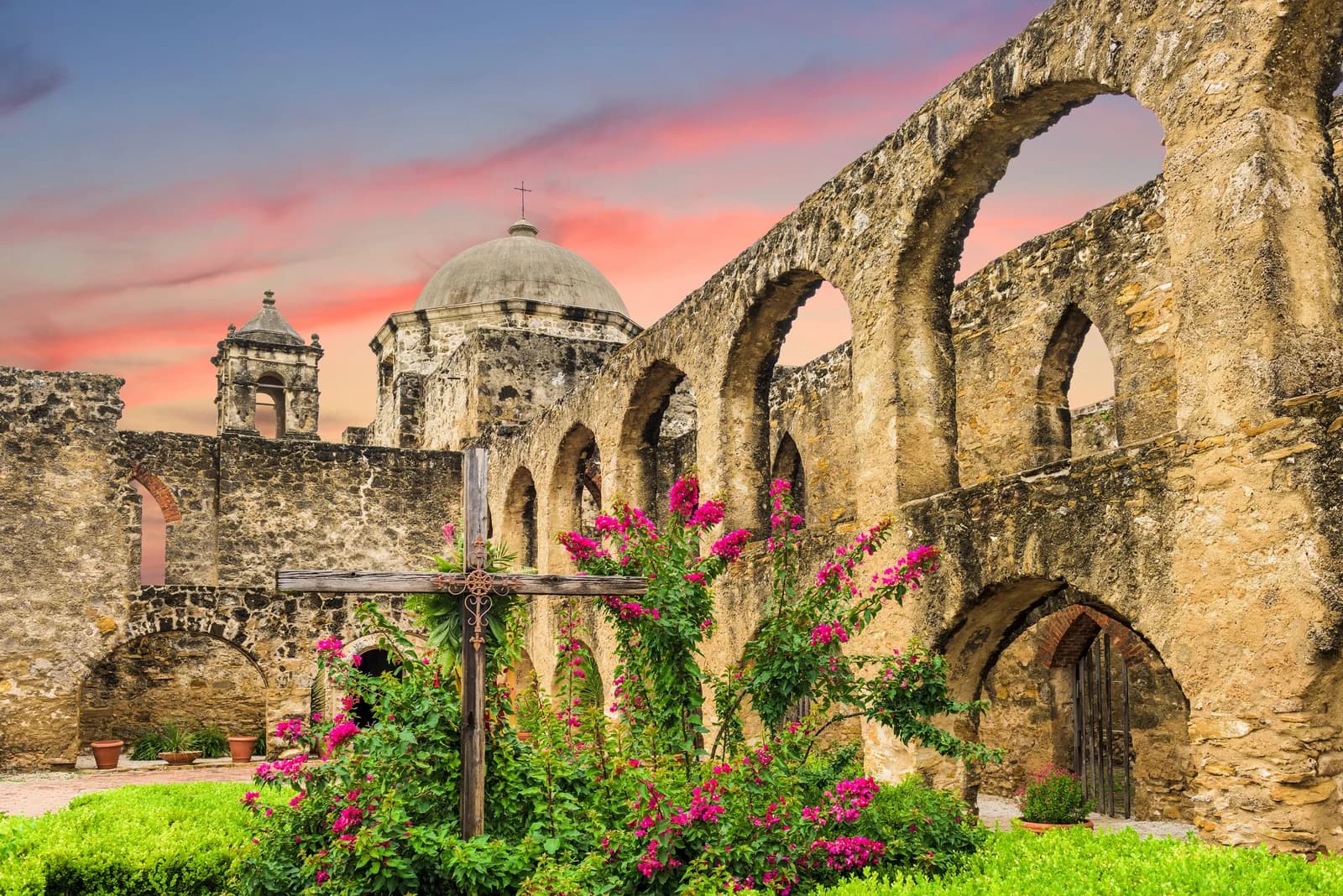
6701 San Jose Dr, San Antonio, TX 78214, USASan Antonio Missions National Historical Park strings together four Spanish colonial missions along the San Antonio River, a few miles south of downtown and the Alamo. Concepción, San José, San Juan Capistrano and Espada are the four stops, run by the National Park Service, and every one of them is free to enter. The park also looks after the Espada Aqueduct and a more remote site called Rancho de las Cabras, though most visitors never make it that far south.
What catches people off guard is that all four missions are still working Catholic parishes. Mass is said most weeks at each one, baptisms and quinceañeras still happen in the same stone naves the Franciscans built in the 1700s, and the churchyards are not museum pieces behind glass but places a San Antonio family might actually belong to. That continuity, nearly three centuries of it, is the thing that separates this park from almost anything else in the National Park System.
Why San Antonio Missions National Historical Park matters
These four missions, along with Mission San Antonio de Valero, better known as the Alamo, were inscribed together as a UNESCO World Heritage Site in 2015, the first in Texas. The Alamo itself sits downtown and is managed separately by the Texas General Land Office, so it's not part of the National Historical Park, but it shares the same origin story and the same stretch of river system that made mission life possible here.
The missions were built as combined religious and economic settlements, meant to convert and incorporate Indigenous peoples, mainly Coahuiltecan groups, into Spanish colonial society. Each mission has its own friary, granary, workshops and defensive walls, and each drew water from the river through a network of acequias, the gravity-fed irrigation ditches that still partly survive today. Walking the grounds, you're looking at one of the most intact examples of Spanish mission infrastructure left in North America.
Quick facts
- Four missions: Concepción, San José, San Juan Capistrano, and Espada, plus the Espada Aqueduct and Rancho de las Cabras
- Admission is free at all sites
- Main visitor center is located at Mission San José
- All four missions remain active Catholic parishes
- Part of a UNESCO World Heritage Site inscribed in 2015
- Connected by the paved Mission Reach section of the San Antonio River Walk and the Mission Trail
Getting there
The missions sit along the San Antonio River south of downtown, strung out over roughly eight miles from Concepción at the northern end to Espada at the southern end. Driving between them is simple and most visitors do it this way, parking at each site in turn. The missions also connect via the Mission Reach, a paved hike-and-bike trail that follows the river and links to the downtown River Walk, so if you're already comfortable on a bike it's a scenic way to cover the distance, especially between San José and Espada where the trail runs close to the water.
There's no single entrance gate for the park since the sites are spread across the city, but Mission San José is generally treated as the hub. If you're coming from downtown or the Alamo, it's a short drive south, and it's the logical first stop.
The layout and experience
Start at the Mission San José visitor center. It has the short orientation film, exhibits on mission life and the Indigenous communities who lived and worked there, and the Junior Ranger passport stamp if you're collecting those. Rangers are usually on hand to answer questions and point you toward ranger-led tours when they're running.
From there, San José itself rewards slow walking. Its restored granary, the famous Rosa's Window carved above a side chapel, and the reconstructed Indigenous quarters along the compound walls give you a sense of scale the other three missions don't quite match. It's the largest of the four and often called the "Queen of the Missions."
Concepción, the northernmost, is the one with the most original fresco fragments still visible on its interior walls and ceiling, faint geometric patterns painted not long after the church was completed. Its twin bell towers and stone facade are largely unaltered, which makes it feel the oldest even though all four were built around the same period.
San Juan Capistrano is smaller and quieter, with a walking trail through a restored farmland area that gives a sense of what the mission's agricultural operation looked like. Espada, the southernmost, has the most rural feel of the four, partly because of its distance from the city center and partly because of the Espada Aqueduct nearby, a stone structure that has carried water across Piedras Creek since the Spanish colonial period and is still in use today, making it one of the oldest functioning aqueducts in the United States.
History and background
Mission San José was founded in 1720. Concepción, San Juan Capistrano and Espada were established slightly later, relocated to the San Antonio River in 1731 after earlier attempts at mission sites in East Texas struggled with crop failure, disease and resistance from local tribes. The move concentrated Spain's mission efforts along a reliable water source and closer to the presidio that would eventually anchor the city of San Antonio.
Each mission functioned as a self-contained community. Indigenous residents learned European farming and trade techniques, worshipped in the mission churches, and lived within the walled compounds for protection. The acequia system the missions built to irrigate their fields was remarkably sophisticated for the period, and parts of it, including the Espada Aqueduct, remain in operation nearly three hundred years later.
By the early 1800s, secularization policies had stripped the missions of their original religious and administrative role, and the land was redistributed. The churches themselves, though, never stopped being used for worship, which is why they still function as parishes today rather than sitting as preserved ruins.
Tickets and entry
There's no admission fee anywhere in the park, a point worth repeating since so many San Antonio attractions nearby charge for entry. The visitor center at Mission San José is the place to pick up a map, get the passport book stamped, and check whether a ranger talk or guided walk is scheduled for that day. Because the churches are active parishes, visiting hours inside the sanctuaries can be affected by Mass schedules, weddings or funerals, so it's worth checking signage at each site rather than assuming you can walk straight into every church at any hour.
Best time to visit
Spring and fall mornings are the most comfortable, with San Antonio's summer heat making midday visits between the missions fairly punishing, especially if you're walking or biking the Mission Reach trail between sites. Early morning light also tends to suit the stone facades well, particularly at Concepción where the carved details catch low sun. Weekday visits are quieter than weekends, when local parishioners are at the churches for services.
Practical tips
- Begin at Mission San José for the visitor center, film and passport stamp before moving to the other three
- Bring water and sun protection, since shade is limited at several of the compounds, especially Espada
- Wear shoes suited to walking on uneven stone and gravel if you plan to see all four missions in one day
- Check for Mass times or private events before planning to photograph the church interiors
- Combine a mission visit with the Alamo downtown to see all five sites tied to the 2015 UNESCO listing, keeping in mind the Alamo is managed separately
- Rancho de las Cabras, south near Floresville, has very limited access and isn't a casual add-on to a same-day visit
FAQ
Is the Alamo part of this national park?
No. The Alamo, formally Mission San Antonio de Valero, shares the same UNESCO World Heritage designation but is managed separately by the Texas General Land Office, not the National Park Service.
Visiting San Antonio Missions National Historical Park works best as a half-day or full-day loop rather than a quick stop. Seeing the four missions in sequence, from San José's scale down to Espada's quieter edge of town, gives a far better sense of how Spanish colonial San Antonio actually functioned than any single site could on its own.
Reviews
Sign in and mark this place visited to leave a review.
No reviews yet.
Free Trip Planner
Plan your United States trip with our free planner
Build a day-by-day itinerary with AI suggestions, hand-picked places, and friends. Free forever — no credit card.
Related reading

Things to see near San Antonio Missions National Historical Park

Mission Espada

Mission San Juan

Espada Aqueduct

Mission San Jose
Places to eat or drink near San Antonio Missions National Historical Park

Freetail Brewing Co.

Beethoven Maennerchor

Little Em's Oyster Bar