Spanish Mosque
Chefchaouen 90001 Morocco Posted by Brandon B.Admin
The Spanish Mosque Above Chefchaouen's Blue Medina
The Spanish Mosque sits on a hilltop above Chefchaouen, looking down over one of Morocco's most photographed cities. Getting there takes about 20 minutes on foot from the medina, and the reward is a panorama that most visitors agree is the best view in the Rif Mountains. If you've spent a morning wandering the blue-painted lanes around Plaza Uta el-Hammam, the hike up here offers a completely different perspective on the city you just walked through.
The mosque itself is a ruin, and that's partly why it works so well as a destination. There's no ticket booth, no guided tour, no audio guide. Just a crumbling white structure, a wide terrace, and a view that opens up Chefchaouen in full.
Why the Spanish Mosque Draws So Many Visitors
Chefchaouen's fame rests almost entirely on its lower medina, the labyrinth of indigo and cobalt walls that draws photographers from around the world. But most of those photographs flatten the city. Standing at the Spanish Mosque, you finally understand the geography: the medina packed into a narrow valley, the Rif ridgelines rising behind it, the Oued Laou river cutting through the landscape below.
The light at dawn and dusk does something particular here. In the early morning, mist often clings to the valley and the city glows softly below. At sunset, the medina shifts through amber and orange while the white walls of the mosque itself turn pink. Both windows are worth planning around.
Quick Facts
- Location: Hilltop northwest of the medina, Chefchaouen
- Walk from Plaza Uta el-Hammam: approximately 20 minutes uphill
- Entry: Free, no ticket required
- Access to interior: Non-Muslims are not permitted inside the mosque itself
- Best time of day: Sunrise or the hour before sunset
- Facilities on site: None (no toilets, no vendors at the top)
- Terrain: Steep dirt and stone path, not suitable for wheelchairs or strollers
Getting There
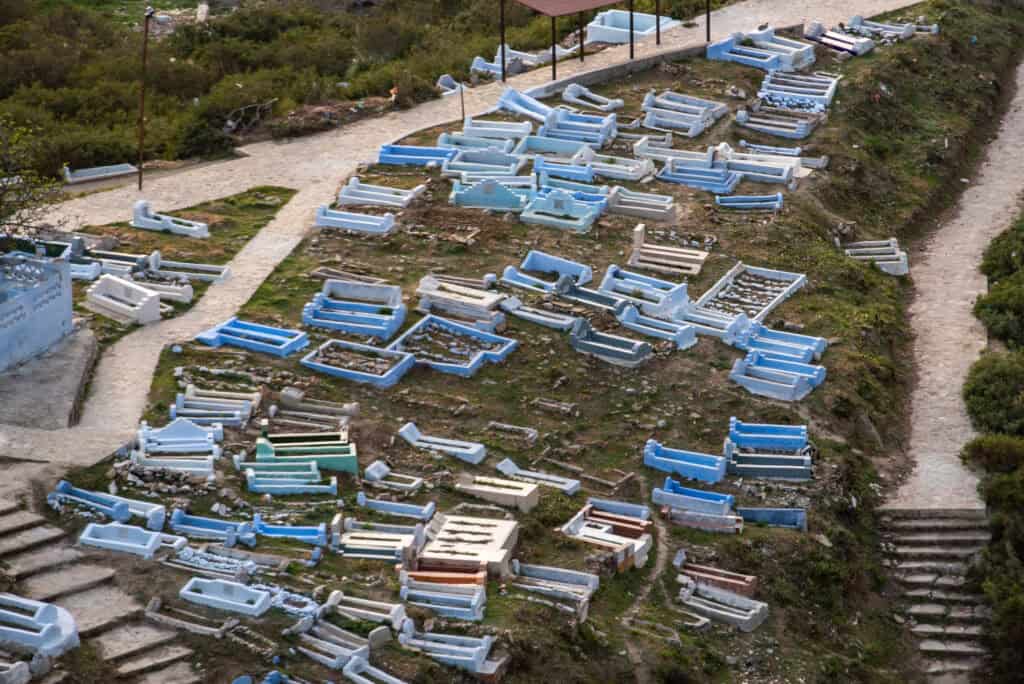
The most straightforward route starts near the blue stairs above the medina. Head toward the cemetery on the northern edge of the old town, then follow the well-worn dirt path that climbs through pine trees and scrubby hillside. The trail is obvious once you find it, though the lower section involves a few branching paths where you should keep heading uphill.
Wear shoes with grip. The path is loose in places and dusty in summer. In the rainy season, sections turn slippery. The last stretch steepens noticeably before you reach the terrace. Most reasonably fit visitors handle it without difficulty, but it's not a casual stroll in sandals.
You can also approach from the other direction, looping around from the Ain Tissimane area, though this route takes longer and is less clearly marked. Most visitors go up and come back the same way.
History and Background
The mosque was built during the Spanish protectorate period, when Spain administered northern Morocco from 1912 to 1956. The Spanish constructed it for the local Muslim population, which created an awkward dynamic from the start: a colonial power building a place of worship for the people under its control. The project was never fully embraced, and the mosque was largely abandoned not long after Moroccan independence.
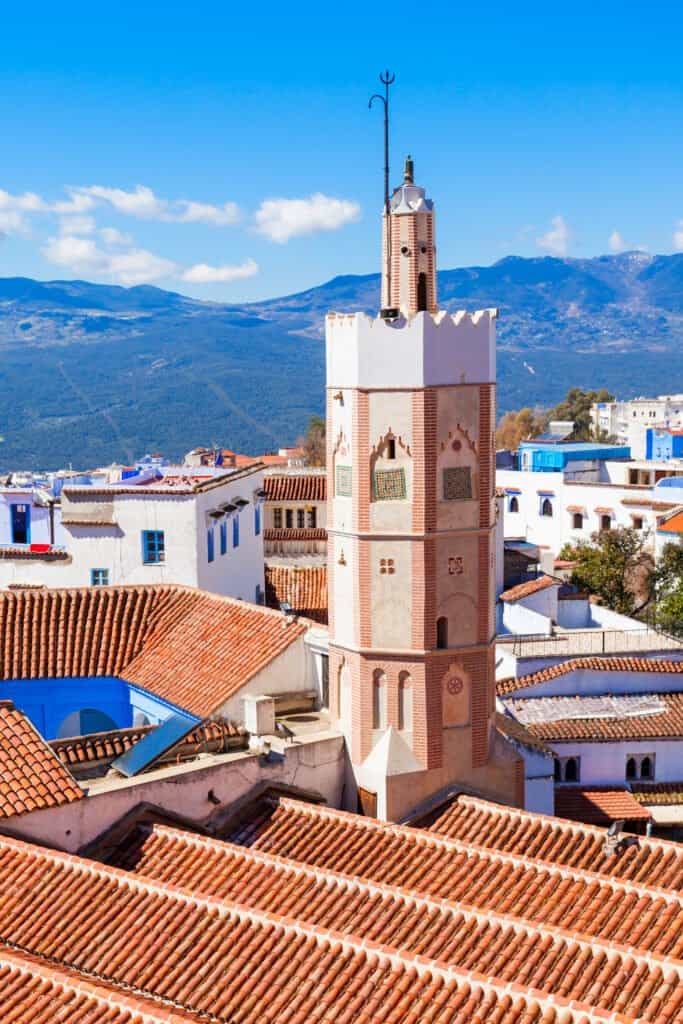
It has stood empty ever since. Decades of neglect have left the structure partially open to the sky in places, though the walls and the distinctive square minaret remain largely intact. The Spanish protectorate left several architectural traces across northern Morocco, but this one has become the most visited almost entirely because of the view rather than any particular architectural merit.
Chefchaouen itself was founded in 1471, though the blue-washing of the medina that defines its modern identity developed more gradually over the centuries. The Spanish Mosque sits outside that historic core, which is partly why it offers such an unobstructed sightline over it.
The View and What You'll See
From the terrace, the entire medina spreads out below you. On a clear day you can see well beyond the city into the Rif valleys. The minaret of the Grand Mosque near Plaza Uta el-Hammam is easy to pick out. So is the kasbah, the old fortress that anchors the medina's southern edge.
The surrounding hillsides are covered in pine and cedar, which gives the view a greenness that surprises visitors who associate Morocco primarily with desert landscapes. Chefchaouen sits at around 600 meters elevation, and the air up here tends to be noticeably cooler and fresher than the medina lanes below.
Goats occasionally wander the hillside around the mosque. Locals use the path too, and you'll often pass Chefchaouen residents heading up for their own morning or evening air, not just tourists with cameras.
Best Time to Visit
Sunrise is the quieter option. If you're willing to leave your riad while it's still dark and navigate the lower medina by the light of your phone, you'll likely have the terrace almost to yourself. The city wakes up slowly, and the early light is genuinely extraordinary.
Sunset draws more people, partly because it requires no early alarm. The terrace can get crowded in peak season, particularly in July and August, but it rarely feels truly packed given the open space. Arrive at least 45 minutes before sundown to secure a good spot and let your eyes adjust to the changing light.
Spring, from March through May, tends to offer the clearest air and the greenest hillsides. Autumn is similarly pleasant. Midday in summer is the one window to avoid: the path is exposed, the light is flat for photography, and the heat on the open hillside is considerable.
Photography Tips
The classic shot frames the medina through one of the mosque's arched windows or doorways. This requires getting close to the structure, and the interior is off-limits, but the exterior openings face toward the city and work well for framing. A wide-angle lens captures more of the valley context. A longer focal length pulls the minaret and kasbah closer and compresses the rooftops into something more abstract.
For sunrise, position yourself on the eastern side of the terrace. For sunset, the western edge gives you the light hitting the medina face-on. The mosque's white walls make a useful foreground element in both directions.
Drones are technically regulated in Morocco, and you should check current rules before flying anything here. Most visitors work with phone cameras and do perfectly well.
Combining With Nearby Attractions
The Spanish Mosque works naturally as a bookend to a day in Chefchaouen's medina. Spend the morning exploring the blue lanes, ducking into the souks around the main plaza, and visiting the kasbah museum, then take the late afternoon to hike up for sunset. The walk back down takes about 15 minutes and deposits you close to the medina's restaurant strip in time for dinner.
Ras el-Maa, the small waterfall and washing area on the eastern edge of the medina, is a pleasant stop on the way back. It's a 5-minute detour and one of the quieter corners of the old town.
Practical Tips
- Bring water. There are no vendors on the path or at the top, and the climb is more demanding than it looks from below.
- Start the hike before it gets fully dark if you're going for sunrise. The lower section of the path is easier to navigate with some ambient light.
- Respect the mosque as a religious site. Non-Muslims should not attempt to enter the interior, regardless of its ruined state.
- The path has no lighting, so bring a torch or use your phone's flashlight for pre-dawn or post-sunset visits.
- Layers are useful. The hilltop can be noticeably cooler than the medina, especially in the shoulder seasons.
- Local guides are available in the medina if you prefer company on the walk up, though the path is easy enough to follow independently.
FAQ
Is the Spanish Mosque free to visit?
Yes, there is no entry fee and no ticket required. The site is open access, though as a mosque it should be treated with appropriate respect.
Can non-Muslims go inside?
Non-Muslims are not permitted to enter the mosque itself. The terrace and surrounding grounds are accessible to everyone, and the view from outside is the main draw anyway.
How difficult is the hike?
It's a moderate uphill walk of about 20 minutes on a dirt path. Fit adults handle it without trouble. Steep sections toward the top require decent footwear. It is not accessible for visitors with mobility limitations.
Is it safe to visit at sunrise or after dark?
Most visitors and locals consider the path safe, and it's commonly used at dawn and dusk. Standard common-sense precautions apply: go with someone if you're uncertain, bring a light source, and let someone know where you're headed.
How does the view compare to other viewpoints in Chefchaouen?
The Spanish Mosque is generally considered the best viewpoint above the city. There are other spots on the surrounding hills, but none offer quite the same unobstructed sightline over the medina combined with a foreground subject as photogenic as the mosque itself.
Reviews
Sign in and mark this place visited to leave a review.
No reviews yet.
Free Trip Planner
Plan your Chefchaouen trip with our free planner
Build a day-by-day itinerary with AI suggestions, hand-picked places, and friends. Free forever — no credit card.