Posted by bazartravelsAdmin
Overview
The Temple of Amada sits on the western shore of Lake Nasser, about 180 kilometers south of the Aswan High Dam. This sandstone temple dates to the 18th Dynasty of ancient Egypt, making it one of the oldest temples still standing in Nubia. What makes it remarkable is not just its age but how it survived the construction of the Aswan High Dam in the 1960s. When Lake Nasser filled, engineers physically moved the entire structure to higher ground, a feat of modern archaeological preservation that saved it from drowning.
The temple was built under Thutmose III and later expanded by Amenhotep III. Walking through its modest entrance, you encounter carved reliefs that have weathered over 3,400 years, their pigments still visible in places. The columns inside bear hieroglyphic inscriptions, and the sanctuary walls show scenes of pharaohs making offerings to gods. For travelers interested in ancient Egypt beyond the crowded monuments of Luxor and Cairo, this temple offers something quieter and more intimate.
Why this place matters
Amada is one of the oldest rock-cut temples in Egypt, predating the more famous temples at Abu Simbel by centuries. Its preservation during the Aswan High Dam project represents a turning point in how the world approaches archaeological heritage in the face of modern development. The relocation effort in 1964 involved cutting the temple into sections, moving it 65 meters inland, and reassembling it with remarkable precision. This engineering solution became a model for saving other threatened monuments.
The temple's historical record is also valuable. Its walls document royal campaigns and religious practices under three different pharaohs, offering insights into the political reach of the New Kingdom into Nubia. Few temples give you such a direct visual connection to this period.
Quick facts
- Built during the 18th Dynasty, approximately 1500 BCE to 1420 BCE
- Originally carved into a hillside; relocated 65 meters uphill during the Aswan High Dam project in 1964
- Located 180 kilometers south of the Aswan High Dam on Lake Nasser's western shore
- Dedicated to Amun, Ra-Horakhty, and other deities worshipped in Nubia
- Accessible only by water or organized tours from Aswan
- The temple structure spans roughly 10 meters wide and 30 meters deep
Getting there
There is no road access to the Temple of Amada. You must travel by boat across Lake Nasser from Aswan. Most visitors reach it through organized tours that depart from Aswan, either as part of a multi-day Lake Nasser cruise or as a day excursion. The boat journey takes several hours depending on weather and lake conditions.
If you're arranging independent travel, hire a boat with an experienced captain who knows Lake Nasser. The lake can be unpredictable, with sudden winds and changing water levels, so weather conditions matter. Tours typically include transportation from your Aswan hotel, boat passage, and a guide who can explain the temple's history and hieroglyphics. Bring sun protection and water for the boat ride, as shade is limited.
The layout and experience
The temple opens with a shallow forecourt, then narrows into a covered portico supported by columns. Beyond that lies a hypostyle hall with more columns, and finally the inner sanctuary where the gods were believed to reside. The passage from bright sunlight into progressively dimmer chambers creates a deliberate spiritual progression, typical of Egyptian temple design.
The walls are carved with shallow reliefs, not the deep carvings you see at other temples. This style is characteristic of the 18th Dynasty. In the sanctuary, you can see images of Thutmose III and later pharaohs in the presence of gods. Some reliefs retain traces of the original paint, red ochre and blue pigment still faintly visible on the stone. The air inside is cool and still, a stark contrast to the heat and glare outside.
The temple is modest in scale compared to Abu Simbel or Karnak. This intimacy is part of its appeal. You won't be jostled by tour groups, and your guide can speak without shouting. The silence of the desert around you makes the ancient voices in the stone feel more audible.
Main highlights
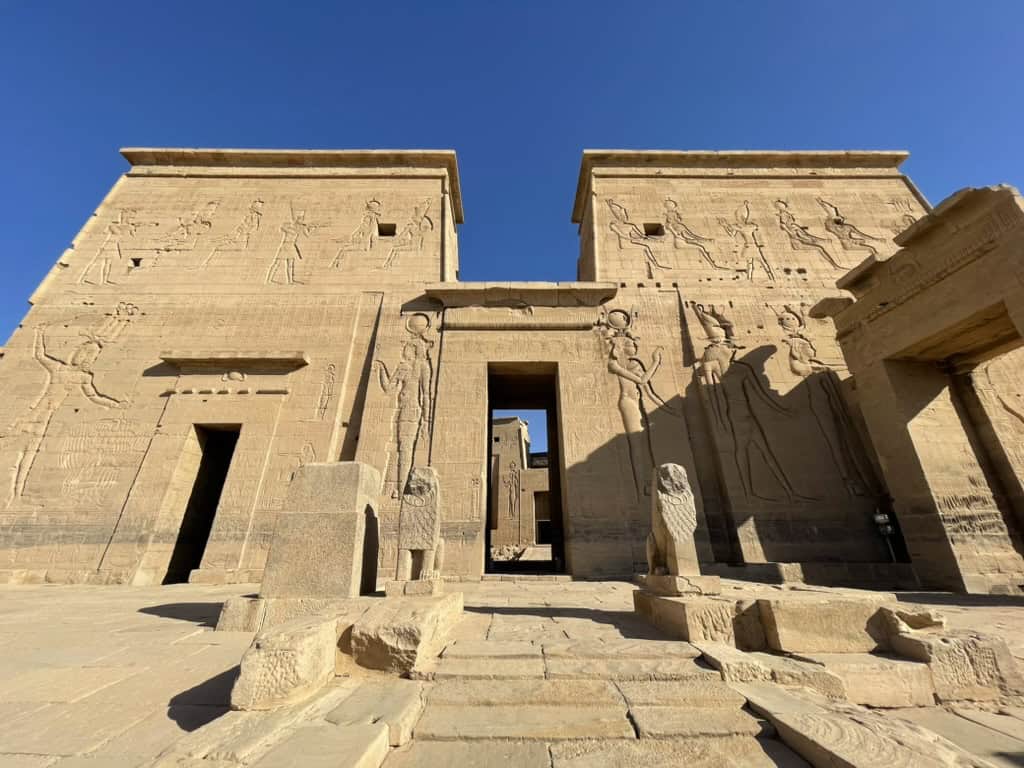
The reliefs on the entrance pylons show Thutmose III in his royal regalia, making offerings to the gods. These carvings are remarkably well preserved considering their age and exposure to the elements. Inside the hypostyle hall, look for scenes depicting the pharaoh in a ritual boat, a motif that connects the king to the sun god Ra's daily journey across the sky.
The sanctuary walls contain some of the temple's most significant inscriptions. These include texts that record the pharaoh's piety and military campaigns in Nubia. If you have time, ask your guide to point out the cartouches, the oval frames containing the pharaoh's royal names. Deciphering them gives you a tangible connection to the individual rulers who commissioned the work.
One unusual feature is the temple's alignment. The entrance faces east toward the rising sun, which illuminates the inner sanctuary during certain times of year. Watching light move across the sanctuary walls during your visit adds a sensory dimension to understanding how the ancient builders used natural light as part of their design.
History and background
The Temple of Amada was constructed during the reign of Thutmose III, around 1450 BCE. Thutmose III was one of Egypt's greatest military commanders, and his campaigns extended Egyptian control deep into Nubia. The temple served as a religious outpost, a place where Egyptian officials could perform rituals and assert Egyptian cultural authority in the region. Amenhotep III later expanded the temple, adding chambers and reliefs that reflected his own reign and piety.
For over 3,000 years, the temple sat undisturbed in the Nubian landscape. Then in the 1960s, the construction of the Aswan High Dam threatened to flood the entire region. UNESCO launched a campaign to save the temples of Nubia. The Temple of Amada's relocation was one of the most dramatic rescues. Between 1964 and 1968, engineers cut the structure into blocks, transported them uphill by rollers and levers, and reassembled the temple on a new stone foundation 65 meters higher than its original location. The relocation was so successful that visitors today can barely detect the joins in the stone.
Tickets and entry
Entry to the Temple of Amada requires a ticket, which is typically included in organized tour packages from Aswan. If you arrange independent boat access, you'll purchase a general admission ticket at the site. The ticket grants you access to explore the temple interior at your own pace, though a guide is recommended to explain the inscriptions and architectural details.
Tours from Aswan often combine the Temple of Amada with visits to other Lake Nasser temples like Kalabsha or Philae. Multi-day cruises allow more leisurely exploration. Entrance fees are mid-range, reflecting the remoteness of the location and the logistical costs of boat access. Hours are typically from sunrise to sunset, though your tour operator will set the specific timing.
Best time to visit
The ideal season is October through April, when temperatures are cooler and Lake Nasser is calmer. December through February sees the most pleasant weather, with daytime temperatures in the 20s to low 30s Celsius. The lake can be rough during spring and summer months, when winds pick up and heat becomes intense. Visiting in May through September is possible but uncomfortable, with temperatures exceeding 40 Celsius and higher wind risk on the water.
Early morning visits catch the best light on the temple's eastern-facing entrance. If your tour departs early, you'll have softer shadows for photography and the interior will feel cooler. Afternoon visits are equally valid if that's what your tour schedule allows, though the sun will be higher and harsher.
Photography tips
The temple's sandstone carvings show best detail in raking light, which occurs in early morning or late afternoon. Bring a polarizing filter to reduce glare from the stone and enhance the contrast of the reliefs. The interior sanctuary is dim, so a tripod and high ISO will help capture the hieroglyphics on the walls without flash, which can damage the fragile pigments.
The exterior pylons make strong compositions against the blue water of Lake Nasser beyond. Include the lake in your framing to show the temple's isolation and the landscape that shaped Nubian culture. Wide-angle shots work well for capturing the full structure and its setting, while close-ups of individual reliefs reveal the carver's skill and the remaining traces of color.
Facilities and preparation
The temple site has minimal facilities. There is no café, shop, or restroom. Bring plenty of water, at least two liters per person, as the desert heat is relentless. Wear comfortable walking shoes with good grip, as the stone floor inside the temple can be uneven. A wide-brimmed hat and sunscreen are essential, even if you're only outside for part of your visit.
The boat ride to reach the temple can be bumpy. If you're prone to motion sickness, take appropriate medication before boarding. Bring a light layer even in hot months, as the breeze on the water creates evaporative cooling. A small notebook and pen are useful if you want to jot down details about the reliefs or translations your guide provides.
Combining with nearby attractions
The Temple of Amada is part of the Lake Nasser temple cluster. The Temple of Kalabsha lies nearby and is often visited on the same day. Kalabsha is larger and more ornate, making a good contrast to Amada's simplicity. The Temple of Philae, relocated to an island in Lake Nasser, is another major site accessible from Aswan. Many visitors combine all three temples in a multi-day cruise itinerary.
If you have extra time in Aswan, visit the Nubian Museum, which houses artifacts and information about the temples and the cultures that built them. The museum provides helpful context for understanding what you see at Amada. The Aswan High Dam itself is worth a visit to understand the modern engineering feat that necessitated the temple rescues.
Sample visit plan
Day 1: Depart Aswan early morning by boat, arriving at the Temple of Amada by mid-morning. Spend two to three hours exploring the temple with your guide, photographing the reliefs, and resting in the interior's cooler sanctuary. Return to Aswan by late afternoon.
Alternatively, book a multi-day Lake Nasser cruise that includes the Temple of Amada, the Temple of Kalabsha, and possibly the Temple of Abu Simbel. These cruises typically offer meals, accommodation on the boat, and guided visits to each temple, spreading the experience over several days and allowing deeper exploration of the region's archaeological heritage.
Practical tips
- Book tours through reputable operators in Aswan. Your hotel can recommend trusted companies with reliable boats and experienced guides.
- Bring a head covering for the boat ride. The sun reflects off the water intensely, and the breeze won't keep you cool.
- If traveling independently, confirm weather conditions and lake status before departing. Sudden storms can make the lake unsafe for small boats.
- Hire a guide who speaks your language. The hieroglyphics and historical context are much richer when explained by someone knowledgeable.
- Respect the temple's sacred spaces. The sanctuary is an archaeological site and a place of historical significance; move slowly and speak quietly.
- Bring binoculars if you have them. Details high on the walls are easier to see and photograph with magnification.
FAQ
How long does a visit to the Temple of Amada take?
Plan for two to three hours at the temple itself, plus several hours for boat travel to and from Aswan. A full day excursion from Aswan typically lasts eight to ten hours.
Is the temple interior safe to explore alone?
Yes, the temple is structurally sound after its relocation and restoration. However, a guide greatly enhances the experience by explaining the hieroglyphics and historical context. The interior is dim, so a flashlight or headlamp is helpful if you wander off the main path.
Can I visit the Temple of Amada year-round?
Technically yes, but summer visits (May to September) are extremely hot and Lake Nasser can be rough. October through April is strongly recommended for comfort and safety.
What makes the Temple of Amada different from other Egyptian temples?
Amada is one of the oldest temples in Nubia and represents the northernmost extension of Egyptian cultural influence in the region. Its relocation during the Aswan High Dam project makes it a symbol of modern archaeological preservation efforts. The temple's modest scale and intimate interior also offer a quieter, more contemplative experience than larger monuments.
Reviews
Sign in and mark this place visited to leave a review.
No reviews yet.
Free Trip Planner
Plan your Aswan trip with our free planner
Build a day-by-day itinerary with AI suggestions, hand-picked places, and friends. Free forever — no credit card.