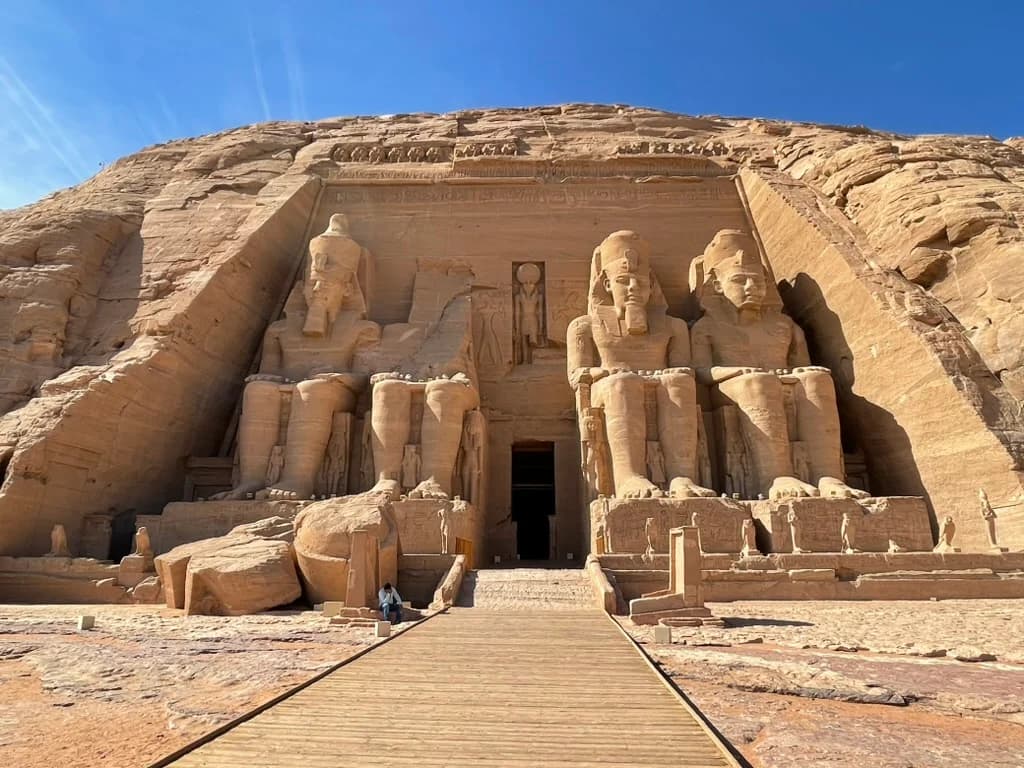
Temple of Wadi El-Sebua
Abu Simbel Egypt Posted by bazartravelsAdmin
Overview
Temple of Wadi El-Sebua sits along the Nile River in southern Egypt, roughly 140 kilometers south of Aswan. Built during the reign of Ramesses II in the 13th century BCE, this sandstone temple represents one of the more accessible monuments in Abu Simbel without the overwhelming crowds that surround the famous colossal statues nearby. The temple's name means "Valley of the Lions" in Arabic, a reference to the sphinx-lined processional avenue that once led to its entrance.
Unlike the grand scale of Abu Simbel's twin temples, Wadi El-Sebua offers a more intimate encounter with New Kingdom architecture. Its modest size and relative quietness make it an ideal stop for travelers who want to experience Egyptian temple design without the tourist density of major sites.
Why this place matters
Wadi El-Sebua belongs to a chain of temples that Ramesses II commissioned to consolidate Egyptian control over Nubia. The temple served both religious and political purposes, demonstrating pharaonic power to local populations while honoring the gods Amun-Ra and Ra-Horakhty.
The site gained modern significance when it was relocated in the 1960s during the Aswan High Dam construction. UNESCO and Egyptian authorities moved the entire structure to higher ground to prevent it from drowning in Lake Nasser. This feat of archaeological engineering preserved an otherwise lost monument and speaks to the international commitment to saving cultural heritage.
Quick facts
- Built circa 1250 BCE during the 19th Dynasty under Ramesses II
- Relocated 65 meters uphill in 1966 due to Lake Nasser flooding
- Located roughly 140 kilometers south of Aswan along the Nile
- Dedicated to the gods Amun-Ra and Ra-Horakhty
- Features eight sphinx statues along its original processional approach
- Open year-round with flexible daylight hours
Getting there
Most visitors reach Wadi El-Sebua as part of a Lake Nasser cruise or a guided tour from Aswan. The site is not accessible by conventional road transport for independent travelers. If you're booking a cruise or tour package, confirm that Wadi El-Sebua is included in the itinerary, as not all operators stop there.
The journey from Aswan takes several hours by water. Cruise operators typically schedule visits in the early morning or late afternoon to avoid the midday heat. The temple sits on the west bank of the Nile, and visitors are usually ferried ashore by small boat.
The layout and experience
The temple's design follows the classical pylon-courtyard-hypostyle hall-sanctuary sequence found in many New Kingdom temples. You approach via a modern walkway that traces the original sphinx-lined avenue. Eight sphinx statues flank the processional path, though some are damaged or partially reconstructed.
The pylon gateway stands approximately 10 meters high, decorated with relief carvings depicting Ramesses II in scenes of worship and battle. Beyond the pylon lies an open courtyard where you can see the temple's front facade with its seated statuary. The interior hypostyle hall contains columns supporting a ceiling decorated with astronomical and religious motifs.
The innermost sanctuary, which housed the sacred barque (boat) of the gods, is smaller and darker than in larger temples. This intimate space reflects the temple's focused purpose. The entire visit typically takes 30 to 45 minutes if you move at a moderate pace and read some inscriptions.
Main highlights
The sphinx avenue is the first striking feature. These eight statues, with human heads and leonine bodies, once formed an impressive ceremonial approach. Some retain their original paint and detail while others show weathering typical of 3,200-year-old stone carving.
The pylon reliefs deserve close attention. Ramesses II appears prominently in scenes that likely depicted his military campaigns in Nubia. The quality of carving varies, suggesting the temple was completed over several construction phases or by artisans of different skill levels.
Inside the hypostyle hall, look upward at the ceiling decoration. Astronomical patterns and religious symbols were carved to align with the temple's sacred function. The columns supporting this ceiling are less ornate than those in grander temples, reflecting the site's secondary importance in the royal building program.
History and background
Ramesses II ruled Egypt for 66 years and left an architectural footprint across the country and beyond. Wadi El-Sebua was one of at least four temples he built in Nubia between the Third and Fourth Cataracts of the Nile. These temples served to assert Egyptian dominance over the gold-rich region and to facilitate trade and resource extraction.
The temple's original location stood lower on the riverbank, subject to seasonal flooding from the annual Nile inundation. This was acceptable in ancient times, as temples were periodically cleaned and restored as part of ritual maintenance. However, the Aswan High Dam, completed in 1970, created Lake Nasser behind it, which would have completely submerged the temple under 50 meters of water.
Beginning in 1964, a combined Egyptian and international effort relocated Wadi El-Sebua piece by piece. The temple was cut into manageable blocks, moved upslope, and reassembled in its current location. The process took roughly two years and cost millions in 1960s currency. The relocated site includes reconstructed elements and modern infrastructure to protect the monument from further degradation.
Tickets and entry
Wadi El-Sebua is not independently ticketed. Access is controlled through organized tours and Lake Nasser cruises. If you book a cruise from Aswan, the operator arranges all entry permissions and local guides. The cost structure varies widely depending on the cruise company, duration, and onboard amenities.
Independent travel to the site is not feasible due to its remote location and the need for boat transport. Plan to visit as part of a multi-day cruise or a guided day tour. Tour operators in Aswan can arrange transportation if you have limited time, though this is more expensive than including the temple in a longer itinerary.
Best time to visit
Southern Egypt experiences extreme heat from May through September, with daytime temperatures regularly exceeding 40 degrees Celsius. The best window for visiting Wadi El-Sebua runs from October through April, when temperatures are more manageable and humidity is lower.
December and January see the highest tourist traffic and the most comfortable weather. If you prefer fewer crowds, consider visiting in October or November, when temperatures are pleasant but cruise bookings are lighter. Avoid the summer months entirely if possible.
Water conditions on Lake Nasser affect cruise scheduling. Most operators run their full itineraries from November through March. During other months, some cruises may be shortened or rerouted depending on water levels and weather patterns.
Photography tips
The sphinx avenue offers your best opportunity for dramatic wide-angle shots, especially in early morning light when shadows bring out the carved details. The low angle of the sun at dawn and dusk creates definition in the stone relief work.
The pylon gateway frames well from the courtyard, particularly in the hour before sunset when the western-facing sandstone glows warm. Bring a polarizing filter to reduce glare and enhance the sky.
Interior photographs in the hypostyle hall and sanctuary are challenging due to low light and reflective stone surfaces. A tripod is useful if your tour guide allows time for longer exposures. Avoid using flash, which can damage the ancient painted surfaces and is typically prohibited.
The sphinx statues are best photographed from ground level to emphasize their scale. Shoot in the early morning when shadows define their carved features.
Facilities and preparation
Wadi El-Sebua has minimal facilities on-site. There is no shade structure, no food or water vendors, and no restroom facilities beyond what a cruise ship provides. If you are on a day tour from Aswan, bring ample drinking water, a hat, and sunscreen.
Wear sturdy walking shoes with good grip, as the sandstone pathway can be uneven and slippery if wet. The terrain is mostly flat but involves some climbing over stone blocks and steps. The walk from the boat landing to the temple entrance takes 10 to 15 minutes.
If you have mobility concerns, inform your tour operator in advance. The pathway is not wheelchair accessible, and some portions require stepping over or around relocated blocks.
Combining with nearby attractions
Most Lake Nasser cruises that include Wadi El-Sebua also visit Abu Simbel's twin temples, roughly 80 kilometers further south. Abu Simbel is the flagship attraction in the region, with its four colossal statues of Ramesses II carved directly into the mountainside. The sheer scale of Abu Simbel dwarfs Wadi El-Sebua, but visiting both offers a fuller picture of Ramesses II's architectural ambitions in Nubia.
Some cruises include the temple of Kalabsha, which lies north of Wadi El-Sebua and was also relocated during the dam construction. Kalabsha is larger and more ornate than Wadi El-Sebua, dedicated primarily to the Nubian god Mandulis. A multi-day cruise typically covers three to five temple sites depending on water levels and itinerary design.
Aswan itself, at the northern end of most cruises, offers the Aswan Museum, the Nubia Museum, and the island temples of Philae. If you have flexibility, spend a day in Aswan before or after your cruise to explore these complementary sites.
Sample visit plan
If you book a three-day Lake Nasser cruise from Aswan, Wadi El-Sebua typically appears on day two. You would depart Aswan in the evening or early morning, sail south overnight, and arrive at Wadi El-Sebua in the mid-morning. A guided tour of the temple takes 45 minutes to an hour, followed by a return to the ship for lunch.
The afternoon might include a second temple visit or relaxation on deck. Evening brings either a second temple stop or a sunset cruise as the ship continues south toward Abu Simbel, where you arrive the following morning for a longer visit.
If you are on a day tour from Aswan, departures typically occur at dawn, with the boat reaching Wadi El-Sebua by mid-morning. After your visit, the boat either returns directly to Aswan or includes a second temple stop before returning in the late afternoon.
Practical tips
- Book your cruise or tour at least two weeks in advance, particularly during peak season (December through January)
- Bring a good quality camera or smartphone with extra batteries, as there is no charging station at the site
- Wear layers, as the Nile breeze can be cool in the morning but the midday heat is intense
- Ask your guide about the reconstruction process and which elements are original versus modern restoration
- Respect any barriers or roped-off areas, which protect fragile relief carvings and reassembled sections
- If traveling in a group, stay with your guide to ensure you do not miss important details or become separated
FAQ
How long does a typical visit to Wadi El-Sebua last? Most visitors spend 45 minutes to an hour at the temple, including the walk from the landing and a guided explanation of the main features. You can spend more time if you want to photograph extensively or study the reliefs closely.
Is Wadi El-Sebua worth visiting if I am also going to Abu Simbel? Yes, though Abu Simbel is more visually spectacular. Wadi El-Sebua offers a quieter, more personal encounter with Egyptian temple architecture and gives context to Ramesses II's broader building program in Nubia. Many travelers find the contrast between the two sites enriching.
Can I visit Wadi El-Sebua without booking a multi-day cruise? Not easily. Day tours from Aswan exist but are less common and more expensive than including the temple in a cruise itinerary. Check with tour operators in Aswan for current options.
What is the best time of day to visit Wadi El-Sebua? Early morning offers the best light for photography and the coolest temperatures. Most cruises schedule visits for mid-morning to allow time for travel from Aswan.
How much of the temple is original versus reconstructed? The basic structure and many reliefs are original, but the relocation process in the 1960s involved dismantling and reassembly. Ask your guide to point out which sections were moved and any areas that required restoration or reconstruction.
Reviews
Sign in and mark this place visited to leave a review.
No reviews yet.
Free Trip Planner
Plan your Abu Simbel trip with our free planner
Build a day-by-day itinerary with AI suggestions, hand-picked places, and friends. Free forever — no credit card.