Posted by Brandon B.Admin
Wat Phnom: Phnom Penh's Hilltop Temple and the City's Founding Myth
Wat Phnom sits on the only natural hill in Phnom Penh, a modest 27-meter mound that nonetheless makes it the highest point in the entire city. It is not just a temple. It is the reason Phnom Penh exists at all, or so the story goes. If you arrive on a weekend morning, you will find locals burning incense, releasing birds for good luck, and consulting fortune tellers who set up near the base of the hill. The atmosphere is genuinely devotional in a way that many tourist-facing temples in Southeast Asia have lost.
The site sits along Norodom Boulevard near the riverfront, within easy walking distance of the Royal Palace and the Foreign Correspondents' Club. Most visitors pass through in under an hour, but the surrounding park and the energy of the place tend to slow you down.
Why Wat Phnom Matters
The founding legend attached to this hill is central to Cambodian national identity. According to the story, a wealthy widow named Daun Penh discovered four Buddha statues washed ashore in a hollow tree trunk along the Mekong River in 1372. She ordered a hill built to house them, and a temple was constructed on top. The city that grew around it eventually took the name Phnom Penh, which translates directly as "Hill of Penh." So the temple is not merely old. It is, in the Cambodian imagination, the city's origin point.
The temple has been rebuilt and restored several times over the centuries, with significant work done in 1434, 1806, and again in 1894. The current structure reflects that layered history rather than any single architectural moment.
Quick Facts
- Location: Norodom Boulevard at Street 96, near the riverfront district of Phnom Penh
- Height of the hill: approximately 27 meters above the surrounding city
- Entry: foreign visitors pay a small admission fee at the base of the hill
- Open: daily, typically from early morning until early evening
- Dress code: shoulders and knees must be covered inside the vihara (main prayer hall)
- Photography: generally permitted in the grounds and exterior; use judgment inside the shrine rooms
- Nearest landmark: about 10 minutes on foot from the Royal Palace
Getting There
The hill is easy to find. It sits in its own park on Norodom Boulevard, which is one of Phnom Penh's main north-south arteries. Tuk-tuks and ride-hailing apps like Grab will get you there from most central hotels in under 15 minutes. If you are already at the riverfront or visiting the National Museum, it is a short and walkable distance heading north. The park entrance is well-marked, and the hill itself is visible from the street.
Parking for motorbikes is available on the surrounding streets. There is no dedicated tourist bus stop, but the location is central enough that most drivers know it by name.
The Layout and Experience
A wide staircase flanked by naga serpent balustrades leads from the park up to the temple at the top of the hill. The climb takes maybe two minutes and is manageable for most visitors, though the steps are steep enough to warrant comfortable shoes. Vendors selling garlands, incense, and caged birds line the path on busy days.
At the summit, the main vihara is painted in warm ochre tones and houses a large Buddha image along with smaller shrines and offerings. To the side, a separate shrine dedicated to Preah Chau is particularly popular with Chinese-Cambodian worshippers. Statues of elephants flank the staircase, and the whole compound feels compact but layered, with small spirit houses and shrines tucked into corners throughout.
The park at the base of the hill is genuinely pleasant. In the early morning, older residents do tai chi and aerobics under the trees. On weekends, families spread out on the grass. The park has a different energy than the temple itself, more everyday and relaxed.
History and Background
The 1372 founding date tied to Daun Penh is the traditional account, though historians note that the city's political importance shifted over the following centuries. Phnom Penh was not always the Cambodian capital. The royal court moved between several cities, and it was only in the mid-19th century that Phnom Penh became the permanent capital under French colonial administration.
During the French colonial period, the park around Wat Phnom was landscaped in a European style, which is partly why it still has a slightly formal feel compared to other temple grounds in the country. The current vihara structure dates largely from the 1894 restoration. Inside, murals depicting scenes from the Reamker, Cambodia's version of the Ramayana, line the walls.
The temple also contains a stupa that is said to hold the ashes of King Ponhea Yat, who moved the Cambodian capital to Phnom Penh in the 15th century. It stands just behind the main vihara and is easy to walk past without realizing its significance.
Best Time to Visit
Early morning is the best time if you want the temple with fewer tourists and more genuine local activity. Monks often receive alms in the morning, and the light on the hill's ochre walls is softer before midday. Weekday mornings are noticeably quieter than weekends.
Cambodian festivals bring the temple to life in a different way. Khmer New Year in April and the Water Festival in late October or November draw large crowds to Wat Phnom specifically. The atmosphere during these periods is festive and worth experiencing, but expect crowds and noise rather than quiet contemplation.
Midday in the dry season can be punishingly hot. If you are visiting between November and April, arriving before 9am or after 4pm makes a real difference.
Photography Tips
The naga staircase is the most photographed angle, and for good reason. Shooting from the base of the stairs looking up toward the vihara gives you the serpent balustrades in the foreground and the temple behind. Early morning or late afternoon light works best here.
The park below the hill offers wide shots of the full mound with trees framing it, which gives a sense of how the hill rises out of the flat city. If you want candid shots of worshippers and local life, ask permission first and read the situation carefully. People are generally relaxed about cameras, but the shrine areas deserve discretion.
Combining with Nearby Attractions
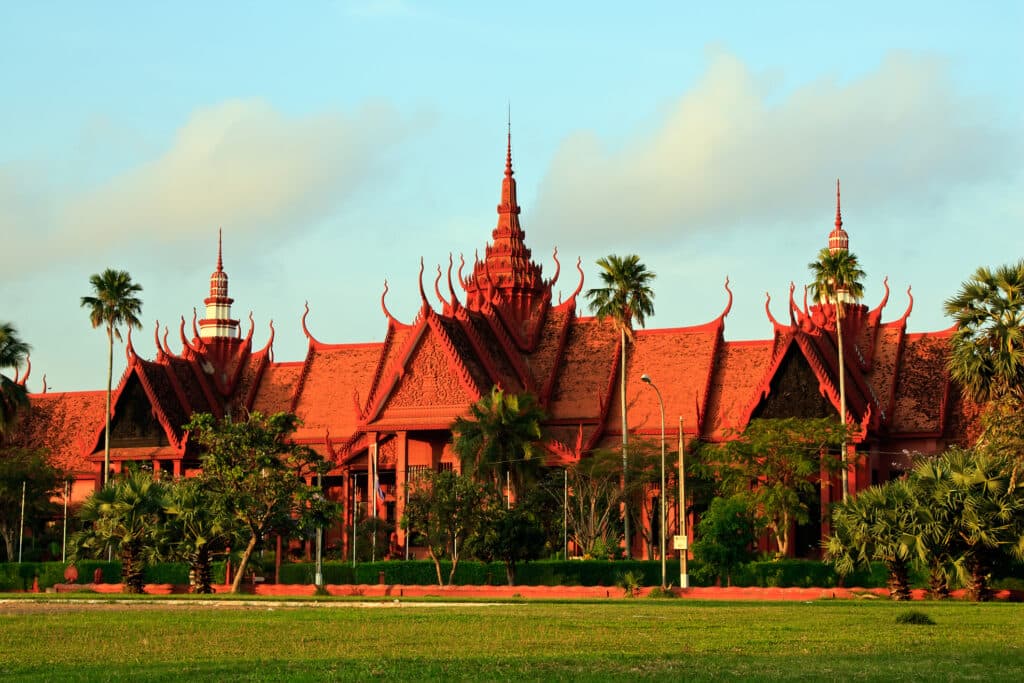
Wat Phnom sits close enough to several major sites that combining visits in a single morning or afternoon is straightforward. The National Museum of Cambodia is about a 10-minute tuk-tuk ride south and holds the world's largest collection of Khmer sculpture. The Royal Palace is similarly close. If you head toward the riverfront, the Sisowath Quay promenade runs along the Tonle Sap and Mekong rivers and has cafes and restaurants worth stopping at for lunch.
The French Quarter, with its colonial-era buildings along streets like Rue Pasteur, is also within walking distance heading south from the hill. Combining Wat Phnom with a walk through that neighborhood gives you a reasonable cross-section of what Phnom Penh's older layers look like.
Practical Tips
- Carry small bills for the entry fee and for offerings if you want to participate in the bird-release tradition
- Wear clothes that cover shoulders and knees, or bring a scarf to wrap around yourself at the entrance
- Remove shoes before entering the main vihara; look for where others are leaving theirs
- Monkeys have been spotted on and around the hill in the past, so keep bags closed and food out of sight
- The park is generally safe during the day but use common sense with valuables as you would anywhere in a busy tourist area
- Fortune tellers near the base often speak some English and will approach you; a polite shake of the head is enough to decline
- Guided city tours often include Wat Phnom as a stop, which can add useful historical context if you are new to Cambodian history
FAQ
Do I need to pay to enter Wat Phnom?
Foreign visitors are charged a small admission fee at the base of the hill. Cambodian nationals typically enter free. The fee is collected at a booth near the main staircase.
How long does a visit take?
Most visitors spend between 30 and 60 minutes at the temple itself. Add more time if you want to sit in the park or explore the surrounding streets.
Is Wat Phnom an active place of worship?
Yes. Monks live and practice here, and local Cambodians visit regularly to pray and make offerings. Treat it with the same respect you would any functioning religious site.
Is it accessible for people with limited mobility?
The main staircase to the top is steep, and there is no elevator or ramp alternative. The park at the base is flat and accessible, but reaching the temple itself requires climbing the stairs.
Can I visit Wat Phnom at night?
The temple itself closes in the evening, but the park and the illuminated hill are visible from the surrounding streets at night. The area is lively on weekend evenings with food carts and local families.
Reviews
Sign in and mark this place visited to leave a review.
No reviews yet.
Free Trip Planner
Plan your Cambodia trip with our free planner
Build a day-by-day itinerary with AI suggestions, hand-picked places, and friends. Free forever — no credit card.