
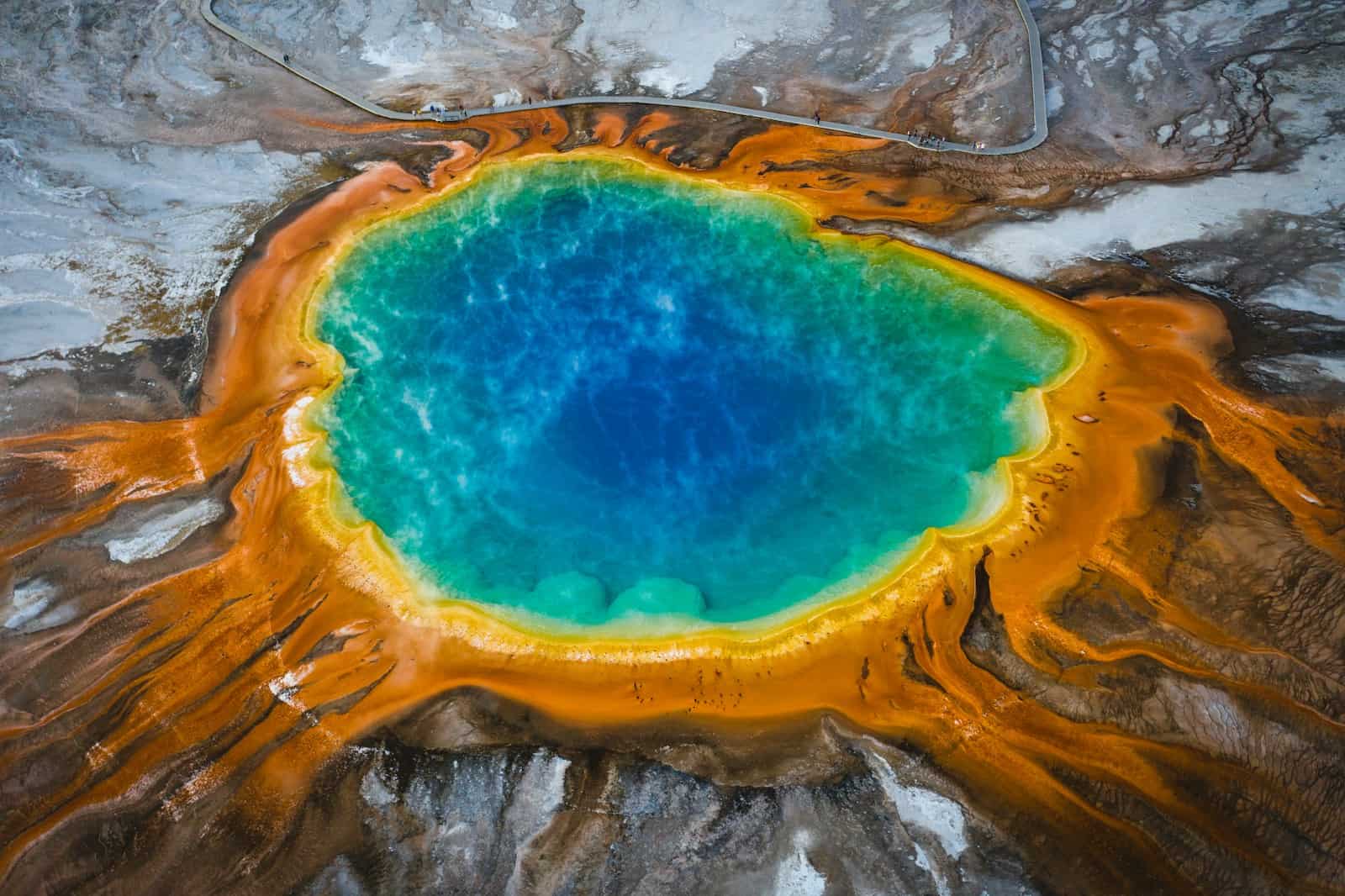
Ultimate Yellowstone National Park Travel Guide
Yellowstone National Park on the map
32 places from this guide. Tap a pin to open the listing.
Yellowstone National Park covers roughly 2.2 million acres across the northwest corner of Wyoming and spills into Montana and Idaho, and it was set aside in 1872 as the first national park anywhere in the world. That history matters here because it shaped how the place is managed: boardwalks instead of paved overlooks at thermal basins, a 142-mile figure-eight road instead of a highway grid, and wildlife that genuinely outranks the infrastructure. This Yellowstone National Park travel guide is built around the park's own geography, so you can plan by season, by entrance, and by the specific basins and overlooks worth your time rather than a generic checklist.
The park sits on top of the Yellowstone Caldera, a volcanic depression roughly 30 by 45 miles wide formed by an eruption some 640,000 years ago. Nearly everything people come for, the geysers, the hot springs, the mudpots, traces back to that geology. Add in the Grand Canyon of the Yellowstone, two mountain ranges, and the largest concentration of free-ranging wildlife in the lower 48, and you understand why a single day trip never feels like enough.
When to Visit
Spring, from April through early June, brings newborn bison calves and elk in the valleys, along with unpredictable weather. Snow can still fall in May at elevation, and some high-country roads don't open until Memorial Day weekend. This is a strong window for wildlife watching in Lamar Valley and Hayden Valley, since animals move down to lower ground as snow melts and grass greens up.
Summer, July through August, is peak season by a wide margin. Roads are fully open, ranger programs run daily, and the park sees its heaviest crowds at marquee stops like Old Faithful and Grand Prismatic Spring. Lodging and campgrounds inside the park typically need to be booked many months ahead for summer dates. Afternoon thunderstorms are common, so pack a rain shell even in July.
September and into early October is arguably the best stretch for a lot of travelers. Crowds thin out noticeably after Labor Day, the elk rut brings bugling bulls to meadows near Mammoth Hot Springs, and aspens turn gold along the northern range. Nights get cold fast, sometimes below freezing, so layer accordingly.
Winter visits require real planning. Most interior roads close to regular vehicles from early November through mid-April, and the only way to see the geyser basins is by snowcoach or snowmobile tour, mostly out of West Yellowstone or Mammoth. What you get in exchange is steam rising off thermal features against snow, far fewer people, and a different park entirely. The road between Mammoth and Cooke City via the Lamar Valley stays open year-round, making it one of the better winter wildlife-watching drives in the country.
Where to stay
Yellowstone doesn't have neighborhoods in the usual sense, but it does have distinct developed areas, and picking the right one shapes your whole trip. Staying inside the park means you wake up closer to the action and avoid some driving, but you'll want reservations locked in well ahead of your dates.
- Old Faithful area: the obvious base if geysers are your priority. The Old Faithful Inn, a log structure finished in 1904, anchors the area, and its Old Faithful Inn Dining Room is worth a meal even if you're not staying there. Nearby Biscuit Basin and Black Sand Basin make easy add-on walks, and the Old Faithful Snow Lodge Obsidian Dining Room stays open through winter for snowcoach travelers.
- Mammoth Hot Springs: in the park's north, close to the Gardiner entrance and the terraces of travertine hot springs that define this corner. The Mammoth Dining Room serves a more formal meal than most park lodges, and elk frequently graze on the lawns outside.
- Canyon Village: the best base for the Grand Canyon of the Yellowstone, with Artist Point a short drive away for the classic waterfall view. Casual eating options here include Wild West Pizzeria & Saloon and the Canyon Eatery, both useful after a long day of hiking.
- Lake Village/Grant Village: on the shore of Yellowstone Lake, with the yellow, colonial-style Lake Yellowstone Hotel and its Lake Yellowstone Hotel Dining Room. West Thumb Geyser Basin, where thermal features sit right at the lake's edge, is a short drive south.
- Tower-Roosevelt: a smaller, quieter corner near Tower Fall and Petrified Tree, with the rustic Roosevelt Lodge Dining Room and easy access into Lamar Valley for wildlife.
- Gateway towns: West Yellowstone, Montana sits right at the west entrance and has the most lodging and restaurant density outside the park, including the Grizzly & Wolf Discovery Center, Running Bear Pancake House, and Madison Crossing Lounge, set in a former schoolhouse. Gardiner, Montana and Jackson, Wyoming anchor the north and south entrances respectively, with Jackson offering a wider range of upscale options.
How to reach the destination
No airport sits inside Yellowstone, so you'll fly into a regional gateway and drive the rest of the way. Bozeman Yellowstone International Airport in Montana is the closest major airport to the park's north and west entrances, roughly 90 minutes from West Yellowstone. Jackson Hole Airport in Wyoming sits close to the south entrance and offers some of the most scenic approach roads anywhere, through Grand Teton National Park, though fares here tend to run higher than other options. Billings Logan International Airport in Montana is a longer drive, around three hours to the north entrance, but often has cheaper flights. Idaho Falls Regional Airport in Idaho is a solid budget and proximity compromise for the west side of the park, with the added bonus of a pleasant small city to pass through. Salt Lake City International Airport in Utah is the farthest of the common options, roughly five to six hours of driving, but the route is straightforward and often cheaper for flights, especially from the West Coast. Delta, United, Alaska, and Southwest all serve one or more of these airports with varying frequency depending on season.
There's no rail line into the park. Amtrak doesn't reach Yellowstone directly, so if you're traveling by train you'll need to connect to a rental car or shuttle service from a nearby city. Driving your own vehicle or a rental remains the most practical way to actually cover ground once you arrive, since the park's entrances are spread across five separate gates and public transit between them doesn't exist.
Getting around the destination
The Grand Loop Road forms a rough figure eight through the park's interior, connecting all the major developed areas and covering about 142 miles. Budget more driving time than the mileage suggests. Wildlife jams, where traffic stops because a bison herd is crossing or a bear is visible from the road, are routine and can add 20 to 30 minutes without warning. Speed limits sit around 45 mph on open stretches and drop to 25 mph or lower through developed areas, and rangers do enforce them.
Renting a car remains the default way to get around. Enterprise, Hertz, and Avis all have counters at the gateway airports. There's no public bus system inside the park, though several companies run guided bus tours from gateway towns that hit highlights like Old Faithful, Norris Geyser Basin, and the Grand Canyon of the Yellowstone in a single day. These suit travelers who want narration and don't want to deal with parking, though you give up the flexibility to linger wherever you like.
Cycling is allowed on park roads and can be a good way to see quieter stretches, particularly in spring before roads fully open to cars, but distances between sights are long and shoulders are narrow in places, so it suits confident, fit cyclists more than casual riders. Hiking trails branch off from nearly every major pullout, and a short walk often gets you away from the crowds that gather at the main boardwalks.
Top destination travel tips
- Stay at least 25 yards from most wildlife and 100 yards from bears and wolves. Rangers cite people every summer for getting too close for a photo.
- Carry bear spray if you're hiking any distance from the road, and know how to use it before you need it.
- Cell service is limited to almost nonexistent outside the main villages. Download offline maps before you lose signal.
- Stick to boardwalks and marked trails around geothermal areas. The ground crust can be thin and the water underneath runs near boiling.
- Fill your gas tank whenever you pass a station. Distances between fuel stops inside the park can run 30 miles or more.
- Book in-park lodging and campgrounds as far ahead as you can for June through August travel. Same goes for dinner reservations at the historic lodge dining rooms.
- Early morning and early evening are the best times for wildlife viewing in Hayden Valley and Lamar Valley, and traffic is lighter then too.
- If a thermal feature smells like rotten eggs, that's hydrogen sulfide and completely normal. The smell fades once you're a few steps away.
Typical costs in the destination
Entrance fees run per vehicle and cover seven consecutive days, with the total typically landing somewhere in the 30 to 40 USD range, though it's worth checking current rates before you go since they do change. An annual park pass or the broader federal lands pass can pay for itself if you're combining Yellowstone with Grand Teton or other parks nearby.
In-park lodging spans a wide range, from budget cabins without private baths to upscale rooms at the historic hotels, with most options landing in the mid-range to upscale tier for peak summer dates. Camping inside the park is the most budget-friendly way to stay, though sites in the most popular campgrounds book out fast. Meals at the historic dining rooms, places like the Old Faithful Inn Dining Room or Lake Yellowstone Hotel Dining Room, sit in the mid-range to upscale bracket, while grill counters and pizzerias like Wild West Pizzeria & Saloon keep things in budget to mid-range territory. Gas inside and around the park tends to cost more than in nearby cities, so filling up before you enter the gates can save a little.
Must try food and drinks
- Bison burger: widely available at park grills and gateway town restaurants, leaner than beef and a regional staple.
- Huckleberry anything: pie, jam, ice cream, even cocktails. Huckleberries grow wild in the surrounding mountains and show up on menus from West Yellowstone to Jackson.
- Trout: Yellowstone Lake and the park's rivers support native and introduced trout species, and several lodge restaurants serve it pan-seared or smoked.
- A full breakfast spread at Running Bear Pancake House in West Yellowstone, a reliable stop before an early start into the park.
- A sit-down dinner at one of the historic lodge dining rooms, whether that's the log-beamed Old Faithful Inn Dining Room, the lakeside Lake Yellowstone Hotel Dining Room, or the more rustic, cookout-style Roosevelt Lodge Dining Room.
- A drink at Madison Crossing Lounge in West Yellowstone, set inside a restored early 20th century schoolhouse.
- S'mores or a camp dinner if you're staying at one of the park's campgrounds, which is about as close to the classic Yellowstone experience as food gets.
FAQ
How many days do you need in Yellowstone National Park?
Plan on at least three to four days to see the major areas without rushing, including Old Faithful, the Grand Canyon of the Yellowstone, and one of the wildlife-heavy valleys. Five to seven days lets you add hikes, slower mornings for wildlife watching, and a buffer for weather delays.
Is Yellowstone National Park expensive to visit?
It can be, mostly due to lodging and the distance you need to drive to reach it, but it doesn't have to be. Camping and picnic lunches keep costs down considerably compared to staying in the historic hotels and eating every meal at a sit-down restaurant.
Do you need a car to visit Yellowstone?
Yes, essentially. There's no public transit network inside the park, and the developed areas are spread far enough apart that walking between them isn't realistic. A rental car or your own vehicle is the standard way to get around, with guided bus tours as the main alternative.
Is Yellowstone safe?
Yes, for the vast majority of visitors who follow basic rules around wildlife distance and thermal area boardwalks. Most incidents happen when people approach animals too closely for photos or step off marked paths near hot springs, both of which are avoidable.
What is the best month to visit Yellowstone?
September tends to offer the best balance of good weather, thinner crowds, and active wildlife, including the elk rut. June offers long days and full road access but comes with the start of peak crowds, so it depends on whether you prioritize quiet or convenience.
Is Yellowstone walkable once you're there?
Each developed area is walkable on its own, with boardwalks and short trails connecting thermal features and viewpoints, but the park itself is far too large to get around on foot. You'll drive between areas and then park and walk once you arrive at each one.
Can you visit Yellowstone as a day trip from Jackson or Bozeman?
Technically yes from Jackson, since the south entrance is close, but it means a very long day and you'll only see a fraction of the park. Both towns work much better as a base for a multi-day visit than a single rushed day trip, which doesn't do this Yellowstone National Park travel guide, or the park itself, justice.
Top Places to Visit in Yellowstone National Park
View all See & Do
 See & DoBudget · $
Lower Geyser Basin
 See & DoBudget · $
 See & Do
Petrified Tree
See & DoBudget · $Grand Canyon of the Yellowstone
See & DoBudget · $ See & Do
Biscuit Basin
 See & Do
Dragon's Mouth Spring
Top Places to Eat in Yellowstone National Park
View all Eat & DrinkModerate · $$
Lake Yellowstone Hotel Dining Room
 Eat & DrinkModerate · $$
Madison Crossing Lounge
 Eat & DrinkModerate · $$
Roosevelt Lodge Dining Room
 Eat & DrinkModerate · $$
 Eat & DrinkModerate · $$
Wild West Pizzeria & Saloon
 Eat & DrinkModerate · $$
Old Faithful Snow Lodge Obsidian Dining Room
 Eat & DrinkModerate · $$
Mammoth Dining Room
 Eat & DrinkModerate · $$