
Why Waiting Time, Not Headcount, Decides How Many Portable Washrooms a Site Needs
By
The queue is the real measure of a temporary washroom
Anyone who has run a fall fair, a wedding on a rural property, or a crew at a remote work site knows how people judge the facilities: by how long they wait. A portable washroom that looks adequate on paper can fail the moment everyone breaks at once. A portable restroom with two private stalls answers that problem in a particular way, and the arithmetic behind it explains why two stalls are worth more than twice one.
Two stalls cut the wait by far more than half
Queues behave in a way that surprises people. With one stall, a single long visit holds up everyone behind it. With two sharing one line, the next person simply uses whichever opens first, so a long visit slows only half the capacity. Waiting time falls steeply as the number of stalls rises, and for the same crowd the average wait with two stalls is well under half the wait with one. For an event or a crew break that comes in waves, that difference is what people remember.
Sizing it against the crowd
Headcount alone hides the real demand on a portable washroom, because people do not arrive evenly. Suppose half of a crew of twenty uses the washroom during a fifteen-minute break and each visit takes about four minutes. That is forty minutes of stall time, against thirty minutes available from two stalls in the same window, so even two stalls leave a queue. The calculation is rough, but it shows why a crowd that arrives in waves needs more capacity than its size suggests.
Ventilation and light keep a small cabin usable
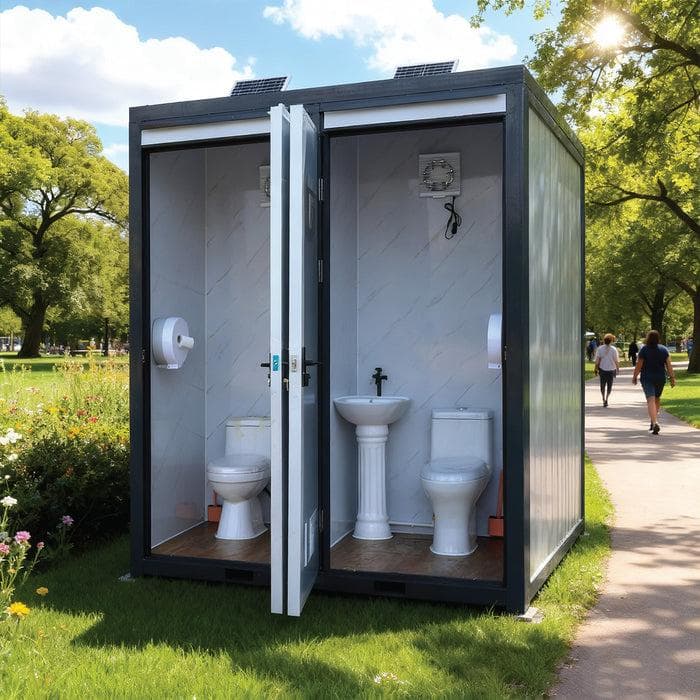
A compact cabin gets stuffy fast, which is why the exhaust fans on this unit are solar-powered and paired with airflow vents. The fans run when the sun is out, and the sun is out when most people use the washroom, so the airflow roughly follows demand without any wiring. Good airflow reduces odor and humidity together, and it makes the space bearable for the second person in a line who has been waiting in the heat.
Cleaning is a routine, and the fittings should help
A portable washroom stays clean through a schedule, not a feature. The unit has two ceramic toilets and triangular wash basins, shapes and surfaces that wipe down quickly and tuck into a small footprint. Ceramic resists staining and holds up to disinfectants better than many plastics, so a quick wipe of the touch points between visits keeps it presentable. Decide before the event who checks supplies, how often, and what happens when the stock runs out.
Placement matters more than people expect
A portable bathroom placed badly costs more than one placed well. Put it on level, firm ground so the doors swing true and nobody steps into mud, give it a short, lit path from the main area, and keep it away from food preparation and drinking water. Also leave room for whoever services it to get close, because a cabin that is hard to reach is a cabin that goes uncleaned. Before the day, walk the route as a guest would:
Level ground with firm footing
Short, well-lit path from the main area
Distance from food and drinking water
Clear access for cleaning and supplies
Privacy and access belong in the plan
Two private stalls mean two separate doors, so users are not sharing a space, which matters for comfort at mixed events and on crews with different needs. A compact seven foot cabin is not designed around a wheelchair, so a site that expects guests with limited mobility should plan an accessible unit alongside it. Lighting for evening use, and a clear path to the door in the dark, are easy to forget until the sun goes down.
A steel frame earns its keep in rough conditions
Temporary sites are hard on equipment: gravel, wind, repeated moving, and the occasional bump from a tractor. A steel frame handles that treatment better than a light shell, and it gives a cabin that stays square so the doors keep closing properly. Rules about how many facilities a site must provide differ between provinces and between workplaces and public events, so check the requirement for the specific use before ordering anything.
Where temporary sanitation is heading
More events and remote work sites are expected to provide something better than the bare minimum, partly because guests and crews now compare facilities as readily as they compare food. A small, well-ventilated two-stall portable washroom is a practical middle step between a single cabin and a full trailer. TMG Industrial also carries a single-stall portable toilet and a shower room in the same line, so a site can add facilities in steps as the crowd grows.