Aben Danan Synagogue
Fes Morocco Posted by Brandon B.Admin
Inside Aben Danan Synagogue, One of Fes's Most Remarkable Survivors
The Aben Danan Synagogue sits in the Fes el-Jdid quarter, tucked inside the old Jewish mellah that dates back to the 14th century. It is one of the best-preserved synagogues in Morocco and, depending on who you ask, one of the most moving religious sites in the entire country. The building has survived centuries of change in a city that reinvents itself constantly, and walking through its doors gives you a rare, quiet window into Moroccan Jewish life before most of that community emigrated in the mid-20th century.
Fes el-Jdid, the "new Fes" that is actually several hundred years old, sits just west of the vast medieval medina. The mellah here was established in 1438, and the synagogue you can visit today was built or substantially rebuilt in the 17th century. That timeline matters. This is not a reconstruction or a replica. The tilework, the carved woodwork, the women's gallery above the main prayer hall, the ritual bath in the basement known as a mikveh — most of it is original.
Why Aben Danan Synagogue Matters
Morocco once had one of the largest Jewish populations in the Arab world. At its peak, the Jewish community of Fes numbered in the tens of thousands. The mellah was a self-contained neighborhood with its own markets, schools, and places of worship. By the late 20th century, emigration to Israel, France, and elsewhere had reduced that population dramatically. Today the Aben Danan Synagogue stands partly as a working reminder of what existed and partly as a monument to a community that shaped this city for centuries.
The synagogue was named after a prominent local rabbi, Rabbi Joseph Aben Danan, whose family played a significant role in Moroccan Jewish religious life. The connection between the building and that lineage gives it a biographical weight that a purely architectural visit might miss.
Quick Facts
- Location: Rue des Mérinides, mellah district, Fes el-Jdid
- Built or substantially renovated in the 17th century
- Part of a larger restoration project supported by the American Jewish Joint Distribution Committee and the Moroccan government
- The mikveh (ritual bath) in the basement is one of the few surviving examples of its kind in Morocco still visible to visitors
- The synagogue is active on certain Jewish holidays, though it no longer hosts regular weekly services
- Entry is typically through a modest doorway that gives no hint of the interior
- A caretaker or guide is usually present and can explain the space in French or Arabic, occasionally in English
Getting There
From the main gate of Fes el-Jdid, the mellah is a short walk of about 10 to 15 minutes on foot. Head toward the covered market street that runs through the old Jewish quarter and look for the signs pointing toward the synagogue. The streets are narrow and can feel confusing, but most locals in this area know the building and can point you in the right direction.
If you are coming from the Fes el-Bali medina, you can walk through Bab Semmarine and into Fes el-Jdid. Taxis from the Ville Nouvelle, the French colonial-era part of the city, will bring you close in under 10 minutes most days. Parking is limited, so arriving on foot or by taxi is the practical approach.
The Layout and Experience
The entrance is understated to the point of being easy to miss. Once inside, the courtyard opens things up considerably. The main prayer hall is long and relatively narrow, with carved cedarwood panels, painted stucco, and zellige tilework that reaches partway up the walls. The color palette leans toward blues, whites, and greens, which is typical of Moroccan Jewish interiors and gives the space a calm, almost cool quality even in the heat of summer.
Above the main floor, a wooden gallery runs along the upper level. This was the women's section, and the latticework screens that front it are well preserved. Looking up at those screens from below, you get a sense of the social architecture of the space, how worship was organized, who could see what, how the community arranged itself.
The Torah ark at the far end of the hall is the visual focal point. It is ornate in the way that Moroccan craftsmanship tends to be, carved and layered, but not excessive. The overall effect is dignified rather than showy.
The basement is worth the short descent. The mikveh there is fed by a natural spring, and the chamber around it has a raw, unadorned quality that contrasts with the decorated hall above. It is one of those spaces that holds atmosphere without trying.
History and Background
Jewish communities in Morocco trace their presence back over two thousand years, predating the Arab conquest and the arrival of Islam. The mellah system, which placed Jewish communities in designated quarters of Moroccan cities, developed under the Marinid dynasty. The Fes mellah, established in 1438, was the first of its kind in Morocco and served as a model for similar quarters in Marrakech, Meknes, and elsewhere.
The Aben Danan family were among the leading religious figures of the Fes Jewish community for generations. The synagogue associated with their name became a center of study and worship during a period when Fes was one of the most intellectually active cities in the Mediterranean world. Scholars, merchants, and refugees from the Iberian expulsion of 1492 passed through and settled here, and the community's intellectual life reflected that mixture.
Restoration work on the synagogue was carried out in the 1990s and has been ongoing at various points since. The Moroccan government's involvement in preserving Jewish heritage sites is part of a broader policy of acknowledging the country's multicultural history, and Aben Danan is one of the most cited examples of that effort.
Tickets and Entry
Entry to the Aben Danan Synagogue typically requires a small admission fee, which is collected by the caretaker on site. The fee is modest. Guided visits are not always formally organized, but the caretaker often walks visitors through the main spaces and offers context, especially if you show genuine interest. Tipping the caretaker is customary and appreciated.
There is no advance booking system for individual visitors. Groups may be able to arrange visits through tour operators in Fes, and some guided city tours of Fes el-Jdid include the synagogue as a stop.
Best Time to Visit
Morning visits tend to be quieter. The light through the upper windows of the prayer hall is better earlier in the day, and you are less likely to overlap with large tour groups. The synagogue is generally open during daylight hours, though it may close on Fridays and during Jewish holidays, or alternatively be busier during those times if a ceremony is taking place.
Spring and autumn are the most comfortable seasons in Fes for general sightseeing. Summer in the city can be intensely hot, and while the interior of the synagogue offers some relief, the walk through the mellah and Fes el-Jdid in the midday heat is genuinely draining.
Photography Tips
The interior is dim in places, so a camera that handles low light well makes a real difference. The zellige tilework and the carved woodwork both reward close shots. The women's gallery from below and the Torah ark from the center of the hall are the two compositions most visitors go for, and both work. Ask the caretaker before photographing the mikveh, as some consider it a more private or sacred space.
Combining with Nearby Attractions
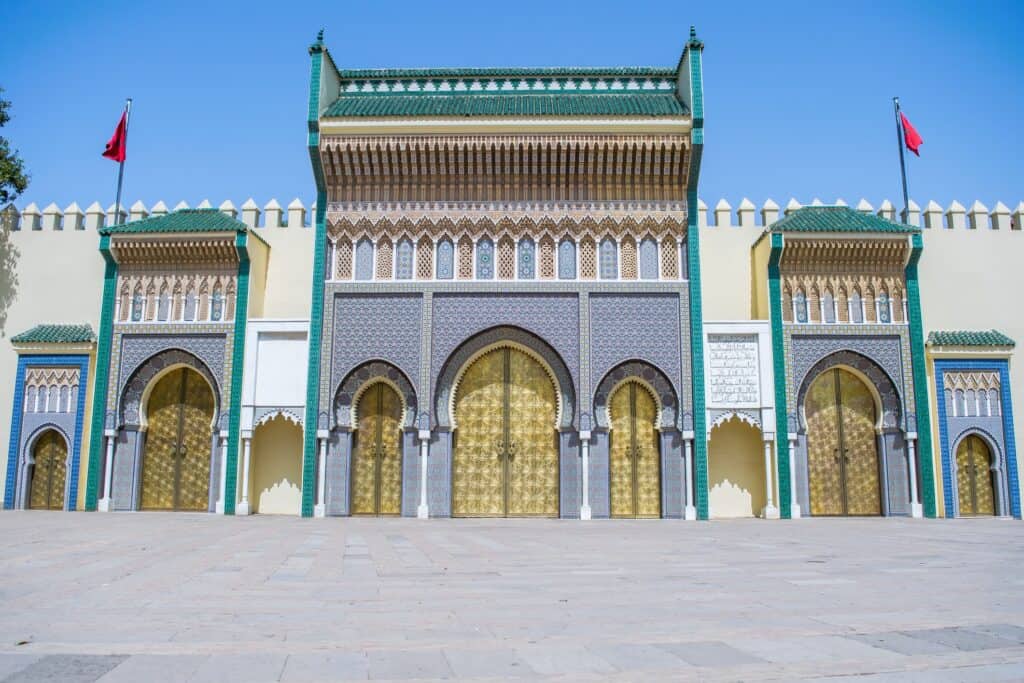
The mellah itself is worth an hour of wandering before or after the synagogue. The old Jewish cemetery adjacent to the quarter is one of the largest in Morocco and is open to visitors. The Royal Palace of Fes, with its famous brass-clad gates, is a five-minute walk from the mellah entrance and makes an easy pairing. From there, Bab Bou Jeloud, the main entrance to the Fes el-Bali medina, is another 15 minutes on foot.
If you are spending a full day in Fes el-Jdid and the mellah, the Dar Batha Museum is a short distance away and houses one of the better collections of Moroccan decorative arts in the country.
Practical Tips
- Dress modestly. Shoulders and knees covered is the standard expectation at religious sites in Morocco regardless of faith.
- The doorway entrance is easy to walk past. Look for a small sign and a door set into a whitewashed wall.
- Bring small bills for the entrance fee and a tip for the caretaker.
- The floor surfaces in the basement near the mikveh can be slippery. Wear sensible shoes.
- If the synagogue appears closed, knocking and waiting a few minutes often produces results. The caretaker lives nearby.
- French is more useful than English here. A few words of Arabic are appreciated.
- Combine the visit with the Jewish cemetery for a fuller picture of the mellah's history.
FAQ
Is the Aben Danan Synagogue still used for worship?
Occasionally, yes. Regular weekly services are not held, but the synagogue does see use during certain Jewish holidays when members of the small remaining Jewish community or visiting worshippers gather here.
Do I need to be Jewish to visit?
No. The synagogue welcomes visitors of all backgrounds. It functions primarily as a heritage site, and respectful curiosity is all that is required.
How long does a visit take?
Most visitors spend between 30 and 45 minutes inside. If the caretaker is available and talkative, or if you spend time in the mikveh chamber and the courtyard, an hour is reasonable.
Is the synagogue accessible for visitors with mobility issues?
The main prayer hall is accessible at ground level, but the basement mikveh involves a staircase with no lift alternative. The streets leading through the mellah are uneven in places.
Are there other synagogues to visit in Morocco?
Yes. The Ibn Danan is one of several. Marrakech has the Lazama Synagogue in its own mellah, and Casablanca has the Beth-El Synagogue. Each reflects a different chapter of the same long story.
Reviews
Sign in and mark this place visited to leave a review.
No reviews yet.
Free Trip Planner
Plan your Fes trip with our free planner
Build a day-by-day itinerary with AI suggestions, hand-picked places, and friends. Free forever — no credit card.