Berlin’s Brandenburg
Pariser Platz, 10117 Berlin, Germany Posted by Brandon B.Admin
Berlin's Brandenburg Gate: What to Expect Before You Arrive
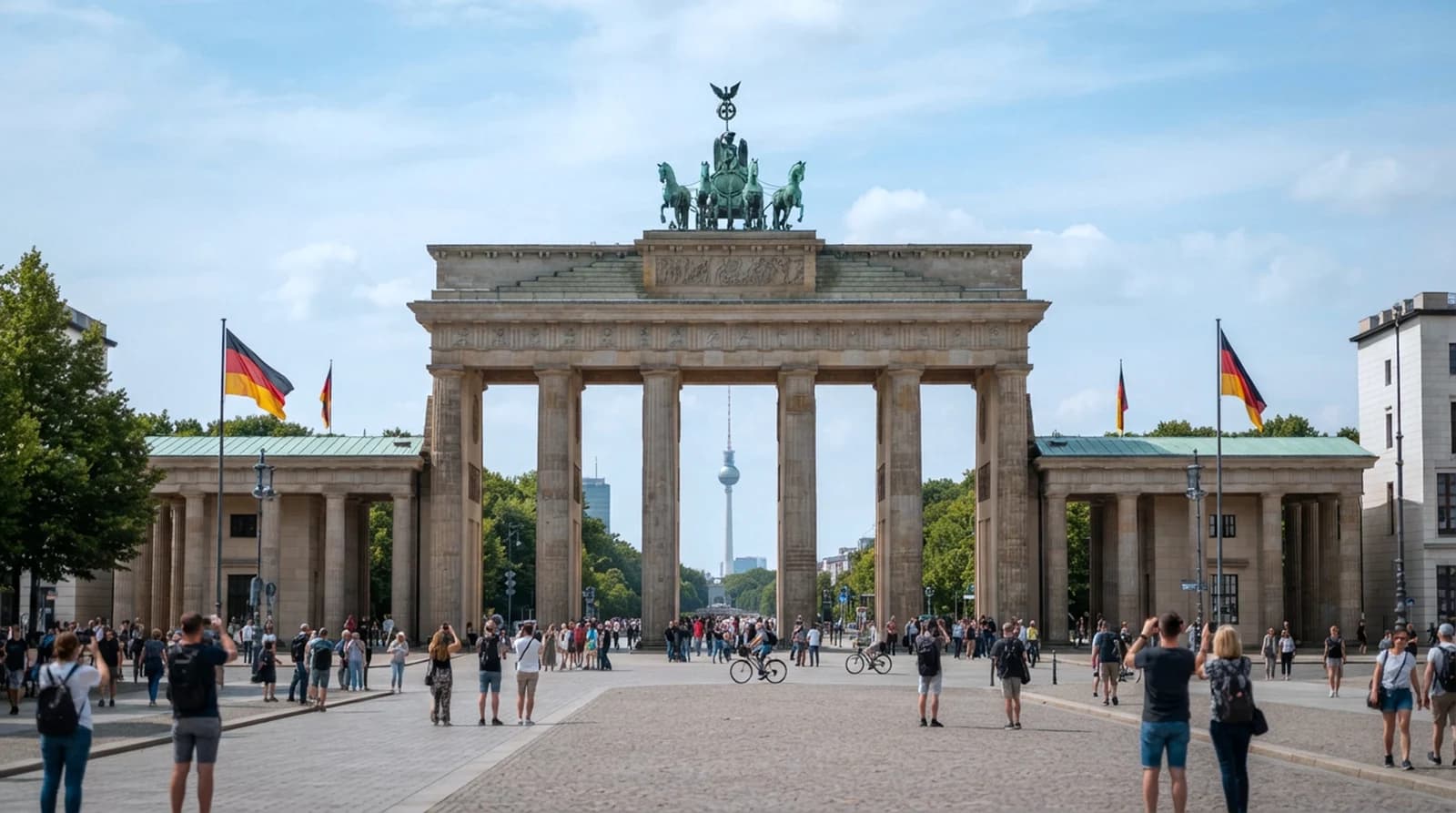
The Brandenburg Gate stands at the western end of Unter den Linden, one of Berlin's most storied boulevards, and it has been the city's most recognized landmark for well over two centuries. Whether you approach from Pariser Platz, through the Tiergarten, or across from the Memorial to the Murdered Jews of Europe, the first glimpse of those twelve Doric columns tends to stop people mid-step. There is nothing quite like seeing it in person after a lifetime of photographs.
It is free to visit, open at all hours, and sits within walking distance of several of Berlin's most significant sites. That combination makes it both a destination in itself and the natural anchor for a half-day in the Mitte district.
Why the Brandenburg Gate Still Matters
Built between 1788 and 1791 under the direction of architect Carl Gotthard Langhans, the gate was commissioned by Prussian King Frederick William II. It was modeled on the Propylaea, the gateway to the Acropolis in Athens, and at roughly 26 meters tall, it was designed to impress. It succeeded.
For most of the 20th century, the gate was less a symbol of welcome than of division. When the Berlin Wall went up in 1961, the gate ended up stranded in the no-man's-land between East and West, inaccessible to ordinary citizens on either side. It became the defining image of a city cut in two. When the Wall fell in November 1989, crowds surged toward it from both directions. The gate did not just witness that moment. It became the moment.
That history is still present when you stand there. The Quadriga, the bronze chariot sculpture pulled by four horses that sits atop the gate, was carted off to Paris by Napoleon in 1806 and only returned in 1814. Even the sculpture has a complicated story.
Quick Facts
- Address: Pariser Platz, 10117 Berlin
- Built: 1788 to 1791
- Architect: Carl Gotthard Langhans
- Height: approximately 26 meters
- Entry: free, no ticket required
- Open: 24 hours, every day of the year
- Nearest U-Bahn and S-Bahn: Brandenburger Tor station, served by the S1, S2, and S25 lines
- Nearest bus: lines 100 and 200 stop at Brandenburger Tor
Getting There
The gate has its own S-Bahn station, Brandenburger Tor, which makes arrival straightforward. From Alexanderplatz, the S-Bahn takes roughly 10 minutes. From Berlin Hauptbahnhof, you can walk south through the Tiergarten in about 20 minutes, which is actually one of the better approaches if the weather is cooperating. You arrive through the park rather than through a busy street, and the gate comes into view gradually as you clear the trees.
Taxis and rideshares can drop you directly on Ebertstrasse, the road running along the gate's western face. Cycling is also a practical option. Berlin's bike infrastructure is solid in this part of the city, and there are bike racks near Pariser Platz.
The Layout and Experience
Pariser Platz, the formal square on the gate's eastern side, is flanked by the Hotel Adlon Kempinski, the French and US embassies, and the Academy of Arts. It has a composed, almost ceremonial feel. Street performers often set up here, and depending on the time of year, you might find food stalls, information stands, or the edge of a larger event spilling in from Unter den Linden.
The gate itself has five passageways. The central one was historically reserved for royalty and later for official motorcades. These days all five are open to pedestrians, so you can walk straight through. On the western side, the Tiergarten stretches out toward the Victory Column, roughly a 25-minute walk away.
There is a visitor center in the southern wing of the gate, run by the Stiftung Berliner Mauer (Berlin Wall Foundation). It is small but worth a few minutes. The exhibition inside covers the history of the gate and its role during the division of Berlin, using photographs and original documents. Entry is free.
Best Time to Visit
The gate is busy almost every day, but the crowds vary considerably. Midday in summer tends to be the most congested, with tour groups, school trips, and general tourist traffic all converging at once. Early morning, especially before 8am, gives you the square largely to yourself and much better light for photographs.
At night the gate is lit up and the effect is genuinely striking. Evening visits are quieter than midday and offer a completely different atmosphere. On major public holidays, particularly New Year's Eve, Pariser Platz transforms into one of Europe's largest public celebrations, with hundreds of thousands of people gathering around the gate. It is spectacular and also genuinely overwhelming if crowds are not your thing.
Winter visits have their own appeal. On grey afternoons, the stone columns look almost monumental in a way that summer sunshine can flatten. If it snows, the square becomes very quiet very quickly.
Photography Tips
The most common shot is taken from Pariser Platz looking west through the gate toward the Tiergarten. That works, but consider walking about 150 meters west into the park and shooting back east. You get the full gate framed by trees, and the Hotel Adlon and the square appear behind it, giving the image context and depth.
The Quadriga detail at the top photographs well with a longer lens from the Ebertstrasse side. Early morning light hits the eastern face of the gate from around 7am depending on the season. Golden hour in the evening lights up the western face nicely and the crowds are usually thinner than at midday.
If you want the gate without people in frame, your best realistic window is weekday mornings before 8am. Even then, a few other photographers will likely have the same idea.
Combining With Nearby Attractions
The gate sits at the intersection of several major Berlin itineraries. The Memorial to the Murdered Jews of Europe is directly south, a two-minute walk from Pariser Platz. The Reichstag building and its glass dome, which requires advance registration for free entry, is about five minutes north on foot. Unter den Linden runs east from the gate toward Museum Island, a walk of roughly 25 to 30 minutes that passes the Humboldt Forum, the Berlin State Opera, and the Neue Wache memorial along the way.
West through the Tiergarten, the Victory Column is a logical next stop. The park itself is large and pleasant enough that the walk there does not feel like transit. It feels like part of the day.
Practical Tips
- The visitor center in the gate's south wing keeps its own hours and may be closed on certain public holidays. Check before making it a centerpiece of your visit.
- Pariser Platz can get uncomfortably crowded during major events. Berlin's event calendar is worth checking if you are visiting around a public holiday or a major sporting event.
- Pickpocketing is reported around heavily touristed areas in Berlin. Standard precautions apply here as they would anywhere with dense crowds.
- There are no bag checks or entry restrictions for the gate itself, but the Reichstag nearby requires advance registration and security screening.
- If you are visiting in summer, the square has limited shade. A hat and water are worth having, especially if you plan to linger.
- The area is fully accessible for wheelchairs and strollers. The passageways are level and the surrounding square is paved.
FAQ
Is there an entry fee for the Brandenburg Gate?
No. Walking through and around the gate is completely free at any hour. The visitor center inside the south wing is also free.
Can you go inside the gate or climb it?
The passageways are open to walk through, but there is no public access to the upper structure or the Quadriga platform.
How long should I plan to spend here?
Most people spend 20 to 40 minutes at the gate itself. Add another 15 minutes if you visit the small exhibition in the south wing. If you are using it as a starting point for Unter den Linden or the Tiergarten, budget at least a half-day for the broader area.
Is the Brandenburg Gate the same as Checkpoint Charlie?
No. Checkpoint Charlie was the most famous crossing point between East and West Berlin and is located about 1.5 kilometers southeast of the Brandenburg Gate, near Friedrichstrasse. Both are significant Cold War sites but they are separate locations.
What is the Quadriga?
The Quadriga is the bronze sculpture of a four-horse chariot driven by a winged figure that crowns the gate. It was created by sculptor Johann Gottfried Schadow and installed in 1793, then removed by Napoleon and returned after his defeat. The current version is a 1958 reconstruction, as the original was heavily damaged during World War II.
Reviews
Sign in and mark this place visited to leave a review.
No reviews yet.
Free Trip Planner
Plan your Berlin trip with our free planner
Build a day-by-day itinerary with AI suggestions, hand-picked places, and friends. Free forever — no credit card.