Calle de los Suspiros
Calle de los Suspiros
Calle de los Suspiros, 70000 Colonia del Sacramento, Departamento de Colonia, UruguayCalle de los Suspiros, the Street of Sighs, is a narrow cobblestone lane in the Barrio Histórico of Colonia del Sacramento, Uruguay's oldest town and one of South America's best-preserved colonial settlements. It runs barely 100 to 150 meters from the river waterfront into the interior of the old quarter, lined with low pastel-colored houses whose wooden doors and iron window grilles have survived more than two centuries of weather and footsteps. There's no ticket booth, no opening hours, no entrance gate. You simply walk onto it, and for most visitors to Colonia del Sacramento, that happens whether they planned it or not.
The name itself carries a story, or several, depending on who you ask. Some say it comes from lovers who once met here in secret, their sighs the only sound in the quiet lane. Others point to a darker version involving a brothel or convent nearby. Nobody can confirm which, if any, is true, and that uncertainty is part of the street's charm. It's a place built as much on atmosphere as on fact.
Why Calle de los Suspiros matters
This short stretch of stone is one of the clearest physical traces of Colonia del Sacramento's Portuguese founding. The town was established in 1680 as a Portuguese trading post and fort, positioned directly across the Río de la Plata from what is now Buenos Aires. That location made it valuable and, for more than a century, fiercely contested between Portugal and Spain. The low, tightly packed buildings along Calle de los Suspiros, with their thick walls and narrow proportions, reflect building techniques brought over from Portugal rather than the broader, more formal streets typical of Spanish colonial towns elsewhere in the region.
The street also sits at a kind of hinge point in the town's layout, marking where the newer sections of Colonia give way to the old historic quarter. Walking its length, you move from one era into another in the space of a few minutes. It's one of the most photographed corners of Uruguay, and it earns that reputation less through any single landmark than through the cumulative effect of faded color, worn stone, and quiet.
Quick facts
- Located in the Barrio Histórico, the historic quarter of Colonia del Sacramento, a UNESCO World Heritage Site since 1995
- No admission fee to walk, photograph, or linger on the street
- Roughly 100 to 150 meters long, depending on where you mark the start and end
- Street width runs about 3 to 4 meters, flanked by two- to three-story colonial buildings
- Best visited early morning or late afternoon for light and fewer crowds
- Colonia del Sacramento is about 45 minutes by ferry from Buenos Aires, or roughly 3 hours by car from Montevideo
- The town was founded by the Portuguese in 1680
Getting there
Calle de los Suspiros runs north from the waterfront near the Barrio Histórico. If you've arrived by ferry from Buenos Aires, you'll land at the port on the south side of town, and from there it's a 10 to 15 minute walk uphill and inland. Head north along Avenida General Flores, then cut into the old quarter on one of the side streets. Signs pointing toward the Barrio Histórico are frequent enough that you won't need much more than that.
If you're driving in from Montevideo or elsewhere in Uruguay, park near the port or along the quieter edges of the historic quarter rather than trying to drive into it. The old town's streets are narrow, often one-way, and genuinely not built for cars. Everything worth seeing in the historic center is walkable, and the cobblestones make driving slow and uncomfortable anyway.
The layout and experience
The street is narrow enough that you're rarely more than a few steps from either row of buildings. Houses here stand two to three stories, their facades painted in faded yellow, pink, white, and blue, the kind of palette that looks almost deliberately muted by sun and salt air rather than by paint choice. Many retain their original wooden doors and shuttered windows, some fitted with iron grilles that have oxidized to a soft brown-black over the decades. The cobblestones underfoot are uneven, rounded smooth in places by centuries of use.
There's a noticeable drop in temperature on this street compared to the open avenues nearby, something to do with the narrow channel between tall walls and the proximity to the river. Walking it, even with other tourists around, there's a stillness that's hard to explain and easy to feel. Small doorways open onto galleries, antique shops, and cafes, some no bigger than a single room, occasionally with just one chair and a small table set outside as an invitation to stop.
Geographically, the street links Calle de Comercio on the waterfront to the interior of the old town. Walk north to south and you descend gradually toward the Río de la Plata. Go the other way and you move deeper into the historic quarter, toward the central plaza and the Iglesia Matriz.
Main highlights
There's no single monument to check off here. The street itself is the point, and the highlights are details rather than destinations. Look up as you walk: wooden shutters, painted trim worn thin by weather, the slight lean some of these 18th and 19th century buildings have developed with age. The ironwork on windows and the fitted stonework of the walls show craftsmanship that's easy to miss if you're moving quickly.
The small shops and galleries sell local crafts, art, and antiques, and while a few lean toward tourist souvenirs, most are small businesses that have occupied the same spaces for years. A handful of cafes serve coffee and simple pastries, and sitting at one of their tiny outdoor tables gives you a reasonable sense of what daily life on this street might have looked like a hundred years ago, minus the phones.
Light is arguably the real highlight. In the morning, sun comes from the east and lights one side of the street while the other falls into shadow. By late afternoon the pattern reverses. That shifting contrast, combined with the narrow framing of the lane, is why photographers return to this particular street again and again rather than to wider, more open parts of town.
History and background
Colonia del Sacramento was founded by the Portuguese in 1680 as a fortified trading post on the Río de la Plata, positioned to challenge Spanish control of the region from directly across the water from Buenos Aires. Over the following century, the town changed hands repeatedly between Portuguese and Spanish rule, and that back-and-forth left a visible mark on the architecture. Low rooflines, narrow streets, and construction techniques tied to Portuguese building traditions sit alongside later Spanish colonial additions, giving the historic quarter its mixed, slightly unresolved character.
Most of what you see walking Calle de los Suspiros today dates to the 18th century, with later restoration work layered on top. By the 19th century, Colonia had lost much of the strategic and commercial importance that justified its founding, and the town slid into a long period of quiet decline. That decline turned out to be the thing that saved it. Without the money or motive to tear down and rebuild, the old town's colonial structures simply stayed standing, unmodernized, while other cities moved on.
In 1995, UNESCO designated the historic quarter of Colonia del Sacramento a World Heritage Site, recognizing the rare intactness of its colonial urban fabric. That listing brought tourism, funding, and more careful restoration. Calle de los Suspiros, already known locally, became one of the most recognized single streets in Uruguay, a shorthand image for the whole town.
Best time to visit
Timing changes the experience here more than at most attractions, mainly because the street has no fixed hours and no gate to control flow. Before 9 a.m., the street belongs mostly to residents, a few early photographers, and whatever pigeons have claimed the cobblestones. The light at this hour is soft and comes in low, raking across the facades.
Late afternoon, roughly 4 to 6 p.m., is the second window worth planning around. Many day-trippers from Buenos Aires have already headed back to the ferry terminal, and the light turns warm and golden, particularly flattering on the worn stone and peeling paint. Midday is when tour buses tend to unload, and the street fills with groups moving slowly in both directions. It's still worth seeing at midday if that's the only time you have, but expect company and flatter, harsher light.
Seasonally, summer (December to February) brings the heaviest tourist numbers and the warmest weather. Winter (June to August) is cooler, quieter, and has noticeably shorter daylight hours. Spring and fall tend to offer the best balance of mild weather and manageable crowds.
Photography tips
Given how often this street appears in photographs of Uruguay, you'll have plenty of company with a camera, and that's not a bad thing. The narrow lane keeps you close to your subject no matter which direction you shoot, and the converging lines of the buildings create a strong natural frame.
Morning and late afternoon light are your best bets. Midday sun is harsh here, washing out the pastel facades and creating hard shadows that don't flatter the texture of the stone. The hour just before sunset tends to bring out the weathered quality of the doors and shutters particularly well.
Don't overlook close-up shots. A single peeling shutter, a cat asleep in a doorway, the grain of an old wooden door, these intimate details often say more about the street's mood than a wide shot of the whole lane. That said, a wide shot from one end, framing the buildings receding into the distance, is a classic composition here for a reason. If you're shooting in low light, a tripod helps, and a wide-angle lens suits the tight space well. A 35mm or 50mm prime is a solid choice if you prefer working closer to street level.
Facilities and preparation
There are no public restrooms or water fountains directly on Calle de los Suspiros. A few cafes and shops along the street will let you use facilities if you buy something, and the nearest public restrooms are a short walk away in the central plaza of the historic quarter.
The cobblestones are uneven and can get slippery when wet, so wear shoes with real grip rather than anything smooth-soled or heeled. Parts of the street have a noticeable slope, which is worth knowing if mobility is a concern.
In summer, bring water and sunscreen, since shade is limited despite the buildings on either side. In cooler months, pack a light jacket, as the street's proximity to the river tends to make it windier and cooler than other parts of town. During the day and early evening the street feels safe and well-traveled. Like most quiet, narrow places, it's worth avoiding very late at night when it empties out and lighting is limited.
Combining with nearby attractions
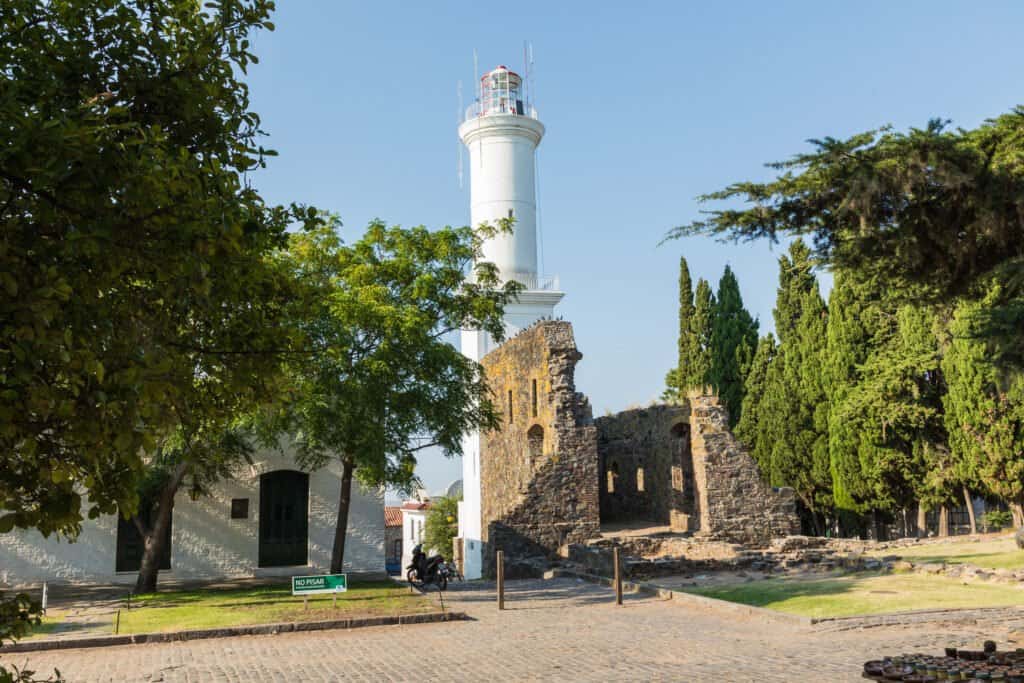
Calle de los Suspiros sits close enough to several other sites that it's easy to build a short loop around it. The Iglesia Matriz, the town's main church, is about a 5 minute walk away. The Museo Portugués occupies a restored colonial house nearby and gives useful context on the Portuguese period that shaped these streets. The old lighthouse, the Faro, and the ruins of the Convento de San Francisco are also within walking distance.
Down toward the water, the Paseo de San Gabriel runs along the river and makes for a pleasant stroll, especially with the restaurants and bars clustered near the port. If you'd rather avoid crowds entirely, streets like Calle Vasconcelos and Calle Ituzaingó have the same colonial texture as Calle de los Suspiros with a fraction of the foot traffic.
Sample visit plan
For a day trip from Buenos Aires, arrive on the morning ferry and head straight into the historic quarter. Spend your first 45 minutes to an hour on Calle de los Suspiros while the light is good and the crowds haven't arrived yet. From there, walk to the Iglesia Matriz and the central plaza, popping into a small museum if one interests you. Lunch at a waterfront restaurant around midday makes sense before the afternoon tour groups fill the street.
In the afternoon, walk the Paseo de San Gabriel or explore some of the quieter side streets, then circle back to Calle de los Suspiros around 4 p.m. for the second good light window before heading to the ferry terminal. If you're staying overnight, there's no need to rush any of this. Revisiting the street at different times of day, in different light, is one of the more rewarding ways to spend an unhurried evening in Colonia.
Practical tips
- The ferry from Buenos Aires to Colonia takes about 45 minutes and runs multiple times daily; book ahead on weekends
- Uruguay uses the Uruguayan peso, but many businesses in the tourist quarter accept Argentine pesos and US dollars, with ATMs near the port
- Spanish is the main language; English is common in tourist areas but not guaranteed everywhere
- Avoid midday if you'd rather skip crowds, and aim for early morning or the hour before sunset instead
- If driving, park near the port or in the designated lots, since the old quarter's streets are narrow and parking inside them is limited
- Wear shoes with good grip for the uneven cobblestones
- Remember people actually live and work along this street, so keep that in mind as you photograph doorways and windows
FAQ
Is there an admission fee to walk Calle de los Suspiros?
No. It's a public street, free to walk at any hour. Some shops and cafes along it charge for goods or food, but you can walk the full length without spending anything.
How long does it take to walk the street?
Walked straight through, about 10 to 15 minutes. With stops for photos, a coffee, or browsing the shops, plan on 45 minutes to an hour.
Is the street safe at night?
It's generally safe in the evening while there are still people around. It's quieter and poorly lit late at night, so it's best avoided then, as with any empty public space.
Can I visit as a day trip from Buenos Aires?
Yes, and many people do exactly this. The ferry crossing takes about 45 minutes each way, leaving plenty of time to explore the historic quarter and Calle de los Suspiros in an afternoon.
What's the best time of year to visit?
Spring (September to November) and fall (March to May) bring mild weather and smaller crowds than summer (December to February), which is the busiest and warmest stretch. Winter (June to August) is cooler and quieter with shorter days.
Reviews
Sign in and mark this place visited to leave a review.
No reviews yet.
Free Trip Planner
Plan your Colonia del Sacramento trip with our free planner
Build a day-by-day itinerary with AI suggestions, hand-picked places, and friends. Free forever — no credit card.
Things to see near Calle de los Suspiros

La Bombonera
Colonia del Sacramento Lighthouse

Field Gate