
Cloak Bridge
381 01 Český Krumlov-Český Krumlov 1, CzechiaOverview
Walk across the Cloak Bridge in Český Krumlov and you step onto one of Central Europe's most photogenic spans. The bridge arches over the Vltava River where it bends sharply through the medieval town, its stone surface worn smooth by centuries of footsteps. On most days you'll find locals cutting through on their way to the castle side of town, while visitors pause mid-span to frame shots of the water and the red-roofed buildings climbing the hillside behind.
The bridge connects the old town square to the castle district, making it impossible to miss if you're exploring Český Krumlov. Its modest length (roughly 40 meters) and simple arched design belie its age and significance. Standing here, you're in the geographic heart of a place where medieval street patterns still govern how people move through the landscape.
Why this place matters
The Cloak Bridge is essential to understanding how Český Krumlov functioned as a settlement. For centuries it was the primary crossing point between the town's commercial center and the castle, which rose on the opposite bank. The bridge's construction reflects the town's prosperity during the Renaissance, when the Eggenberg family expanded both the castle and the town's reach.
Its survival is notable. Many bridges across the Vltava in the region were destroyed or rebuilt entirely after floods or wars. This one has retained enough of its original character to feel genuinely old, even if portions have been repaired.
Quick facts
- Location: spans the Vltava River between the town square and castle district
- Construction era: Renaissance period, likely 16th century
- Length: approximately 40 meters
- Access: free, open 24 hours
- Best time to cross: early morning or late afternoon to avoid peak tourist crowds
Getting there
If you're staying in the town square area, the bridge is a five-minute walk downhill toward the river. From the main square, head toward the Church of St. Jidji and follow the street (Radniční) as it slopes down. You'll see the bridge appear ahead as the street levels out near the water.
Coming from the castle, walk downhill through the castle gardens or follow the main path out of the castle complex and descend toward the river. The bridge will be directly in front of you as you approach the water level.
There's no dedicated parking on the bridge itself. If you're driving, park in one of the lots near the town square or castle and walk. The bridge is pedestrian-only.
The layout and experience
The Cloak Bridge is straightforward: a single span with a gentle arch, stone railings on both sides, and enough width for two people to pass comfortably. The surface is uneven in places, worn by foot traffic and weather. If you arrive early, before 9 or 10 in the morning, you'll have stretches of quiet crossing time.
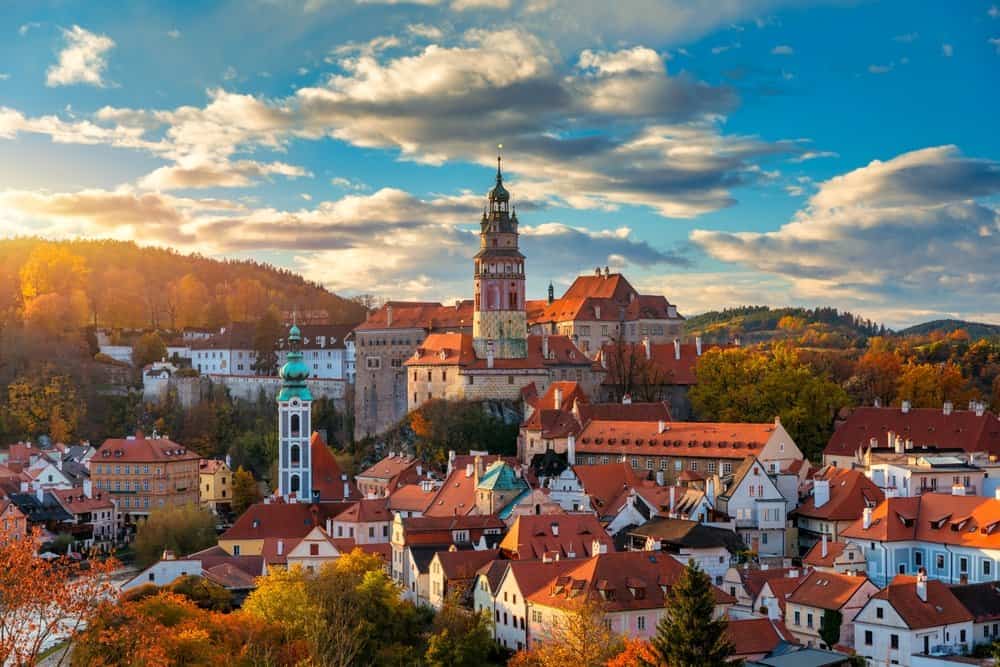
The experience changes depending on which direction you're heading. From the town square side, you descend gradually as you approach the bridge, then cross with the castle and forested hillside rising on your left. The water curves beneath you in a sharp bend. From the castle side, the perspective reverses: the old town's clustered rooftops and the church tower come into view as you cross.
Most of the time, especially outside peak summer months, the bridge feels like a functional crossing rather than a tourist attraction. That changes in mid-morning and early afternoon, when tour groups converge. By late afternoon, it quiets again.
Main highlights
The views from mid-span are the primary draw. Looking downstream, the river curves into a tighter bend, and the landscape opens toward forested hills. Upstream, the water reflects the buildings and sky. The play of light changes throughout the day. Morning light tends to come from behind the castle, illuminating the old town's facade. Afternoon light hits the water more directly.
The bridge itself, rather than a specific feature on it, is the highlight. Its age, its integration into the medieval street pattern, and its role as a literal threshold between the two halves of the town are what make it worth crossing deliberately rather than just passing through.
History and background
The Cloak Bridge's exact date of construction is not documented with certainty, though it's generally attributed to the Renaissance period, likely the 16th century, when Český Krumlov was at its economic peak under the Eggenberg family. The bridge was built to facilitate movement between the expanding castle complex and the commercial town center.
The origin of its name is unclear. Local sources offer various explanations, but none is definitively sourced. What's certain is that the bridge has been a fixed point in the town's geography for at least 400 years. It survived the Thirty Years' War, subsequent floods, and the industrial transformations that swept through much of Central Europe in the 19th and 20th centuries.
The bridge was likely restored or reinforced at various points, particularly after the major Vltava floods that periodically affected the region. Modern repairs have been made to preserve the structure, but the original stone and arched design remain visible and functional.
Best time to visit
The Cloak Bridge is accessible year-round and at all hours. Timing your crossing depends on your preference for solitude versus atmosphere. Early morning, before 8 or 9 AM, offers the quietest experience. The town is still waking up, and you may have the bridge nearly to yourself.
Late afternoon, after 4 or 5 PM, is also relatively peaceful. The midday tour-group crush has passed. Winter months tend to be quieter overall, though the stone can be slippery after rain or ice.
If you want to experience the bridge as locals do, cross it on an off-season weekday morning. You'll see it as a functional crossing, not a photo opportunity, which is perhaps closer to its true character.
Photography tips
The bridge works best photographed from the water level if you can access the riverbank. Several small paths lead down to the river from both sides. Shooting from below, with the bridge framing the old town or castle above it, captures the structure in context.
From the bridge itself, the views downstream and upstream both reward photography. The morning light from behind the castle is softer than the harsh midday sun. Afternoon light rakes across the water and can produce strong reflections if the river is calm.
If you're photographing the bridge as a structure, overcast days reduce the contrast and glare, making the stone texture more visible. The worn surface of the bridge is part of its character, so close-up shots of the stonework and railings work well.
Avoid the peak hours between 10 AM and 3 PM if you want images without crowds. Early or late in the day, you can frame shots without waiting for foot traffic to clear.
Facilities and preparation
The bridge itself has no facilities. It's an open span with no shelter, restrooms, or vendor services. If you need anything before or after crossing, the town square has restaurants, cafes, and shops within a few minutes' walk in either direction.
The stone surface can be wet and slippery after rain or in winter. Wear shoes with decent grip. The railings are sturdy, but the bridge is narrow enough that you'll be close to the edge if traffic is heavy. Keep children and pets close.
The bridge is fully exposed to weather. In summer, there's no shade. In winter, it can be icy. Neither condition prevents crossing, but both are worth accounting for in your timing and clothing.
Combining with nearby attractions
The Cloak Bridge is one element in a larger walk through Český Krumlov. Most visitors cross it as part of a route between the town square and Český Krumlov Castle, which sits on the hillside above the opposite bank. The castle is the major attraction in the area and is worth a few hours of exploration if you have time.
The town square itself, with its Renaissance buildings and the Church of St. Jidji, is worth exploring before or after the bridge. Several restaurants and cafes line the square and the streets leading to it. The Vltava River walk continues upstream and downstream from the bridge, offering quieter views of the landscape if you're interested in walking beyond the immediate town center.
If you're spending a full day in Český Krumlov, the bridge serves as a natural waypoint between different parts of your route. It takes only a few minutes to cross, but it's worth pausing mid-span to actually look at the water and the buildings rather than just passing through.
Sample visit plan
Start in the town square early, around 8 AM. Spend 30 to 45 minutes exploring the square and the streets immediately around it. Walk downhill toward the river and the Cloak Bridge. Cross the bridge slowly, pausing to look at the views. The crossing itself takes 5 to 10 minutes if you're not hurrying.
On the castle side, you have options. If you're visiting the castle, buy your ticket and allow 2 to 3 hours for a tour of the interior and grounds. If you're skipping the castle, walk around its exterior and the surrounding gardens for 20 to 30 minutes, then return across the bridge to the town side.
Plan for lunch or a cafe break once you're back near the square. This entire loop, without entering the castle, takes roughly 2 to 3 hours. With the castle included, allow a full half-day.
Practical tips
- Cross the bridge in the early morning or late afternoon to avoid crowds and get better photographs.
- Wear shoes with grip if there's been recent rain or if you're visiting in winter.
- Don't assume you need to enter the castle to appreciate the bridge; crossing it and viewing the surroundings is valuable on its own.
- The bridge is narrow. If you're traveling with a large group, cross in smaller clusters rather than all at once.
- Use the bridge as a natural waypoint to rest and look around, not just a passageway to get somewhere else.
- If you want solitude, visit on a weekday outside the May-to-September peak season.
FAQ
Is the Cloak Bridge free to cross? Yes. There are no tolls or entry fees. Access is open 24 hours.
Can I drive across the bridge? No. It's pedestrian-only and has been for centuries. Vehicles must use alternate routes or park and walk.
How long does it take to cross? The actual crossing takes 5 to 10 minutes if you're walking at a normal pace. If you pause to look at the views, allow 15 to 20 minutes.
Is the bridge safe? Yes. The railings are intact and sturdy. The main hazard is a wet or icy surface after rain or in winter. The bridge is stable and has been in continuous use for centuries.
What's the best time of year to visit? Any season works. Spring and fall offer pleasant weather and fewer crowds than summer. Winter can be beautiful but requires caution on wet stone. Summer is the busiest period but also the warmest and most reliably dry.
Opening hours
Reviews
Sign in and mark this place visited to leave a review.
No reviews yet.
Free Trip Planner
Plan your Český Krumlov trip with our free planner
Build a day-by-day itinerary with AI suggestions, hand-picked places, and friends. Free forever — no credit card.
Things to see near Cloak Bridge



Places to eat or drink near Cloak Bridge

Penzion a restaurace Maštal

Masná 130 House﹠Café

Drunken Coffee

Kolektiv cafe & wine bar
More places in Český Krumlov

Egon Schiele Art Centrum

Český Krumlov Castle Tower

náměstí Svornosti
