Desert View Drive
Grand Canyon, Arizona 86023, United States Posted by Brandon B.Admin
Desert View Drive: The Grand Canyon's Most Rewarding Road
Desert View Drive runs along the South Rim of Grand Canyon National Park for roughly 25 miles, connecting Grand Canyon Village to the Desert View area near the park's east entrance. It is, without question, one of the finest scenic drives in the American Southwest. You move through pinyon pine and juniper forest, pull off at overlooks that drop thousands of feet to the Colorado River, and finish at a 1930s watchtower that feels like it belongs in another era entirely. Most visitors who fly into the canyon and back out miss all of this.
The drive is paved, well-maintained, and open to private vehicles for most of the year. It follows the rim eastward from the main visitor hub, which means the crowds thin noticeably once you pass Yaki Point. That matters more than people expect.
Why Desert View Drive Matters
The South Rim gets around five million visitors a year, and the overwhelming majority of them cluster within walking distance of Grand Canyon Village. Desert View Drive pulls you away from that concentration and gives you something rarer: actual solitude at the edge of one of the world's most visited places.
Each overlook along the drive reveals a different angle on the canyon. The geology shifts in the light. The Colorado River appears and disappears depending on where you stand. By the time you reach the Desert View Watchtower at the eastern terminus, you're looking at a panorama that takes in not just the canyon but the Painted Desert stretching out beyond it. On a clear day, you can see for more than 100 miles.
Quick Facts
- Total length: approximately 25 miles one way, east from Grand Canyon Village
- Drive time without stops: roughly 45 minutes
- Number of named overlooks along the route: at least six, including Grandview, Moran, Lipan, and Navajo Points
- Desert View Watchtower: built in 1932, designed by architect Mary Colter
- Elevation at Desert View: around 7,500 feet
- Park entry fee: required, covers the entire South Rim including this drive
- America the Beautiful pass accepted
Getting There
If you're staying in Grand Canyon Village, the drive begins just east of Mather Point, near the main visitor center. Head east on the park road signed for Desert View and East Entrance. There is no separate toll or ticket for the drive itself. Your park entry fee, paid at the South Entrance Station or East Entrance Station, covers everything.
If you're coming from the east, perhaps from Cameron, Arizona, or from the Navajo Nation, you can enter through the East Entrance Station on Highway 64 and start the drive from the Desert View end. This is a legitimate and often overlooked approach. Cameron is about 30 miles from the east entrance, and the drive up from there on Highway 64 already starts showing canyon geology before you even reach the gate.
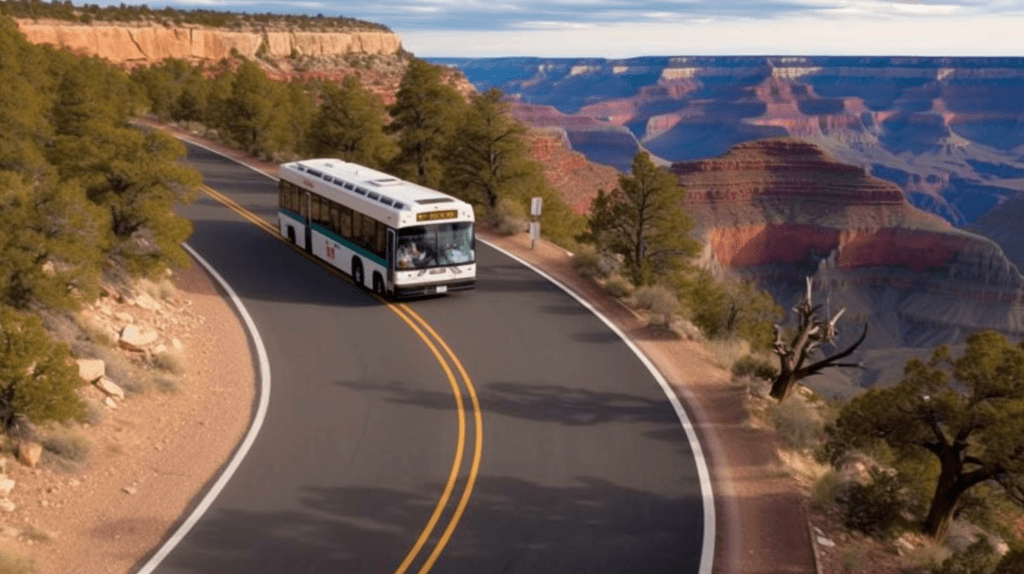
The free South Rim shuttle system does not extend to most of this drive. Private vehicles are the practical choice. Bicycles are permitted on the road shoulder but the distance and elevation changes make it a serious undertaking rather than a casual ride.
The Layout and Experience
The overlooks are spaced far enough apart that each one feels like its own stop rather than a variation on the last. Yaki Point sits close to the village end and is accessible by shuttle during peak season, which is worth knowing if you want to avoid driving that short stretch. After that, the road pulls back slightly from the rim and runs through forest before delivering you to Grandview Point.
Grandview Point was once the site of a hotel and the trailhead for mining operations in the late 1800s. The Grandview Trail drops steeply from here and is considered one of the more demanding day hikes on the South Rim. Even if you don't hike, the overlook itself is exceptional, with a view that includes a prominent canyon feature called Horseshoe Mesa.
Moran Point comes next, named for the painter Thomas Moran, whose 1873 canvas of the Grand Canyon helped make the case for its federal protection. Then Tusayan Ruin, which is easy to miss but worth the short detour. It's a small ancestral Puebloan site with a modest museum, and it puts human scale back into a landscape that can otherwise feel purely geological.
Lipan Point tends to be a favorite among repeat visitors. The Colorado River is clearly visible from here, curving through the inner canyon in a way that lets you understand the river's role in shaping what you're looking at. Navajo Point comes just before the end of the drive and sits slightly higher than Desert View itself, though most people skip it in their rush to reach the watchtower.
The Desert View Watchtower
Mary Colter designed the watchtower in 1932 for the Fred Harvey Company, basing the exterior on ancient Puebloan towers found at sites like Hovenweep in Utah and Colorado. The building looks genuinely old, which was entirely intentional. Colter studied the original structures carefully before designing this one, and she incorporated actual ancient pottery shards and artifacts into the construction.
Inside, the walls are covered in murals painted by Hopi artist Fred Kabotie. They depict Hopi ceremonial imagery and cosmology, and they are extraordinary. Most people spend about ten minutes in the watchtower. Spend thirty. The upper levels offer the widest panoramic view available anywhere on the South Rim.
There is a gift shop and a small convenience area at Desert View, along with restrooms and a seasonal campground. The campground at Desert View is one of the park's most desirable spots precisely because it sits at the far end of the drive, far from the village noise.
Best Time to Visit
Spring and fall are the most comfortable seasons for this drive. Summer brings heat and afternoon thunderstorms, though the storms themselves can produce dramatic light over the canyon if you're willing to wait them out at an overlook. Winter closes the East Entrance Station and Desert View facilities seasonally, so check current park conditions before planning a winter trip from that direction.
Sunrise at Lipan Point or Desert View is worth the early alarm. The canyon collects shadow and light in a way that changes minute by minute in the first hour after dawn. Most visitors don't arrive until mid-morning, so if you're out before 7am, you may have an overlook entirely to yourself.
Avoid arriving at Desert View Watchtower right around midday in July or August. The parking lot fills quickly, the temperature at 7,500 feet is still significant, and the light is flat. Late afternoon, when the sun angles in from the west, is generally better for both comfort and photography.
Photography Tips
Each overlook faces a slightly different direction, which means the ideal time of day shifts as you move east. Grandview Point faces roughly south and picks up good light in the morning. Lipan Point opens more to the west and rewards late afternoon shooting. The watchtower itself photographs well from the parking area in the hour before sunset, when the warm light hits the stone facade.
For interior shots of the Kabotie murals, a wide-angle lens helps in the tight spaces of the tower's lower levels. Flash photography is typically restricted inside the watchtower, so higher ISO settings become necessary in the darker sections.
Combining with Nearby Attractions
If you're entering or exiting through the east entrance, the Cameron Trading Post on Highway 64 is worth a stop. It has been operating since 1916 and sells genuine Navajo and Hopi crafts alongside a decent restaurant and a small gallery. It's about 30 miles from the east entrance.
The Little Colorado River Gorge Navajo Tribal Park sits just outside the national park boundary near the east entrance. It's a separate site managed by the Navajo Nation, with its own entry fee, and it offers a very different view of a river gorge carved by a Colorado tributary. The turquoise color of the Little Colorado during certain seasons is unlike anything inside the national park.
From the village end of the drive, the South Kaibab Trailhead near Yaki Point connects to one of the most popular rim-to-river routes in the park. Even walking the first mile down gives a sense of the canyon's interior that no overlook can replicate.
Practical Tips
- Fill your gas tank before entering the park. There is no fuel available along Desert View Drive until you reach the Desert View area, and availability there can be limited or seasonal.
- Cell service is unreliable along most of the drive. Download offline maps before you go.
- Restrooms are available at Grandview Point and Desert View, but not at every overlook.
- The speed limit inside the park is low and enforced. Budget more time than the distance suggests.
- Tusayan Ruin has limited parking and can fill up. Arrive early or visit on the return trip when traffic has thinned.
- If you're camping at Desert View Campground, reservations through the national park system are strongly recommended during peak season.
- Bring layers. The rim sits above 7,000 feet and temperatures drop sharply after sunset even in summer.
Frequently Asked Questions
Is Desert View Drive open year-round?
The road itself is generally open year-round, but the East Entrance Station and Desert View facilities close seasonally, typically in winter. The drive from the village end remains accessible. Always check the National Park Service website for current road conditions before visiting.
How long should I budget for the full drive?
If you stop at every overlook and spend real time at the watchtower, plan on at least three to four hours. Rushing through in 90 minutes is possible but defeats the point.
Can I walk or bike the drive?
Cycling is permitted on the road shoulder, but the 25-mile distance and elevation changes make it demanding. There is no dedicated bike path. Walking the full length is not practical, but short walks from overlook parking areas to viewpoints are easy and well-marked.
Do I need a separate ticket for the watchtower?
No. Entering the watchtower is included with your national park admission. There is no additional charge to go inside.
Is the drive suitable for large RVs?
The road can accommodate most RVs, but parking at some overlooks is sized for standard vehicles. Desert View has a larger lot. Check current National Park Service guidance on vehicle size restrictions before bringing an oversized rig.
Reviews
Sign in and mark this place visited to leave a review.
No reviews yet.
Free Trip Planner
Plan your Arizona trip with our free planner
Build a day-by-day itinerary with AI suggestions, hand-picked places, and friends. Free forever — no credit card.