Hotel Sacher Vienna
Hotel Sacher Vienna
Philharmoniker Str. 4, 1010 Wien, AustriaHotel Sacher Vienna occupies a stretch of Philharmoniker Strasse that most visitors cross without realizing they're walking past one of Austria's most storied addresses. The Vienna State Opera sits directly across the street. St. Stephen's Cathedral is a five-minute walk north. Since 1876, this five-star property has operated out of the same landmark building, and it remains one of the few hotels in Europe whose name is as recognizable for a dessert as for its rooms. The Sachertorte, the dense chocolate cake with a thin layer of apricot jam, was created here in the 1830s and has stayed on the menu ever since. For many visitors, the cake is the reason they first hear of the hotel at all.
What makes Hotel Sacher Vienna worth a longer look is how comfortably it holds both identities. It is a working five-star hotel with 120 rooms and a full restaurant operation, and it is also something closer to a cultural institution, tied to Vienna's self-image the way the Opera or the Ringstrasse is. You don't need to book a room to understand why people care about this place. But if you do book one, you get a kind of access that casual visitors to the cafe don't.
History of the hotel
The story usually starts with Franz Sacher, a sixteen-year-old apprentice chef in the kitchen of Prince Klemens von Metternich in Vienna in 1832. Asked to create a special dessert for the prince's guests, Sacher produced the chocolate cake that would eventually carry his name. The hotel itself came later. Franz's son, Eduard Sacher, trained as a confectioner and hotelier, and in 1876 he opened the Hotel Sacher on this site, a short walk from the newly built State Opera, which had opened just seven years earlier in 1869.
The Sachertorte recipe became the subject of a long-running dispute between the Sacher family and Demel, the historic Viennese confectionery, over which establishment had the right to call its cake the "original" Sachertorte. The disagreement stretched across decades of the twentieth century before reaching a resolution in 1963, after which Hotel Sacher retained exclusive rights to market its cake as the "Original Sachertorte," a distinction still printed on the box if you buy one to take home. That history is part of why the cake served here carries more weight than a simple dessert. It's a trademark, a family legacy, and a tourist ritual all at once.
Why stay here
- Direct access to Vienna's most important cultural landmarks without needing transit
- The original Sachertorte, served in the hotel's cafe and restaurant, made to the same recipe since the 1830s
- A five-star property with a genuine connection to Vienna's history rather than a corporate identity
- Period interiors that reflect 19th-century Viennese design throughout the building
- Personal service shaped by generations of family ownership rather than chain-hotel standardization
Rooms and suites
The 120 rooms and suites run from Classic Rooms up to the Imperial Suite, and because the building predates modern hotel planning, the rooms are not uniform. Some are generously proportioned, others more compact, depending on where they sit within the original 19th-century floor plan. Rooms facing Philharmoniker Strasse look onto the Opera and the street life below. Rooms facing the courtyard trade the view for quiet.
Suites typically separate the sitting area from the bedroom, giving you more room to spread out if you're staying several nights. Across all categories, the furnishings mix antique Viennese pieces and traditional fabrics with contemporary additions like climate control and marble bathrooms. Nothing feels like it was ordered from a catalog. The higher suite categories come with dedicated concierge service and access to a private lounge serving breakfast and light refreshments through the day, which is worth considering if you're using the hotel as a base for an extended Vienna stay or simply want a quieter space to retreat to outside your room.
Dining and drinks
The hotel runs two dining spaces, and both matter to people who aren't even staying there. Restaurant Sacher is the formal dining room, built around Austrian and international dishes served in a setting that leans into the building's period character rather than modernizing it away. Cafe Sacher is the more famous of the two, and it's where the Sachertorte ritual plays out dozens of times a day. The cake is served by the slice or whole, with apricot jam worked into the layers and a side of unsweetened whipped cream, the traditional way to cut its richness. It's made in the hotel's own pastry kitchen, to the trademarked recipe, and it's dense enough that a single slice with a Viennese melange is a complete sitting rather than a quick stop.
Cafe Sacher also serves other Viennese pastries and light meals, along with breakfast for hotel guests. The hotel bar is a separate, quieter proposition, built around cocktails and a wine list anchored in Austrian producers, Grüner Veltliner and Blaufränkisch among them. It's a conversation space rather than a scene, which fits the general temperament of this city.
Location and setting
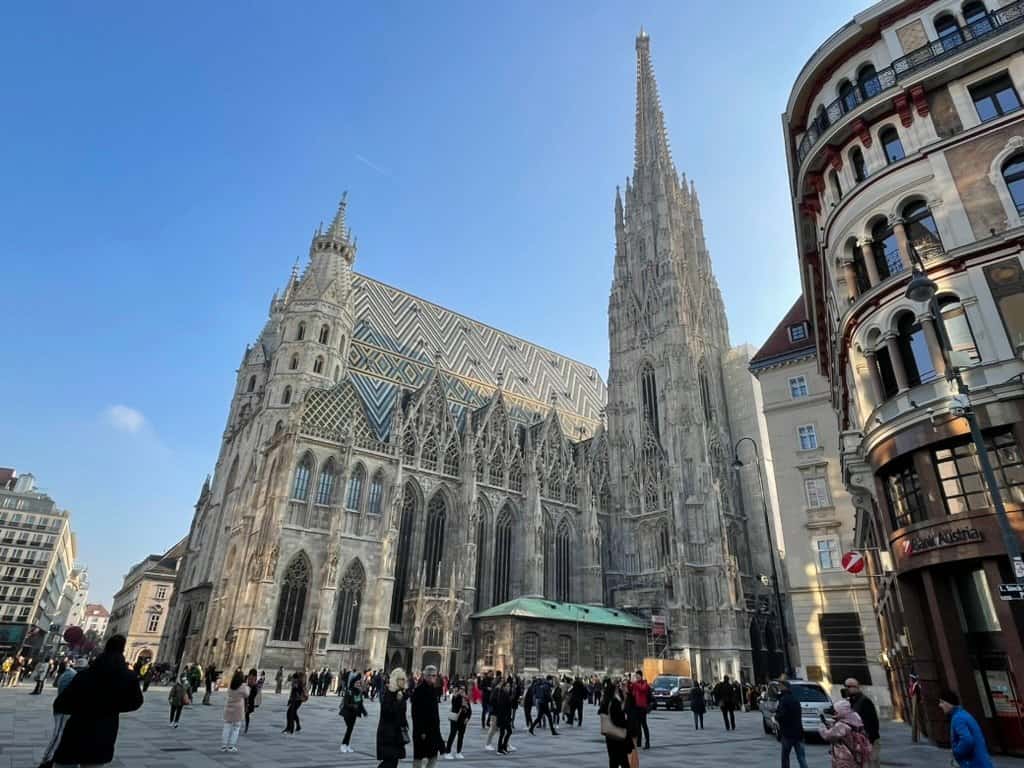
The address puts you in Vienna's first district, the historic core bounded loosely by the Ringstrasse. The State Opera is across the street. St. Stephen's Cathedral is five minutes north on foot. The Hofburg Palace, Belvedere Palace, and St. Charles Church are all within a ten to fifteen-minute walk, and Neuer Markt, a baroque square lined with cafes and the Kapuzinergruft crypt, is two minutes away. If you want to get out of the old city's density, the Danube Canal is about fifteen minutes on foot, a reasonable walk for an evening if the inner city starts to feel crowded.
This is not a quiet corner of Vienna. Philharmoniker Strasse carries steady foot traffic from morning into the night, much of it generated by the Opera itself, and the street can feel more like a thoroughfare than a residential block. That's the tradeoff for being this central. Courtyard-facing rooms are noticeably quieter than those on the street side, and it's worth requesting one if you're a light sleeper or simply want your evenings calmer than the street outside suggests they'll be.
Experiences and activities
Hotel Sacher doesn't try to be a destination unto itself the way a resort property might. The concierge desk arranges opera tickets, classical concerts, and museum entries, functioning as a kind of filter for Vienna's dense cultural calendar rather than an in-house activity program. Most guests treat the hotel as a launch point, not a place to linger during the day.
The exception is the Sachertorte experience itself, which functions as an activity in its own right for a large share of visitors, many of whom never book a room. Staying here means skipping the queue and the competition for a table that can build up at Cafe Sacher during peak tourist hours, since hotel guests get priority seating and a direct route in from the lobby.
Insider tips
- Request a courtyard-facing room if you're sensitive to noise. Philharmoniker Strasse is central and handsome, but it carries the sound of Vienna's tourist traffic from morning until late evening.
- The Sachertorte in the cafe is identical to what's served in the restaurant. If you just want the cake without committing to a full meal, the cafe is the faster, less formal route.
- Don't plan on spending much time in your room. The concentration of museums, churches, and galleries within a ten-minute walk is about as dense as it gets in Europe.
- Ask the concierge for recommendations beyond the obvious landmarks. They tend to know the quieter cafes and smaller galleries tucked into the first district's side streets.
Booking guidance
Demand for Hotel Sacher Vienna runs high year-round, driven by both the location and the brand recognition that comes with the Sachertorte name. If you have specific dates, book as far in advance as you can. Availability tightens months ahead during the summer months of June through August and again around the Christmas season, when Vienna's markets and concert calendar draw heavy crowds into the first district. Spring, from April to May, and fall, from September to October, tend to offer a better balance of availability and manageable weather.
This is a luxury-tier property, and rates reflect the location, the history, and the five-star service standard rather than any one amenity. Booking directly through the hotel can sometimes offer small advantages in rate flexibility or added perks compared to third-party sites, though this varies by season and should be checked at the time of booking. If your main interest is the Sachertorte and the Sacher name rather than a stay itself, remember the cafe welcomes non-guests, and an afternoon coffee and slice of cake is a complete, lower-commitment way to experience what the hotel is known for.
Perfect for
- Visitors prioritizing proximity to St. Stephen's Cathedral and the Vienna State Opera
- First-time travelers to Vienna who want a central base without navigating unfamiliar neighborhoods
- Classical music enthusiasts attending performances at the State Opera or nearby concert halls
- Travelers seeking a five-star property with Viennese character rather than international chain consistency
- Couples and small groups who value walkability and cultural access over room size or on-site amenities
Hotel Sacher Vienna works because it doesn't try to separate its two roles. It's a five-star hotel on one of the first district's most central streets, and it's the origin point of a cake that most visitors to Vienna will eat at some point during their trip, whether or not they ever see a guest room. Staying here means getting both at once, with the Opera at your doorstep and a slice of the original Sachertorte a few steps from the lobby.
Opening hours
Reviews
Sign in and mark this place visited to leave a review.
No reviews yet.
Free Trip Planner
Plan your Vienna trip with our free planner
Build a day-by-day itinerary with AI suggestions, hand-picked places, and friends. Free forever — no credit card.