Kiek in de Kök Fortification Museum
Komandandi tee 2, 10130 Tallinn, EstoniaOverview
Walk up the narrow stone passage toward Kiek in de Kök and the fortification rises in front of you like a ship's hull turned to brick. The tower's name is Dutch, a 16th-century joke: "peek in the kitchen," because soldiers stationed here could supposedly see into the kitchens of the town below. Today it stands as one of Tallinn's most distinctive landmarks, a six-story artillery tower that survived centuries of warfare and occupation to become a museum that tells the story of the city's defensive walls and the lives lived behind them.
Kiek in de Kök Fortification Museum occupies this restored tower and an adjacent exhibition space carved into the earth. It is not a typical museum of glass cases and velvet ropes. Instead, you move through thick stone corridors, climb spiral stairs, and emerge onto platforms where the view of Tallinn's old town sprawls below you. The museum focuses on the city's fortification system, which once stretched 1.9 kilometers around the medieval center, and on the people who built, maintained, and defended those walls.
Why this place matters
Tallinn's fortification system is one of the most complete in Europe. Built over several centuries starting in the 13th century, the walls and towers represent layers of military engineering and urban defense strategy. Kiek in de Kök, completed in 1475, was one of the most important artillery towers in this system. It was designed to dominate the approaches to the city from the south and east, and its thick walls and multiple gun emplacements made it nearly impossible to breach.
The tower survived the Polish siege of 1577, the Swedish occupation, the Russian Empire period, and Soviet rule. During the Siege of Tallinn in 1944, it was damaged but not destroyed. What makes it significant now is not just its survival but what it represents: a physical record of how cities defended themselves before modern warfare, and a space where you can actually stand where soldiers once stood, look out the same gun ports they used, and understand the scale and logic of medieval military architecture.
Quick facts
- Built in 1475 during the rule of the Livonian Order
- Tower is 38 meters tall with walls up to 4 meters thick
- Six stories, with the upper levels featuring artillery gun positions
- Underground passages connect the tower to the adjacent fortification museum building
- The museum also displays artifacts from the city's defensive history, including weapons, coins, and personal items
- Accessible year-round; climbing to the top requires navigating steep spiral stairs
Getting there
Kiek in de Kök sits on Komandandi tee in the Kalamaja neighborhood, near the eastern edge of Tallinn's old town walls. If you are walking from the city center, head northeast toward the Toompea hill area and follow signs toward the fortification museum. The walk from the Town Hall Square takes roughly 15 minutes on foot.
If you prefer not to walk, trams 2 and 4 run near the area, though the last stretch still requires a short walk uphill. Parking is available on nearby streets, though spaces fill quickly on weekends. The entrance is reached via a stone pathway that slopes upward, so the approach itself prepares you for the weight and solidity of what you are about to enter.
The layout and experience
The museum is organized across two main sections: the tower itself and the underground exhibition space. Most visitors start at ground level in the modern building adjacent to the tower, where orientation and introductory exhibits are located. From there, you descend into passages carved out of the earth, moving through spaces that once served as storage and shelter during sieges. The stone walls here are original, part of the fortification system built centuries ago.
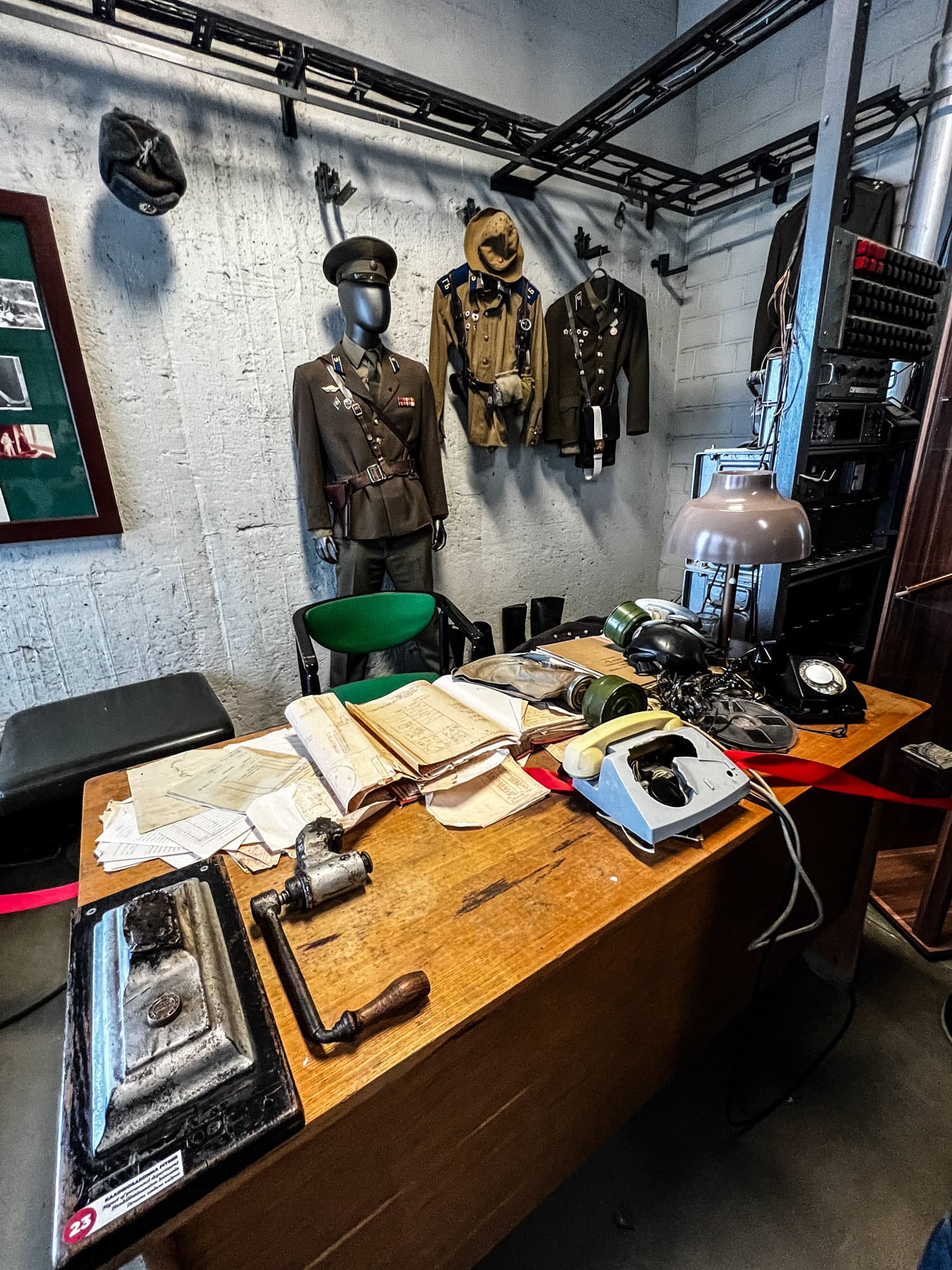
The underground section contains displays on the construction and evolution of Tallinn's walls, artifacts recovered from excavations, and information on daily life in the medieval city. You will see weapons, armor, coins, ceramics, and personal items that belonged to soldiers and citizens. The exhibits are labeled in Estonian and English, though the labels are brief and focus on context rather than extensive narrative.
From the underground passages, you ascend into the tower itself. The climb is steep. The spiral staircase is narrow in places, with low stone arches that require ducking. Each level opens onto a platform or chamber where you stop to look out through gun ports or windows. The views change as you rise, with each level revealing different angles of the old town, the harbor, and the surrounding city. By the time you reach the top level, you have a 360-degree perspective of Tallinn's layout and the terrain the tower was designed to defend.
Main highlights
The gun ports on the upper levels are the most striking feature. Standing at one of these openings, you understand immediately how the tower functioned. The ports are positioned to cover multiple angles of approach, and the thickness of the walls means that an archer or gunner inside was well protected. The sight lines from these positions sweep across what would have been open ground in medieval times, now occupied by the neighborhoods of modern Tallinn.
The collection of medieval weaponry includes crossbows, cannons, and cannonballs. A particularly notable display covers the 1577 siege, when Polish forces attacked the city. The tower's ability to withstand that assault is illustrated through artifacts and explanatory panels. There is also a section on the people who lived and worked in the fortifications, with items like eating utensils, coins, and gaming pieces that hint at the routines of garrison life.
The panoramic views from the upper platforms deserve their own mention. On a clear day, you can see across the entire old town, out to the harbor, and toward the suburbs beyond. The vista changes depending on which level you are on and which direction you face. Photographers will find these views compelling, though the narrow windows and stone frames create challenges for capturing them well.
History and background
Tallinn's walls and fortifications were built over centuries, beginning in the 13th century when the city was established as a trading post. The earliest walls were wooden, later replaced by stone. By the 15th century, when Kiek in de Kök was constructed, the city was enclosed by a sophisticated defensive system featuring towers at regular intervals along the perimeter.
The tower was built during the period of the Livonian Order's rule over Estonia. The order, a military-religious organization, oversaw much of the fortification work in the region. Kiek in de Kök was positioned to defend the southern and eastern approaches to the city, where an attacker would most likely approach. Its construction reflects the military technology of the era: thick stone walls designed to absorb cannon fire, gun ports positioned for maximum coverage, and internal spaces organized for both storage and shelter.
The 1577 siege tested the tower's design. Polish forces under Stephen Bathory attacked Tallinn and bombarded its walls for several months. The tower was hit repeatedly but did not fall. This successful defense enhanced its reputation and served as proof that the fortification system worked. The tower continued to serve a military function through the Swedish period (17th century), the Russian Empire period (18th and 19th centuries), and into the 20th century.
During World War II, the tower and surrounding fortifications were damaged. The museum building was constructed much later, in the 1980s, as part of efforts to preserve and interpret the fortification system. After Estonian independence was restored in 1991, the museum was expanded and updated. Today it stands as a significant heritage site and one of the most visited attractions in Tallinn's old town area.
Tickets and entry
Entry requires a paid ticket. The museum offers general admission, which gives access to both the underground exhibition space and the tower. Some days offer guided tours in Estonian, English, and Russian, though these operate on a limited schedule. Timed entry is not required, so you can visit flexibly, though during peak summer months lines can form in the morning and late afternoon.
Family tickets are available. Children under a certain age may enter free, though specific policies should be confirmed at the entrance or online. The ticket price is mid-range for Estonian attractions.
Best time to visit
The tower is open year-round, but the experience differs by season. Summer brings crowds, particularly in July and August. The views are often clearest on cool, dry days when visibility extends far across the city. Winter visits are quieter and the light at low angles can be beautiful for photography, though the spiral stairs become icy and the tower can be cold inside.
Spring and autumn are pleasant. Fewer tourists arrive, the stone warms enough to be comfortable during the climb, and the old town is less congested. If you want to avoid crowds and still have good weather, aim for May or September.
Morning visits tend to be less crowded than afternoons. If you arrive before 10 am on a weekday, you are likely to have the upper levels mostly to yourself, which makes the experience of standing at those gun ports more contemplative.
Photography tips
The narrow gun ports frame views of the old town beautifully, but they also constrain what you can capture. Wide-angle lenses work well for the underground passages and the spiral staircase, where you want to convey the sense of enclosed stone space. For the views from the upper levels, standard focal lengths capture the vista adequately, though the stone frames of the windows can crop your shot.
Light changes dramatically as you move through the tower. The underground sections are dim and lit artificially, so higher ISO settings help. The upper levels are bright during the day, with strong contrast between the stone and the sky beyond. Shooting at different times of day yields different moods: morning light is soft and golden; late afternoon creates dramatic shadows across the old town.
The spiral staircase itself is worth photographing. The repetition of the stone steps curving upward makes a strong compositional element, and the light falling through occasional windows creates patterns on the walls. Stand near the center of the staircase and shoot upward to capture the spiral effect.
Facilities and preparation
The climb to the top of the tower is substantial. You ascend six stories via narrow spiral stairs with low stone arches. Visitors with mobility issues may find this challenging or impossible. The underground passages are accessible to most people, but the tower itself is not wheelchair accessible. If you have concerns about your ability to climb, discuss this with staff at the entrance; they can advise on what portions of the museum you can comfortably visit.
Wear comfortable shoes with good grip. The stone steps are worn smooth in places, and the stairs are steep. The tower can be cool even in summer, so a light layer is useful. Bring a water bottle, though there is no café or water fountain inside the museum.
The museum does not have extensive facilities. There is a small shop at the entrance selling books, postcards, and souvenirs related to Tallinn's history. Restrooms are available but are minimal. Plan your visit accordingly, as there are no other facilities inside the tower itself.
How it compares to similar places
Tallinn's fortification system includes several other towers and wall sections that are open to visitors. Margareeta Tower, located on the opposite side of the old town, is similar in age and construction but is less extensively developed as a museum. Fat Margaret Tower, also on the waterfront, houses a maritime museum and offers different views of the city.
Compared to other military history museums in Europe, Kiek in de Kök is smaller and more focused. It does not attempt comprehensive coverage of medieval warfare or military technology across regions. Instead, it concentrates on Tallinn's specific defensive needs and the local context of the fortifications. This narrower focus makes it more intimate and easier to understand in a single visit.
If you are interested in medieval fortifications, you might also visit the city walls themselves, which are accessible for walking in several sections. The contrast between standing inside the tower and walking along the outer perimeter of the walls provides different perspectives on how the system functioned as a whole.
Combining with nearby attractions
Kiek in de Kök is located at the edge of Tallinn's old town, making it a natural starting or ending point for a walk through the medieval center. From here, you can head west into the Kalamaja neighborhood, an area of narrow streets and low wooden houses that retains much of the character of old Tallinn. The neighborhood has cafes, galleries, and shops, and it is far less crowded than the central old town.
If you continue south along the fortification line, you can walk sections of the city walls. Several stretches are accessible to the public, offering views from the outside of the structures you have just explored from within. The walk along the walls toward the southwest takes roughly 20 to 30 minutes and connects to other parts of the old town.
Toompea Hill, the site of Tallinn's cathedral and upper town, is about 10 minutes' walk west. Alexander Nevsky Cathedral dominates the skyline from Kiek in de Kök, and it is worth visiting if you have time. The contrast between the medieval fortification tower and the Russian Orthodox cathedral built during the Russian Empire period illustrates different layers of Tallinn's history.
Sample visit plan
Plan for 60 to 90 minutes at Kiek in de Kök. Begin at the entrance, purchase your ticket, and orient yourself with the introductory displays. Descend into the underground passages and move through the exhibition on the fortification system and medieval life. Take your time here; the passages are atmospheric and the artifacts reward close attention. Budget 25 to 30 minutes for this section.
Ascend into the tower and begin climbing. Pause at each level to look out the gun ports and understand the defensive logic of the tower's design. The climb itself takes 15 to 20 minutes, including stops. Spend an additional 10 to 15 minutes at the top level taking in the panoramic views and understanding the geography of the city and its surroundings.
If you have extra time, linger in the underground passages on your way out. They are worth a second look. After leaving the museum, consider walking along the city walls or exploring the Kalamaja neighborhood to the north.
Practical tips
- Bring a phone or camera with a good zoom to capture distant details of the old town visible from the upper levels
- Visit early in the day to avoid crowds and have the upper platforms more to yourself
- The underground passages can be cool and dim, so bring a light layer even in summer
- Do not attempt the climb if you have severe vertigo or mobility issues; the stairs are steep and there are no elevators
- Allow extra time if you want to read all the exhibition labels carefully; they contain detailed information not immediately obvious from the displays
- The shop at the entrance sells a detailed guide to Tallinn's fortifications that provides context for what you see in the tower
- Combine your visit with a walk along the city walls or through Kalamaja to understand the fortification system in its broader context
FAQ
How long does a typical visit take? Most people spend 60 to 90 minutes at the museum. If you climb slowly or read all the exhibition text carefully, budget closer to two hours.
Is the climb to the top difficult? The stairs are steep and narrow, with low stone arches. It is manageable for most people in reasonable fitness, but it is not easy. If you have knee problems or severe vertigo, the climb may be challenging.
Can I visit just the tower or just the underground exhibits? Tickets cover both sections, and the museum is designed to experience them together. However, if you cannot climb the tower, the underground passages alone provide significant context on Tallinn's fortifications.
Are there guided tours? Yes, guided tours are offered on a limited schedule in multiple languages. Check the museum's website or ask at the entrance for current times.
What is the best time to visit to avoid crowds? Weekday mornings, particularly in spring or autumn, are quieter than summer afternoons or weekends.
Opening hours
Reviews
Sign in and mark this place visited to leave a review.
No reviews yet.
Free Trip Planner
Plan your Tallinn trip with our free planner
Build a day-by-day itinerary with AI suggestions, hand-picked places, and friends. Free forever — no credit card.