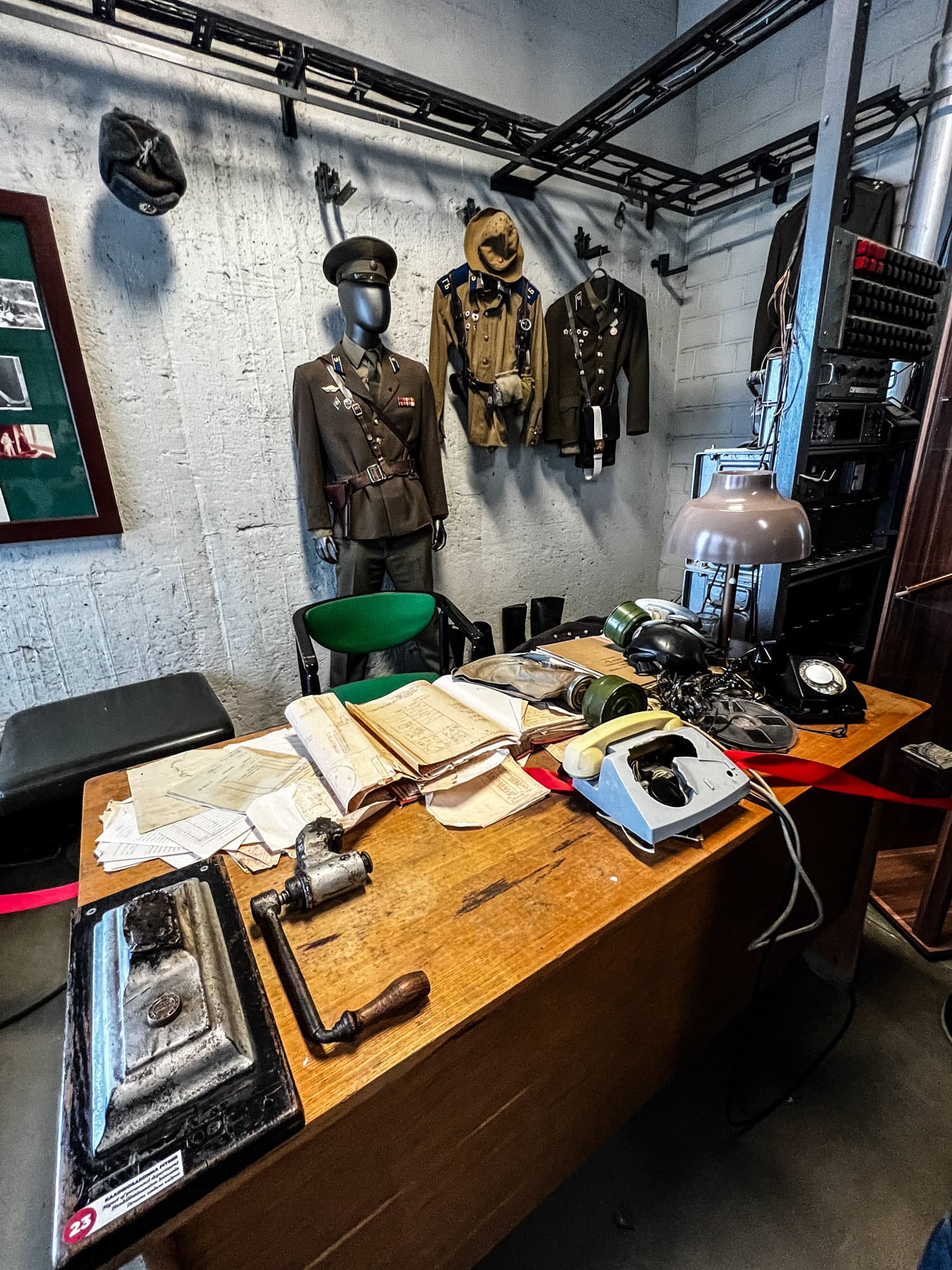
Vabamu Museum of Occupations and Freedom
Closed now
Vabamu Museum of Occupations and Freedom
Toompea tn 8b, 10130 Tallinn, EstoniaOverview
The Vabamu Museum of Occupations and Freedom sits in a converted 19th-century townhouse on Toompea Street, steps from Tallinn's medieval old town. When you walk in, the first thing you encounter is not a grand entrance but a narrow stairwell lined with photographs, voices, and fragments of personal testimony. The museum doesn't organize itself around chronology or grand historical narratives. Instead, it lets ordinary Estonians tell what it felt like to live through Soviet occupation, Nazi invasion, and the recovery of independence.
The museum's name signals its focus: occupations (plural) and freedom. Between 1940 and 1991, Estonia experienced two foreign occupations. The Soviet Union annexed the country in 1940, Nazi Germany occupied it from 1941 to 1944, and then the Soviets returned and held power until 1991. For fifty years, Estonians lived under regimes that criminalised political speech, deported families without warning, and rewrote the nation's official history. Vabamu exists to make that experience concrete and personal, not abstract.
Why this place matters
Tallinn has several museums dedicated to independence and Soviet history. Vabamu stands apart because it privileges individual voices over institutional interpretation. Rather than a timeline of political events, you encounter testimony. A woman describes hiding her family's silver before the deportations. A man recalls the moment he learned his father had been sent to Siberia. A teenager remembers the night the Soviets came.
The museum also spans the full period: not just Soviet occupation, but the years under Nazi rule and the complex experience of Estonian collaboration, resistance, and survival. Few museums in the region treat all three occupations with equal weight.
Quick facts
- Location: Toompea Street 8b, in the Lasnamäe district near the medieval old town
- Opening: 2013
- Exhibits: Five floors covering 1940 to 1991
- Languages: Exhibits feature Estonian, English, and Russian text; audio guides available
- Duration: Most visitors spend 2 to 3 hours
- Accessibility: Limited; ground floor and lower levels accessible, upper floors require stairs
Getting there
The museum is a ten-minute walk from Tallinn's central train station. Exit onto Toompea Street and head uphill toward the old town. The building sits on the left side of the street, recognisable by its renovated 19th-century facade and the museum sign at street level.
Public transport runs frequently from the station. Bus 4 stops nearby on Toompea Street. If you arrive by car, street parking on Toompea is limited and often full; the Viru car park is a five-minute walk away.
The layout and experience
The museum occupies five floors of a townhouse. The layout is intentionally intimate. Rooms are small. Hallways are narrow. You move through the building as if through someone's home, not a grand institution. This architectural choice shapes how the content lands.
The ground floor and first floor focus on the period immediately before and during the first Soviet occupation, 1940 to 1941. You see personal documents, photographs, and recordings. A display case holds a suitcase used by a family about to be deported. Another section covers the Nazi occupation and the complicated responses it provoked among Estonians.
Upper floors move into the late Soviet period: how Estonians maintained cultural identity under pressure, how they resisted censorship, how families stayed connected across borders. The final sections address the independence movement of the late 1980s and early 1990s, often called the Singing Revolution because so much of the resistance took the form of public singing and cultural assertion rather than armed rebellion.
The museum does not shy away from difficult subjects. It addresses collaboration, deportations, and violence without simplifying them into clear victims and villains. Some displays are emotionally heavy. You'll see photographs of people marked for deportation, letters that never reached their destinations, objects left behind by people who never returned.
Main highlights
The deportation rooms are among the most powerful. The museum presents the facts of deportation (the numbers, the destinations, the separation of families) alongside personal testimony from survivors and relatives. A recorded voice describes the night of 14 June 1941, when Soviet security forces arrived at homes without warning.
The exhibition on cultural resistance is less heavy but equally revealing. You see samizdat publications (underground magazines typed and photocopied by hand), records smuggled from the West, and evidence of how Estonians maintained their language and culture even as Soviet authorities pushed Russian language and Soviet ideology.
A section on the Singing Revolution displays photographs and artifacts from the late 1980s, when tens of thousands of Estonians gathered to sing traditional songs as an act of political assertion. The museum contextualises this within the broader independence movement and the collapse of Soviet authority across the Baltic states.
History and background
Vabamu opened in 2013, funded by the Estonian government and private donors. The museum was conceived as a counterweight to Soviet-era narratives that treated the occupation as a liberation and modernisation of a backward nation. For decades after independence in 1991, many Estonians felt their experience of occupation was misunderstood or dismissed by Western audiences more familiar with Western Cold War narratives.
The museum's curators deliberately chose the townhouse format and intimate scale. A large, monumental building might have suggested a grand historical verdict. Instead, the small rooms and personal testimony invite visitors to sit with ambiguity and emotion rather than resolve it into a neat conclusion.
Tickets and entry
General admission is available at the ground floor desk. Timed entry is not required. An audio guide in English is available for rent at additional cost and helps contextualise the exhibits if you have limited background knowledge of Estonian history.
Guided tours in English are offered on request if arranged in advance. The museum is closed on Mondays.
Best time to visit
The museum is quietest on weekday mornings and early afternoons. Late afternoon can draw school groups and independent visitors heading to the old town afterward. There is no seasonal surge; visitor numbers are relatively steady year-round.
If you read Estonian or Russian, you'll find additional layers in the text panels. English translations are present but sometimes briefer than the original. An audio guide compensates for this if you want fuller context.
Photography tips
Photography without flash is permitted in most areas. The narrow rooms and period lighting can make interior shots dark. Wide-angle photography works better than zoomed shots given the tight spaces. The stairwell with photographs is visually striking but difficult to photograph well without a tripod.
Some displays of particularly sensitive material (deportation records, personal letters) are shown in cases that can create glare. Visiting at off-peak hours may give you better conditions for photography.
Facilities and preparation
The building has a small bathroom on the ground floor. There is no cafe or shop inside the museum. The nearest cafes are a two-minute walk away on Toompea Street or in the old town.
The museum is not fully accessible for wheelchair users. The ground floor and lower levels are reachable, but upper floors require navigating stairs. Staff can advise on what's accessible when you arrive.
The exhibits include recorded testimony and some video content. Headphones are provided with the audio guide. If you are sensitive to accounts of violence or displacement, preview the museum's website or ask staff about particularly heavy sections before you commit to a full visit.
Combining with nearby attractions
The museum is a short walk from Tallinn's medieval old town. After your visit, you can spend an hour or two exploring the narrow streets, city walls, and Alexander Nevsky Cathedral. The two experiences complement each other: the old town shows you the physical layers of Tallinn's history, while Vabamu shows you the lived experience of Estonians across the 20th century.
The Estonian History Museum is also nearby in the old town, housed in a 15th-century building. It covers a longer historical span than Vabamu and works well as a second stop if you want to see the pre-occupation period or the centuries before 1940.
Sample visit plan
Arrive mid-morning on a weekday to avoid crowds. Pick up an audio guide if you want contextual information beyond the English text panels. Allow 2 to 2.5 hours for a thorough visit. Start at the ground floor and work your way up, rather than jumping between levels. The exhibits are designed to unfold chronologically as you ascend.
If you have limited time, focus on the ground and first floors (the occupation period) and skip the upper floors. If you have deeper interest in the independence movement or Soviet resistance, allocate extra time to those sections.
Plan to finish by early afternoon so you can walk to the old town for a late lunch or coffee nearby.
Practical tips
- Wear comfortable shoes; the building involves multiple flights of stairs and narrow passages
- Allow extra time if you want to read all the English text panels carefully
- The audio guide is worth the extra cost if you lack background knowledge of Estonian history
- Guides can arrange group visits or tours in advance; call ahead if you're visiting with a group
- The museum is closed Mondays; check opening hours before your visit
- The building can be cool in winter; dress in layers
FAQ
How much time should I spend here? Most visitors spend 2 to 3 hours. If you read all the text carefully and listen to recorded testimony, you could spend 4 hours. If you're short on time, 90 minutes allows you to see the main exhibitions without rushing.
Is the museum suitable for children? The exhibits address deportation, violence, and loss. Older children (10+) interested in history can handle it with parental guidance. Younger children may find it heavy or confusing. There is no specific children's section.
Do I need to know Estonian history beforehand? No. The museum provides enough context through English text and the audio guide. Visitors without prior knowledge will understand the basic narrative and the personal stories. Some nuance requires background knowledge, but it's not essential.
Can I visit the museum without an audio guide? Yes. English text panels provide a clear narrative. The audio guide adds depth and context but isn't required for a meaningful visit.
Is there a gift shop? There is a small shop at the entrance selling books, postcards, and educational materials related to Estonian history and the occupation period.
Opening hours
Reviews
Sign in and mark this place visited to leave a review.
No reviews yet.
Free Trip Planner
Plan your Tallinn trip with our free planner
Build a day-by-day itinerary with AI suggestions, hand-picked places, and friends. Free forever — no credit card.