Killarney House and Gardens
Demesne, Killarney, Co. Kerry, IrelandKillarney House and Gardens sits just a few hundred meters from the center of Killarney town, yet it feels like stepping out of the shops and pubs on College Street and straight into Killarney National Park. The restored Victorian-era house and its gardens form a kind of threshold between the two worlds: urban Killarney on one side, 10,236 hectares of lake, woodland and mountain on the other. For a lot of visitors, this is where the national park actually begins, whether they realize it or not.
The grounds are free to walk, the exhibition inside the house is free to enter, and the whole place works equally well as a twenty-minute detour or a half-day wander if you keep going into the park beyond it. That flexibility is part of what makes it worth building into a Killarney itinerary rather than skipping past on the way to Muckross House.
Why Killarney House and Gardens matters
This isn't just a pretty garden attached to a big house. Killarney House and Gardens functions as the formal gateway to Killarney National Park, Ireland's oldest national park and a UNESCO Biosphere Reserve. The house itself has passed through the hands of an Anglo-Irish earldom and an Irish-American builder before ending up in public ownership, and the gardens were deliberately restored to open up a sightline from the town center straight through to the mountains beyond Lough Leane. Few places in Ireland let you go from a street of shopfronts to an unbroken view of the MacGillycuddy's Reeks in the space of a five-minute walk.
Quick facts
- Location: Demesne, Killarney, Co. Kerry, within Killarney National Park
- Admission: free entry to the gardens and the interactive exhibition
- House tours: guided, run every 30 minutes from April to September
- Garden hours: 9am to 6pm, with longer hours in summer
- Former owners: the Earls of Kenmare, later John McShain
- Restoration: began in 2016, drawing on 18th century French chateau style and 20th century Edwardian detailing
- Dogs: permitted on leash
- Drones: not allowed anywhere on the grounds
History and background
The land here has been tied to the Kenmare family for centuries, and the house that now stands on the site reflects a long, layered rebuilding rather than a single architectural moment. The Earls of Kenmare shaped much of what became Killarney's demesne landscape, planting avenues and laying out the kind of designed parkland that English and Anglo-Irish estates favored through the 18th and 19th centuries.
The more unexpected chapter belongs to John McShain, an Irish-American contractor sometimes nicknamed "the man who built Washington" for his firm's work on the Pentagon, the Jefferson Memorial, and the wartime restoration of the White House. McShain bought the Kenmare estate in the 1950s, used it as a private residence, and later sold it to the Irish State for a token sum specifically so it would be preserved and eventually opened to the public rather than broken up or left to decay. That decision is the reason you can walk these gardens today without a ticket.
Restoration of the house and grounds began in earnest in 2016. The team working on it looked to two very different design languages: the formality of 18th century French chateaux and the restrained elegance of early 20th century Edwardian country houses. The result is a building and landscape that doesn't try to pin itself to one single historical period, but instead reads as a deliberate layering of styles, which in practice means grand stone terracing sitting alongside more domestic Edwardian room proportions inside. The most significant outcome of the restoration, arguably, was landscaping that reopened the view from the town center directly through to the park and the lake beyond, something that had been lost for generations.
Getting there
- Golden Gates Entrance: at the junction of Muckross Road, Countess Road and Kenmare Place, with the Methodist Church as the easiest landmark to spot from a distance
- Mission Road Entrance: beside the monument to Monsignor Hugh O'Flaherty, a quieter approach if you're coming from the east side of town
- Knockreer Entrance: reached from within Killarney National Park itself, useful if you're already out walking and want to loop back toward town
There's no car park on site, so if you're driving, leave the car at Beech Road Public Car Park or another town center car park and walk in. From the main shopping streets it's a five to ten minute walk to any of the three entrances, which makes this one of the easier national park access points to reach without a car.
The layout and experience
Once inside the gates, the gardens unfold in a fairly formal pattern close to the house, with flagstone paths forming a grand promenade in front of the main facade. Cherry trees line some of the walking avenues, which makes spring a particularly good time to visit if you want the blossom as well as the mountain backdrop. Lawns slope away toward the park proper, and the further you walk from the house, the more the landscaping relaxes into something closer to the wilder parkland beyond.
The house stands at the heart of all this, restored rather than reconstructed from scratch, so the rooms retain a sense of having actually been lived in across different eras. Guided tours take you through the main rooms, with a focus on the building's architectural history and its various occupants. The interactive exhibition, housed within the building, is a separate draw from the tour itself and covers the flora, fauna, geology and human history of Killarney National Park, making it a sensible first stop if you're planning to explore the wider park afterward.
Main highlights
- The restored historic house, with guided tours covering its architecture and the Kenmare and McShain eras
- The pleasure gardens, including the cherry blossom avenues and the flagstone promenade in front of the house
- The interactive exhibition on the national park's flora, fauna, history and biodiversity
- The sightline from the gardens through to Killarney National Park and the mountains beyond, which is largely a product of the 2016 restoration
Tickets and entry
Entry to the gardens and the interactive exhibition is free. Guided tours of the house run on a fee basis, though specific pricing isn't published in a way worth repeating here since it changes. Tours operate every 30 minutes from April through September, which is a fairly generous schedule for a house of this size, but it also means tours are seasonal, so outside those months you're generally limited to the gardens and exhibition rather than the interior rooms. If you're set on seeing inside the house during peak summer months, booking ahead is worth doing, particularly in July and August when Killarney's wider tourist numbers climb.
Best time to visit
Spring brings the cherry blossom along the garden avenues, which pairs well with the early-season quiet before the main tourist season picks up. Summer gives you the longest garden hours and the full house tour schedule, but also the most foot traffic in the town itself. Autumn tends to be a good middle ground, with the gardens still open at full hours and noticeably fewer crowds than July or August. Given that there's no roof over most of the experience, checking a forecast before you go isn't a bad idea either way.
Combining with nearby attractions
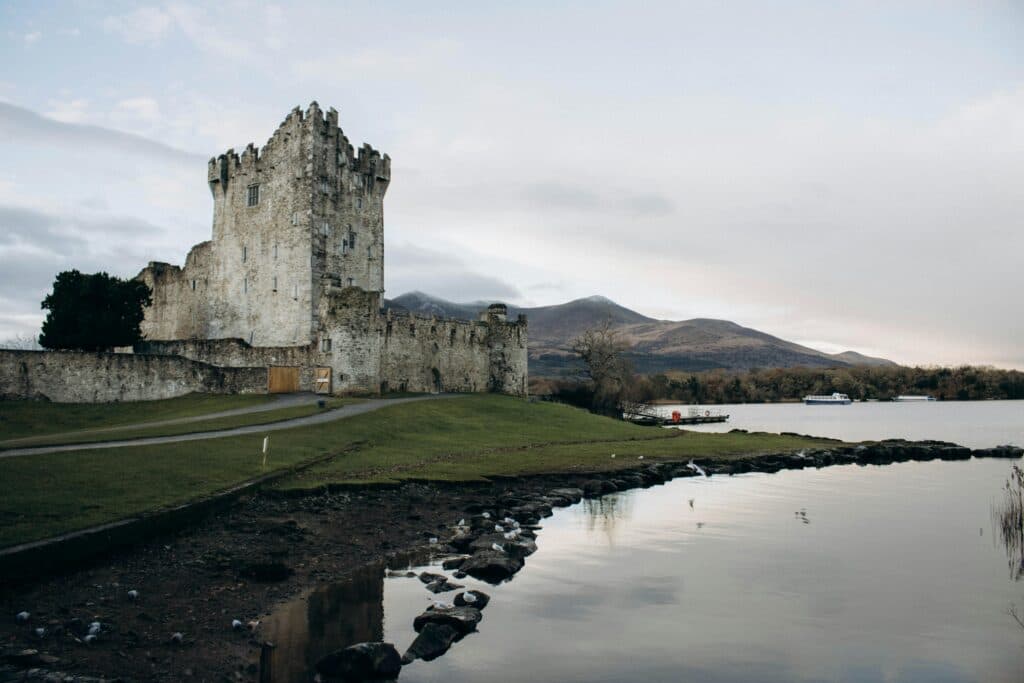
Because Killarney House and Gardens sits right at the edge of Killarney National Park, it works naturally as a starting point rather than a standalone stop. From the Knockreer Entrance you can walk on toward Ross Castle on the shores of Lough Leane, or continue further to Muckross House and Gardens, Muckross Abbey, and the old Copper Mines trail. Innisfallen Island, with its monastic ruins, is reachable by boat from the Ross Castle area if you want to extend the day further. None of these sites are far from each other by Irish standards, and a fit walker could realistically string together Killarney House, Ross Castle and Muckross House in a single day, though most people prefer to split that across two visits.
Practical tips
- There's no on-site parking, so plan to park in town, with Beech Road Public Car Park being one of the closer options
- Both the gardens and the house are wheelchair accessible
- Dogs are welcome on leash throughout the grounds
- Drone use isn't permitted anywhere on the property, in order to protect wildlife and other visitors
- Wear comfortable walking shoes, since the gardens connect directly to the longer trails of Killarney National Park
- Bring water and snacks if you're planning to walk on into the park afterward, as options thin out once you're past the formal gardens
- Book guided house tours in advance during the April to September season, especially in summer
- Follow Leave No Trace guidelines, which the park actively encourages
FAQ
Is Killarney House and Gardens free to visit?
The gardens and the interactive exhibition inside the house are free. Guided tours of the house's interior rooms carry a separate fee.
How far is it from Killarney town center?
It's a short walk, generally five to ten minutes from the main shopping streets, with three separate entrances depending on which direction you're coming from.
Can you bring a dog?
Yes, dogs are allowed on leash throughout the gardens and grounds.
Is there parking on site?
No. There's no car park at Killarney House and Gardens itself, so visitors typically use public car parks in town, such as Beech Road, and walk in.
Do I need to book the house tour ahead of time?
It's recommended, particularly in summer. Tours run every 30 minutes from April to September, and availability can tighten up during peak season.
Reviews
Sign in and mark this place visited to leave a review.
No reviews yet.
Free Trip Planner
Plan your Ireland trip with our free planner
Build a day-by-day itinerary with AI suggestions, hand-picked places, and friends. Free forever — no credit card.