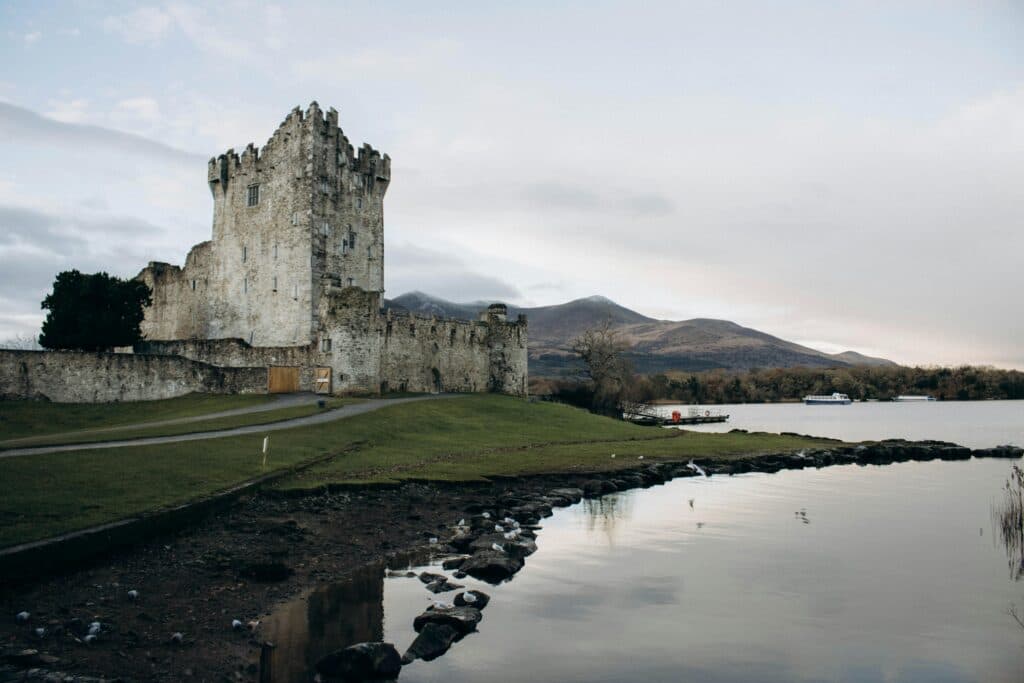
Ross Castle stands at the edge of Lough Leane, just outside Killarney town in County Kerry, inside the boundary of Killarney National Park. It's a 15th-century tower house, blocky and grey against the water, built in a style that was common across Gaelic Ireland before cannon fire made such defenses obsolete. The castle belonged to the O'Donoghue clan and later passed through a string of owners tied up in Ireland's long record of conquest and rebellion. Today it's one of the more visited historical sites in Killarney, partly because of what happened here in the 17th century and partly because the walk to reach it, through oak woodland along the lake shore, is reason enough to come.
You don't need to be a castle enthusiast to get something out of a visit. The setting does a lot of the work. Lough Leane spreads out in front of the tower house, the MacGillycuddy's Reeks rise behind it, and the whole scene has the kind of quiet drama that made this corner of Kerry a fixture on the old Grand Tour routes in the 19th century.
Why Ross Castle matters
Most tower houses in Ireland are ruins, roofless and stripped. Ross Castle has kept its shape, and its interior can still be walked through on a guided tour, which is unusual for a building of this age in this condition. It also has a specific story attached to it, tangled up with Oliver Cromwell's campaign in Ireland, that gives it more narrative weight than the average scenic ruin. For visitors trying to understand Irish history beyond the postcard version, Ross Castle is a useful stop precisely because its history is documented and odd rather than vague and romanticized.
Quick facts
- Location: Ross Road, Ross Island, Killarney, Co. Kerry, inside Killarney National Park
- Built by: the O'Donoghue Mór branch of the O'Donoghue clan, as a defensive tower house
- Access to the interior: guided tour only, no self-guided entry
- Tour group size: up to 15 people per tour
- Tour length: roughly 45 minutes
- Walking distance from Killarney town centre: about 2.5 kilometres
- Parking: two car parks roughly 100 metres from the castle on Ross Road
Getting there
Ross Castle sits close enough to Killarney town that walking is a realistic option, not just a scenic one. It's about 2.5 kilometres from the town centre, mostly along flat paths through the national park, and it's a route locals use for an evening walk as much as tourists use it for sightseeing. If you'd rather not walk both ways, a bike is a good middle option. Killarney has several rental shops right in town, and the ride out is gentle.
Driving is straightforward too. There are two car parks about 100 metres from the castle itself, both on Ross Road, and from there it's a short walk down to the tower house. If you're joining a tour of Killarness National Park that includes Ross Castle as a stop, the logistics are handled for you, which can be worth it if you're short on time or don't want to deal with Kerry's narrow roads.
The layout and experience
The approach to Ross Castle is part of the experience. You come through woodland, past the old boathouses used for the Killarney lake tours, before the tower house appears at the water's edge. It looks smaller than you'd expect at first, then bigger once you're standing underneath it.
The path leading up to the castle has a genuinely steep incline in places, steep enough that the existing guidance on site flags it for visitors with mobility issues. Handrails are provided and worth using. Inside, the tour takes you up through the tower's floors via a spiral stone staircase, which is standard for this kind of building and narrower than modern stairs, so bags and bulky coats can make the climb awkward.
Because entry is guided-only and handled first-come, first-served, there's an element of waiting involved, particularly in summer. Groups of 10 or more need to arrange things in advance rather than turning up and hoping for space.
History and background
Ross Castle was built by the Irish chieftain O'Donoghue Mór, and for generations it functioned as a stronghold for the O'Donoghue clan, one of several ruling families whose influence shaped this part of Kerry before and after the Norman arrival. Tower houses like this one were built for defense first and comfort second, thick-walled, narrow-windowed, designed to be held against raiders rather than lived in elegantly.
The castle's most memorable chapter comes from the mid-17th century, during the Cromwellian conquest of Ireland. Ross Castle was one of the last strongholds in Munster to hold out against Parliamentarian forces, defended under Lord Muskerry. Local tradition held that the castle could never be taken from land, only from water, an old prophecy that gave the defenders some confidence they'd hold. General Ludlow, commanding the besieging forces, is said to have had boats hauled overland and launched onto Lough Leane, technically fulfilling the prophecy and prompting the garrison's surrender rather than a prolonged siege. Whether you take that story as literal history or as the kind of tale that gets attached to a siege after the fact, it's the detail most guides will tell you, and it's the reason Ross Castle gets mentioned in discussions of Irish folklore as much as Irish military history.
The castle later passed through private ownership before coming into state care, and restoration work in the 20th century is what allows visitors today to walk through furnished rooms rather than bare stone shells.
Tickets and entry
Entry to the castle grounds and the exterior is free. Getting inside the tower house requires joining a guided tour, and this is the only way to see the interior, there's no option to wander through on your own. Tours run on a first-come, first-served basis, so there's no pre-booking for individuals, though groups of 10 or more are required to arrange their visit ahead of time.
Admission is priced on a tiered scale, with separate rates for adults, seniors and groups, children and students, and a family ticket that covers the group together. It sits firmly in budget territory, cheap enough that cost isn't really a factor in deciding whether to visit. The castle opens for tours daily, generally from mid-morning into early evening, with the last tour starting roughly 45 minutes before closing. Hours can shift with the season, so it's worth treating any specific times you see online as a guide rather than a guarantee.
Best time to visit
Early in the day is the advice you'll hear from most people who've been, and it holds up. Ross Castle draws coach tours and day-trippers from Killarney town, and the window between opening and mid-morning tends to be quieter, both on the path in and for the tour itself, since groups are capped at 15 people and spaces fill up as the day goes on.
Shoulder season, spring or early autumn, tends to combine good light with smaller crowds. Summer brings the longest opening hours and the easiest logistics if you're relying on buses or bike rental, but also the most competition for a tour slot. Winter visits are quieter still, though shorter daylight hours mean less time to combine the castle with a walk around Ross Island afterward.
Combining with nearby attractions
Ross Castle rarely gets visited in isolation, and it shouldn't be. Ross Island, the peninsula right next to the castle, is worth the extra hour it takes to walk its loop. It holds the remains of a Bronze Age copper mine, one of the oldest known in Ireland and Britain, along with viewpoints at Governor's Rock and Library Point that look back across the lake toward the castle itself.
The Ross Castle Loop trail is free and connects into the wider network of paths through Killarney National Park, including routes that lead toward Muckross House and Torc Waterfall, both popular half-day additions if you've got a car or bike to cover the distance. For a different angle on the same scenery, the Lakes of Killarney boat tour runs out onto Lough Leane and takes in Ross Castle, Innisfallen Island, and the surrounding mountains from the water, which gives you a view of the tower house you don't get standing on land.
Sample visit plan
A reasonable half-day plan starts with an early walk or cycle out from Killarney town, arriving at the castle not long after opening to get ahead of the tour queue. After the 45-minute tour, head out onto Ross Island for an hour or so, taking in the old mine workings and the lookout points. From there, either loop back into town for lunch or continue on toward Muckross House if you've got a full day free and transport sorted. If the weather's cooperating, finishing with a boat tour on the lake is a good way to end the visit, seeing the castle from the water after having stood inside it.
Practical tips
- Arrive early in the day, especially in summer, since tours are first-come, first-served and groups are capped at 15 people
- The path to the castle has a steep section, use the handrails and expect difficulty if you have mobility issues
- Wear shoes with grip, the spiral staircase inside is stone and worn smooth in places
- Groups of 10 or more must arrange their visit in advance rather than turning up
- Keep dogs on a lead throughout the grounds
- Bring a layer even in summer, the lakeside position means it's noticeably cooler than the town centre
- Pair the castle with a walk on Ross Island, it adds relatively little time and covers the copper mine and the best lake views
FAQ
Can you go inside Ross Castle without a tour?
No. The interior is only accessible through a guided tour, and there's no self-guided option for the tower house itself. The grounds and exterior can be explored freely.
Do I need to book in advance?
Individual visitors and small groups don't need to pre-book, tours operate first-come, first-served. Groups of 10 or more are required to arrange their visit ahead of time.
Is the walk to the castle suitable for wheelchairs or strollers?
The path has a steep incline in sections, which makes it difficult for wheelchairs and can be hard going with a stroller. Handrails are provided along the steeper stretch.
What else is there to do near Ross Castle?
Ross Island sits right next to the castle and is worth exploring on foot for its old copper mine and lake viewpoints. The wider Killarney National Park trail network, including routes toward Muckross House and Torc Waterfall, connects from the same area, and boat tours of the Lakes of Killarney depart nearby.
Ross Castle isn't a grand sight in the way some European castles are. It's a single tower house, modest in scale, but its position on Lough Leane and the specific, slightly strange story of its surrender give it a pull that a lot of better-preserved ruins don't manage. If you're in Killarney for more than a day, it's one of the few stops that rewards both the history and the walk it takes to get there.
Reviews
Sign in and mark this place visited to leave a review.
No reviews yet.
Free Trip Planner
Plan your Ireland trip with our free planner
Build a day-by-day itinerary with AI suggestions, hand-picked places, and friends. Free forever — no credit card.